
Glossary of Social Policy – A to C
Absent Fathers
Fathers who don’t live with their children (usually after divorce or separation).
Absolute Poverty
A condition where individuals lack minimum resources necessary for basic survival, such as food, shelter, and clothing. It is typically measured by fixed income thresholds.
Accountability
The principle that organizations and officials implementing social policies must answer for their decisions and actions. This ensures transparency and responsibility to stakeholders and the public.
Active Labor Market Policies (ALMPs)
Government interventions designed to help unemployed individuals find work through training, employment subsidies, and job search assistance. These policies aim to reduce unemployment and increase workforce participation.
Advocacy
Activities aimed at influencing policy decisions, legislation, and resource allocation to advance specific group interests. It involves campaigning, lobbying, and public awareness efforts.
Affirmative Action
Policies designed to increase representation of historically disadvantaged groups in education and employment. These may include targeted recruitment, preferences, or quotas.
Ameliorism/Amelioration Theory
The belief that society can gradually be made better through small, step-by-step improvements and reforms, focusing on identifying specific social problems and finding practical solutions for them.
Anti-racist approach
An active way of fighting against racism in society by taking clear steps to challenge and remove racist systems and practices.
Asset-Based Welfare
Social policy approaches encouraging individuals to build savings and assets rather than relying solely on income support. These often include matched savings programs or development accounts.
Austerity Measures
Government cuts to spending and services, often during economic hard times.
Benefit Cap
Maximum total amount of benefits a household can receive. It applies regardless of family size or needs.
Beveridge Report
The 1942 British report that laid foundations for the modern welfare state, identifying five social evils: want, disease, ignorance, squalor, and idleness. It proposed comprehensive social insurance.
Bismarckian Model
A social insurance approach where benefits are earnings-related and financed through employer-employee contributions. Entitlement is based on employment record and contribution history.
Block Grant
A fixed sum of money transferred from higher to lower levels of government for broadly defined purposes. Recipients have considerable discretion over fund allocation.
Bourgeoisie
The wealthy owners of businesses and property, who are in conflict with the working class (proletariat) according to Conflict Theory.
Capability Approach
A framework emphasizing people’s real freedoms and opportunities to achieve well-being, focusing on what individuals can do and be. It was developed by economist Amartya Sen.
Capitalism
An economic system stressing the private ownership of natural resources and means of producing goods and services, characterized by private property, pursuit of personal profit, competition, and consumer’s sovereignty.
Capitalist exploitation
Power dynamics between capitalists and the working class, where laborers receive disproportionately low wages despite creating value.
Civil rights
Rights to liberty, security, property, and freedom from arbitrary arrest.
Civil Society
Organizations and associations outside government and business, including nonprofits, community groups, and voluntary organizations. These play important roles in social policy advocacy and service delivery.
Classical Liberalism
A 19th-century idea promoting individual freedom and self-interest, focusing on limiting state interference (“Negative Liberalism”).
Colorism
Discrimination based on skin tone, often favoring lighter skin over darker skin, which can exist both within and between racial or ethnic groups.
Commodities (Sen)
Resources like income and education, which matter only if they build people’s abilities (capabilities) to live well.
Comparative needs
Needs identified by comparing what one group has with what a similar group lacks.
Comparative Social Policy
The systematic study and analysis of social policies across different countries or regions. It aims to understand variations and identify effective practices.
Conflict Theory (Marxism)
Sees society as being divided into groups that compete for resources and power, believing tension and struggle between classes are normal and inevitable parts of social life.
Conservatism
A philosophy of Human Imperfection that is against change and stresses the maintenance of traditional order, supporting institutions like family and church for welfare provision.
Conservative Welfare States
Welfare states emphasizing traditional family structures and social insurance, with support typically provided through employer contributions.
Contribution-Based Benefits
Social security benefits where entitlement depends on having made financial contributions through taxes or social insurance during employment. These are earned through prior participation.
Convergence Theory
Suggests that as countries develop economically and socially, their social policies tend to become more similar over time due to shared challenges and policy learning.
Cornucopians (technological optimists)
People who believe that human creativity and technology will solve environmental problems, seeing them as challenges to be fixed with innovation.
Critical Model
An approach that questions whether laws and policies are truly fair and works to change them.
Cultural Racism
A form of racism that values one group’s culture, language, or traditions as better than others, leading to disrespect or rejection of other cultural practices.
Glossary of Social Policy – D to G
Decentralization
The transfer of authority and responsibility for social policy from central government to regional or local levels. It aims to increase responsiveness and local control.
Deep Ecologists
Believe in a “natural morality,” suggesting that society should change to live within the planet’s limits, challenging the focus on constant growth.
Developmental Model (Social Policy)
Focuses on investing in people’s capabilities and potential, viewing social policy as an investment in human development, prioritizing prevention over treatment and taking a long-term perspective.
Discretionary Benefits
Payments based on rules and judgments, such as payments from the Social Fund.
Distributive Justice
Ethical principles concerning fair allocation of resources, opportunities, and benefits among society members. It is central to social policy debates.
Dual Labor Market
A labor market structure with secure, well-paid primary sector jobs and insecure, low-paid secondary sector jobs. This creates distinct social policy challenges.
Dualization
Creation of two-tier systems where some groups receive generous protection while others face precarious conditions. It creates segmented welfare provision.
Entitlement Rules
Requirements people must meet to receive government benefits.
Environmental Managers
People who believe we can achieve sustainable development by improving current systems, using better rules, technology, and market solutions.
Environmentalism in Social Policy
The integration of ecological concerns into welfare and social justice frameworks, recognizing that environmental conditions directly shape people’s quality of life, health outcomes, and social opportunities.
Equity
The principle of fairness in distribution, recognizing that equal treatment may not produce fair outcomes. It acknowledges that different circumstances may require different approaches.
Esping-Andersen‘s Welfare Regimes
A typology identifying three welfare state types: liberal, conservative, and social-democratic. Each represents distinct approaches to social protection and provision.
Ethnicity
A group of people who share a common culture, language, history, or ancestry.
Evidence-Based Policy
The use of rigorous research evidence to inform policy decisions and program design. It emphasizes empirical data over ideology or assumption.
Expressed needs
Publicly voiced demands for services.
Fabian socialist
Fabian socialist is a person who believes in achieving socialism gradually and peacefully, not through revolution or violence.
Fascism
A welfare ideology prioritizing a strong, centralized government led by a powerful leader, focusing on national unity and strength; welfare exists to strengthen the nation.
Felt needs
Subjective feelings of lack.
Feminist Approach (in Social Policy)
A critical framework that examines how policies, programs, and welfare institutions impact women differently than men while addressing systemic gender inequalities through the lens of power and patriarchal structures.
Fiscal welfare
Fiscal welfare refers to the benefits and support that people receive through the tax system, rather than through direct government spending or social programs.
Five Giant Evils
Want (poverty), Idleness (unemployment), Ignorance, Squalor (poor living conditions), and Disease, which the Beveridge Report planned to combat.
Fragmentation
The division of social policy responsibility across multiple agencies or levels of government. It potentially creates coordination challenges and coverage gaps.
Functionalist Theory/Functionalism
Views society as a complex system made up of different parts that work together to maintain overall stability and health; policies focus on helping people fit into society and perform their expected roles.
Functioning (Sen)
The achievements resulting from people’s abilities to live well.
Gemeinschaft
A German word introduced by sociologist Ferdinand Tönnies refers to a type of society based on close personal relationships, shared values, and mutual care.
Gender Mainstreaming
Making sure gender equality is considered in all stages of policy-making to ensure gender equality.
Gender-Based Violence
Violence directed at someone because of their gender, mostly affecting women.
Gender-Disaggregated Data
Statistics separated by gender so we can see different impacts on men and women.
Globalization
The increasing interconnectedness of economies, cultures, and populations worldwide. It creates both challenges and opportunities for national social policies.
Green initiatives
Green initiatives refer to actions or projects that aim to protect the environment and promote sustainability.
Green politics
A political approach focused on environmental protection, sustainability, and social justice, rejecting the traditional political agenda and calling for new ways of organizing society.
Gross Domestic Product (GDP)
The total value of goods and services produced in a country. It is often used as benchmark for measuring social spending levels.
Glossary of Social Policy – H to M
Human Capital
The knowledge, skills, health, and attributes embodied in individuals that contribute to productivity. It is enhanced through education, training, and health policies.
Implementation Gap
The difference between policy intentions and actual outcomes due to challenges in translating policy into practice. It reflects difficulties in policy execution.
Indexation
Automatic adjustment of benefits to changes in prices or wages to maintain real value over time. It protects benefit adequacy against inflation.
Indirect Taxes
Taxes on goods and services rather than income, such as value-added tax or sales tax. These can be regressive and affect lower-income groups disproportionately.
Individual Entitlement
The right to receive benefits based on your own work or citizenship, not through your spouse.
Individual Racism
Occurs when a person holds prejudiced beliefs or behaves unfairly toward someone because of their race.
Industrial-Achievement/Performance Model
A model viewing social policies as supportive of economic development, tying benefits to contributions and work effort.
Informal Sector
Care and support provided by families and communities rather than paid professionals or government services.
In-Kind Benefits
Non-cash assistance provided as goods or services rather than money. These offer targeted support but potentially limit recipient choice.
Institutional Model of Welfare
Accepts need and dependency as a normal, inherent part of society and makes general provision accordingly, promoting social integration.
Institutional Racism
Happens when laws, policies, or practices within institutions (like schools or workplaces) favor one race over others, resulting in unequal opportunities and outcomes.
Institutional Welfare
A model viewing social services as normal functions of modern society, available to all as rights. It contrasts with residual approaches to welfare provision.
Institutional-Redistributive Model
Combines institutional principles with an aim to equalize resources between people through redistribution.
Integrated Services
Coordination of multiple services to provide comprehensive, seamless support for individuals with complex needs. It requires cross-sectoral collaboration.
Internalized Racism
Occurs when people from discriminated groups accept negative stereotypes about their own race.
Intersectionality
The idea that people can face many kinds of discrimination at the same time—like gender, race, class, sexuality, and disability—creating multiple and overlapping forms of disadvantage.
Laissez-faire
A reduction in government activity and reliance on the market, a main feature of the New Right’s market-based approach.
Left-of-center
Left-of-center means having political or social views that support moderate left-wing ideas, but not as extreme as far-left or socialist views.
Left-wing ideology
Left-wing ideology means a way of thinking that focuses on equality, social justice, and support for the poor or working class.
Legalistic Model
An approach that just follows the letter of the law without questioning if it’s fair.
Liberal Welfare States
Characterized by minimal state intervention, emphasizing market solutions and individual responsibility, with benefits often means-tested.
Liberalism
A political ideology focused on the ‘liberty’ of the individual, believing the state should have a limited role in society and the economy.
Localism
Devolving decision-making authority to local communities or governments. It is based on beliefs about local knowledge and democratic participation.
Male Breadwinner Model
The idea that men should earn money while women stay home to care for family, a traditional model challenged by feminists.
Marketization
Developing and encouraging markets, privatizing activities previously managed by government, and creating market mechanisms where they did not exist before.
Married Women’s Option
A rule (until 1978 in the UK) that let married women stop paying into the pension system.
Marx’s Class Conflict Theory
Marx’s class Conflict Theory is 1848, through The Communist Manifesto, though he continued expanding on these ideas later in Das Capital (published in 1867).
Marxism
A socio-political theory rooted in class struggle that advocates for a revolution where the working class establishes collective ownership of resources to prioritize social welfare and eliminate exploitation.
Materialist Critique
A Radical Socialist critique focusing heavily on real, physical inequalities in society, such as differences in quality of hospitals or housing.
Matthew Effect
The principle that advantages accumulate, where those with resources gain more. It creates increasing inequality without policy intervention.
Means-tested
Something (like government help or a benefit) is only given to people who do not have enough money, or benefits assessed based on income.
Mixed economy of welfare
The practical reality of blending social welfare policy approaches. Also known as Welfare Pluralism, highlighting services provided by public, private, voluntary, and informal sectors.
Mixed Welfare Systems
Systems combining elements of both institutional and residual approaches, providing universal services in some areas while maintaining selective, targeted support in others.
Modern Liberalism
Emerging in the early 20th century, supporting a welfare state to help people with education, healthcare, and jobs (“Positive Liberalism”).
Modicum of Independence
A small but significant amount of freedom and self-sufficiency.
Glossary of Social Policy – N to R
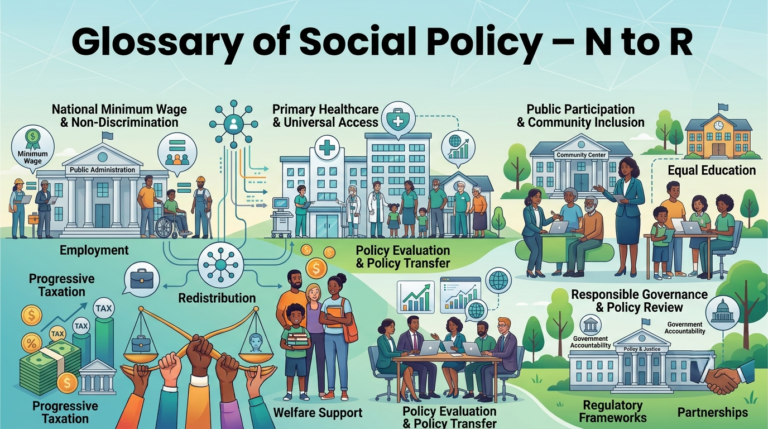
Negative freedom (“freedom from”)
Freedom meaning that no one forces you or causes you harm, such as being safe from crime or discrimination.
Neo-liberal policies
Ideas often shown through the New Right approach, prioritizing the market over government control.
Neoliberalism
Political-economic philosophy emphasizing free markets, reduced government intervention, and individual responsibility. It has influenced welfare state restructuring since the 1980s.
Net Lifetime Beneficiaries
People who receive more from the welfare system over their lives than they pay in.
Net Payers
People who pay more into the welfare system than they receive from it.
New Right Approach
A conservative perspective emphasizing individual responsibility, a reduced role of the state in welfare, reliance on free-market solutions, and the belief that excessive welfare creates dependency.
Non-Contributory Benefits
Benefits available without requiring prior contribution through taxes or social insurance. These are typically funded from general taxation.
Nordic Model
A welfare state approach combining comprehensive universal services, generous benefits, and active labor market policies. It is characteristic of Scandinavian countries.
Normative Assumptions
Beliefs about what’s “normal” or “proper” that are built into how institutions work.
Normative needs
Defined by professional standards and judgments.
Normative Objectives
Goals or aims that are based on values, principles, or ideas of what “should” happen in society, focusing on ideals like justice, equality, fairness, human rights, and welfare rather than only practical results.
Occupational Benefits
Benefits based on employment record/status, like statutory sick pay.
Occupational Segregation
Men and women working in different types of jobs, with women’s jobs often paying less.
Occupational Welfare
Employment-based benefits like pensions, health insurance, and paid leave. These supplement or substitute for public provision.
Operationalization
The process of translating broad aims into specific, actionable goals.
Outsourcing
Contracting private or nonprofit organizations to deliver services traditionally provided by government. It is part of welfare state restructuring.
Paternalism
Policy approaches limiting individual choice for their own good. It is debated in contexts like mandatory savings and benefit conditionality.
Path Dependency Theory
Argues that past decisions and historical events strongly influence current policy choices, making established policy directions harder to change once set.
Perpetrator Accountability
Making sure people who commit violence face consequences for their actions.
Pluralism
Recognition of diverse values, interests, and groups in society. It is relevant to how policies accommodate difference and promote inclusion.
Policy Evaluation
Systematic assessment of policy implementation and outcomes to determine effectiveness and impact. It informs future policy improvements and accountability.
Policy Transfer
The process by which knowledge about policies in one setting is used in another. It requires attention to contextual differences and adaptation.
Political Economy Model of Power (Marxist)
Suggests that big businesses and capitalist interests dominate major policy decisions.
Positive freedom (“freedom to”)
Having the ability to access things like food, housing, and education, which usually needs government help.
Poverty Trap
Situation where working or increasing earnings results in benefit loss exceeding earnings gains. It discourages employment and progression.
Power
The ability to create the results you want, which can be used through force, influence, or authority.
Preventive Services
Interventions addressing problems before they become severe or preventing them entirely. These are often cost-effective but require upfront investment.
Primary Care
First-contact healthcare services providing comprehensive, accessible care for most health needs. It is foundational to healthcare systems.
Privatization
Transfer of public services or assets to private ownership or management. It is debated for effects on access, quality, and equity.
Productivist Model (Social Policy)
Emphasizes the relationship between social policy and economic production, aiming to support and enhance economic growth by ensuring policies help productivity and competitiveness, often using a work-centered approach.
Progressive Taxation
Tax systems where higher earners pay proportionately more. It is important for financing redistributive social policies.
Proletariat
The working class who sell their labor, according to Conflict Theory.
Racial equity
Ensuring that everyone has fair access to opportunities and resources, regardless of their race, recognizing that different groups may need different support to achieve similar outcomes.
Racist views
Racist views mean thinking one race is better than others and treating people unfairly because of their race.
Radical Social Work
Radical social work means a type of social work that focuses on challenging and changing the social and political systems that cause inequality, poverty, and injustice — rather than only helping individuals cope with their personal problems.
Radical Socialist/Marxist Approach (to Social Policy)
Views welfare policies as serving to maintain the capitalist system by creating stability so people do not rebel, giving temporary relief without eliminating the root causes of injustice.
Rational Choice Theory
Assumes that people make decisions by carefully weighing the costs and benefits of different options and choosing the one that gives them the greatest personal advantage, treating policy-making as a pursuit of self-interest.
Reciprocity
The principle that rights to benefits should be balanced with responsibilities or contributions. It underlies debates about welfare conditionality.
Redistribution
Transfer of resources from some groups to others through taxation and benefits. It is a core function of social policy addressing inequality.
Redistributive Model (Social Policy)
Focuses on reducing inequality and ensuring all members of society have access to basic necessities and opportunities, emphasizing fairness and social solidarity over economic efficiency.
Regressive Taxation
Tax systems where lower earners pay proportionately more. It potentially counteracts redistributive social spending.
Relative poverty
Relative poverty means being poor in comparison to others in the same society — even if a person has enough to meet basic needs.
Residual Model of Welfare
Collective welfare provision designed as a “safety net” only for those who are unable to cope through primary means (own resources, family, market).
Residual Welfare
A model where state intervention occurs only when family and market fail. It features limited, targeted, means-tested provision.
Rights-Based Approach
Grounding social policies in entitlements rather than discretionary charity. It emphasizes dignity, empowerment, and accountability.
Glossary of Social Policy – S to Z
Safety Net
Programs providing basic support for those unable to support themselves. These prevent destitution and serve as last-resort protection.
Selective policy
Explicitly selects the people who will receive a service, often involving a test of means or needs.
Sen’s Theory (Capability Approach)
Focuses on what people are actually able to do and be in their lives, arguing that social policy should aim to expand people’s capabilities and freedoms to live the kind of lives they value.
Service Integration
Coordinating different services to provide seamless support for people with complex needs. It requires cross-agency collaboration and coordination.
Sexist Assumptions
Beliefs built into policies that unfairly favor one gender or assume traditional gender roles.
SMART Principle (Goals)
A framework dictating that effective targets should be Specific, Measurable, Achievable, Relevant, and Time-bounded.
Social Assistance
Non-contributory, means-tested benefits providing minimum income support. It typically serves as last resort after other sources exhausted.
Social Capital
Networks, norms, and trust enabling cooperation and collective action. It is important for policy implementation and community resilience.
Social Cohesion
Degree of connection, solidarity, and cooperation within society. It is influenced by inequality levels and inclusion policies.
Social Democracy
A political ideology believing in a gradual transition from capitalism to socialism by democratic means, correcting capitalism and providing welfare according to the needs and wishes of its people.
Social Democratic Welfare States
Welfare states offering comprehensive support to all citizens regardless of need, funded by high taxes.
Social dilemma
Social dilemma is a situation where individual interests conflict with the interests of the group or society as a whole.
Social Division of Welfare
The Richard Titmuss’s 1955 essay, which marked a turning point by showing that welfare should be understood in a wider context, not just as separate services.
Social Exclusion
Multidimensional process whereby individuals or groups are marginalized from social, economic, and political participation. It is broader than poverty alone.
Social Expenditure
Total government spending on social policies, typically measured as percentage of GDP. It enables international comparisons of welfare effort.
Social Inclusion
Policies and practices ensuring all individuals can participate fully in society. It addresses multiple dimensions of exclusion and marginalization.
Social Insurance
Programs where benefits are earned through contributions and related to employment history. These provide earnings-related protection against life risks.
Social Investment
Approach emphasizing human capital development and early intervention as economically productive welfare strategies. It views social spending as investment rather than consumption.
Social Justice
Fair distribution of advantages and disadvantages in society. It is a fundamental goal concerned with rights, opportunities, and resources.
Social Mobility
Movement of individuals or families between socioeconomic positions. It is enhanced or constrained by education, healthcare, and other policies.
Social Policy
Plan of action to deliver social benefits in the form of social services (Thomas H. Marshall).
Social Security
Comprehensive system of social insurance and assistance providing income security across life risks. The definition varies internationally.
Social Stratification
Hierarchical organization of society into classes or strata. Social policies may reinforce, challenge, or transform this structure.
Social Welfare
Encompasses the organized system of social services and benefits designed to assist individuals and groups in meeting their basic needs and achieving an acceptable standard of living. It is also identified as the core subject matter of social policy.
Socialism
An ideology in which people prefer unity rather than individuality, demanding that natural resources and means of producing goods/services should be collectively owned, believing in social equality or equality of outcome.
Socio-economic status
Used today to study inequalities in health, education, and housing, often understood through occupation and education.
Solidarity
Mutual support and obligation, often linked to community networks and vital for welfare.
Stakeholder
Individuals, groups, or organizations with interests in or affected by social policies. Their views may be considered in policy-making processes.
Status
A structured social identity influencing opportunities and lifestyles, often followed through education.
Stigma
Linked to status, where certain attributes or characteristics lead to social rejection. Richard Titmuss argued against it in publicly provided services.
Structural (Systemic) Racism
Refers to the overall system where social, economic, and political structures work together to keep racial inequalities in place; this type is deep-rooted and widespread.
Subsidiarity
city of policies to continue meeting needs long-term without exhausting resources. It is particularly relevant to pensions and environmental policies.
Third Sector
Voluntary and community organizations, charities, and social enterprises distinct from public and private sectors. These increasingly deliver services.
Third Way
A political idea aimed at combining the best parts of the comprehensive welfare state (socialism) and free-market (Capitalism) Thatcherism to create a middle ground or “partial synthesis”.
Triangulation
Policymakers looking at social, economic, and environmental factors together to find conflicting trends and possible ways to work together.
Typology
Classification systems for comparing welfare states or policies. These include Esping-Andersen’s regime types or Titmuss’s models.
Underemployment
Working fewer hours than desired or in jobs below skill level. It creates income insecurity despite employment status.
Universalism
Providing benefits or services to all citizens as rights rather than targeting based on need. It is debated for effects on generosity and solidarity.
Universalist view
Argues that moral principles should apply equally to all human beings, regardless of their nation.
Universality
It is a belief that social programs should be available to everyone, not just certain groups, regardless of income or background, to prevent discrimination.
Unpaid Care Work
Looking after children, elderly people, or sick family members without getting paid.
Utilitarianism
An ethical theory holding that the best action or policy is the one that produces the greatest good for the greatest number.
VAT
VAT stands for Value Added Tax. It is a tax added to the price of goods and services at each stage of production or distribution.
Vertical Equity
Principle that those with greater ability to pay should contribute more. It underlies progressive taxation systems.
Welfare Pluralism/Mixed Economy of Welfare
Highlights that welfare services are provided from many different sources, including the public, private, voluntary, and informal sectors.
Welfare State
A comprehensive governmental framework that aims to provide social and economic support to all citizens, ensuring their basic needs are met and promoting a fair and just society.
Work-Life Balance
Policies enabling individuals to combine employment with caring responsibilities and personal life. These include leave provisions and flexible working arrangements.