
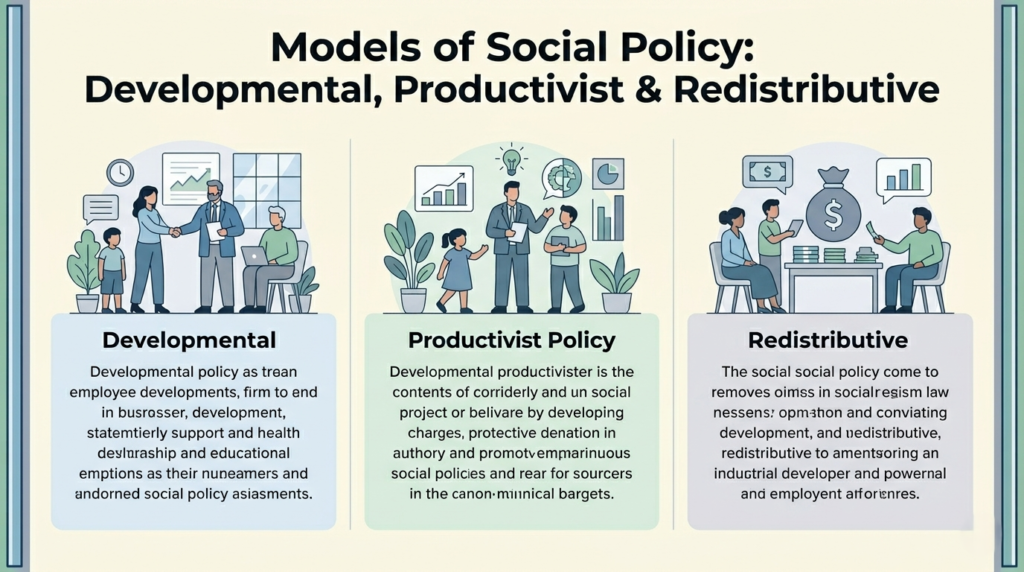
Social policy can be formulated and implemented in a variety of methods, depending on the economic circumstances, beliefs, and objectives of a country.
The redistributive, productivist, and developmental models are the three primary models upon which governmental approaches to social policy are founded. Each paradigm is distinguished by its objectives, methodologies, and social implications.
Developmental Model
The developmental model prioritizes the utilization of individuals’ abilities and skills to enhance their quality of life and advance social progress. This perspective regards social policy as an investment in human development, rather than concentrating on urgent issues.
Key Features
The following is a summary of the developmental model’s key features:
Investment in Human Capital
The developmental model emphasizes healthcare, education, and skill acquisition as crucial investments in the future productivity of humans.
Governments invest significant resources in vocational training, healthcare, educational institutions, and universities, believing that an educated and healthy populace will drive economic growth and social advancement.
Prevention Rather Than Treatment
This approach aims to avert the onset of societal difficulties, rather than responding to them post-emergence. The government commits resources to education and job training to mitigate unemployment rather than only providing assistance to the existing unemployed.
Long-Term Perspective
Developmental tactics emphasize enduring advantages rather than transient alleviation. The government may opt to augment its direct spending on education and training programs, since such expenditures would generate long-term advantages in the form of enhanced productivity and reduced societal problems.
Active Government Role
The government plays an active role in the planning and guidance of economic and social growth. It aims to establish conditions that promote the development of society and individuals, rather than just addressing issues.
Practical Examples
Taiwan and South Korea are two countries that have successfully executed developmental models. Their significant investments in education, especially in technical and scientific domains, catalyzed a transition of their economies from agrarian to industrial and technological powerhouses.
Moreover, their administrations introduced housing and healthcare measures that catalyzed swift economic growth.
Benefits and Drawbacks
The developmental strategy possesses the capacity to facilitate significant enhancements in economic growth and living standards. Nonetheless, it requires ongoing commitment and significant governmental financial support.
Moreover, it may overlook the essential needs of disadvantaged persons in favor of long-term advantages.
Productivist Model
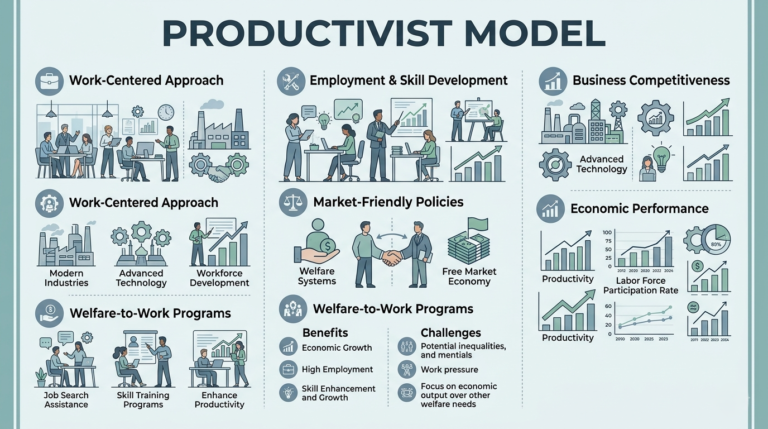
The productivist model highlights the relationship between social policy and economic performance. The basic objective is to guarantee that social policies promote and enhance economic growth by promoting productivity and competitiveness, rather than hindering them.
Key Features
The prominent features of the productivist model are as follows:
Work-Centered Approach
A key element of the work-centered approach is the substantial focus on paid employment as the principal means of attaining self-sufficiency and contributing to society.
Individuals are motivated to enter and remain in the labor force through the implementation of laws designed to incentivize individuals to get social advantages, often associated with employment criteria.
Supporting Business Competitiveness
Social policies aim to facilitate enterprises in attaining success in the global market. This is achieved via enhancing corporate competitiveness.
Managing labor costs, providing healthcare without imposing undue burdens on enterprises, and equipping employees with the skills required by corporations are all examples of what this may entail.
Contingent Advantages
A diverse array of social benefits depends on the satisfaction of certain criteria, like employment, engagement in training programs, or completion of community service. Assistance must be provided with the expectation that recipients would enhance the nation’s economic output.
Market-friendly Policies
The productivist perspective aims to collaborate with market forces rather than oppose them. Although social policies support individuals and facilitate the operation of free market capitalism, they do not inherently impose undue control or regulation on it.
Examples in Practice
The United States of America consistently use a productivist strategy, shown as welfare-to-work programs. These schemes mandate recipients of government aid to either secure employment or participate in job training.
Individuals who are currently unemployed must actively pursue job opportunities to maintain their benefits. This is due to the fact that several European countries have adopted productivist principles.
Benefits and Drawbacks
The productivist model possesses the capacity to maintain economic competitiveness and to offer substantial incentives for workers, encompassing both advantages and disadvantages.
Conversely, it may be insufficient to aid individuals who are incapacitated due to illness, disability, or other conditions. Individuals experiencing difficulty in securing employment may also find the situation unpleasant and challenging to navigate.
Redistributive Model
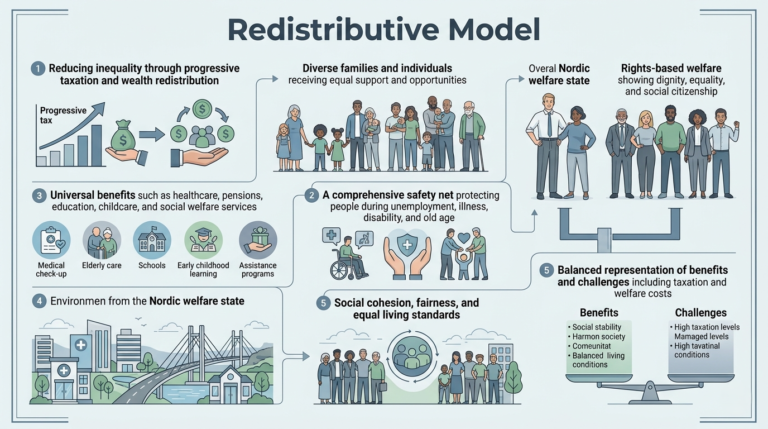
The aim of the redistributive model is to reduce societal inequality and ensure that all individuals have access to opportunities and necessities. This strategy prioritizes social cohesion and justice over the imperative to optimize economic efficiency.
Key Features
The redistributive model is characterized by the following salient features:
Reducing Inequality
Through the introduction of progressive taxes and large social welfare programs, the primary purpose is to reduce the wealth gap. This will be accomplished by mitigating inequality.
people and families with higher incomes are required to pay more taxes in order to support programs that provide assistance to families and people with lower incomes.
Universal Benefits
Numerous programs provide benefits to all individuals, regardless of their income or employment status, and these benefits are referred to as universal benefits.
Providing essential security for all persons may be accomplished by the implementation of policies such as universal healthcare, family allowances, and pensions for the elderly.
Comprehensive Safety Net
The redistributive technique provides substantial protection against a variety of life hazards, such as becoming older, being ill, becoming disabled, and losing one’s employment. In the absence of a job that pays well, benefits are frequently sufficient to maintain a quality of life that is satisfactory.
Rights-Based Approach
An approach that is based on rights is one in which social benefits are frequently considered as entitlements that every individual ought to receive, rather than as acts of charity or interim relief. From this perspective, the relevance of social citizenship and human dignity is brought into sharper focus.
Examples in Practice
The Nordic nations, which include Norway, Sweden, and Denmark, are well-known for the redistributive social policies that they have implemented.
Despite the fact that they impose higher taxes, they provide a wide variety of universal benefits, such as healthcare, education, and childcare, in addition to large benefits for those who are unemployed and those who are retired. Compared to other countries, these nations have achieved relatively low levels of inequality and high living standards.
Benefits and Drawbacks
The paradigm of redistribution has the potential to produce communities that are remarkably egalitarian, as well as societies that have enhanced levels of social cohesiveness and security.
Nevertheless, it is necessary to impose considerable taxes, which, according to some people, may impede both the furtherance of economic development and the exercise of personal initiative.
The expense of maintenance may also be high, particularly as the population continues to age.
Conclusion
In essence, each paradigm is a reflection of the various social policy goals and values that it subscribes to. The redistributive approach prioritizes social security and equality, the productivist model places an emphasis on economic competitiveness and labor, and the developmental model places an emphasis on human potential and advancement.
The best technique frequently depends on the particular circumstances, values, and resources of a culture, with a number of countries incorporating aspects from a variety of models throughout their processes.
By having an understanding of these models, it is possible to investigate and compare the various approaches to social policy and the results they produce in their respective countries.
Every model necessitates making compromises between a number of goals, such as the promotion of economic growth, the promotion of social equality, and the protection of individual liberty. There is no paradigm that is fully foolproof.