
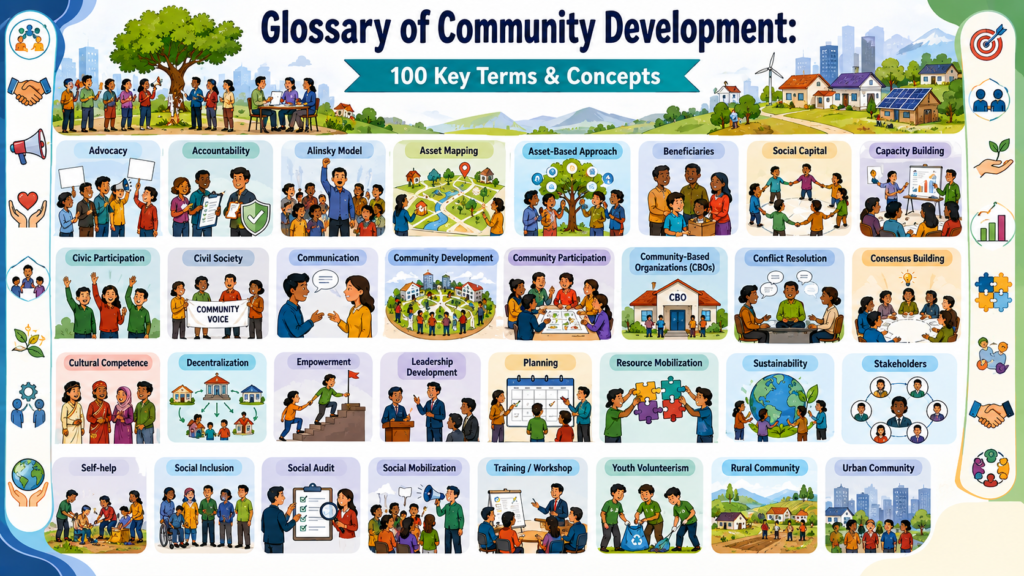
Glossary of Community Development – A to C
Advocacy
Advocacy is the act of supporting or arguing for a cause or policy to bring about social change or address community issues.
Accountability
Holding individuals and organizations responsible for their actions and decisions in community projects.
Alinsky Model
The Alinsky model, developed by Saul Alinsky, is a conflict-based community organizing approach that empowers marginalized communities to challenge power structures through collective action and negotiation. It focuses on building local leadership, identifying issues, and using strategic pressure to bring about social change.
Assessment in CD
Assessment in CD is a comprehensive process that requires a thorough understanding of local needs, strengths, and resources.
Asset Mapping
Asset Mapping is a systematic approach to identifying and documenting the resources, skills, and strengths present within a community.
Asset-Based Approach
Asset-Based Approach focuses on what is missing or broken, and what already exists within a community. It aims to identify and build upon the strengths and resources that are available within the community.
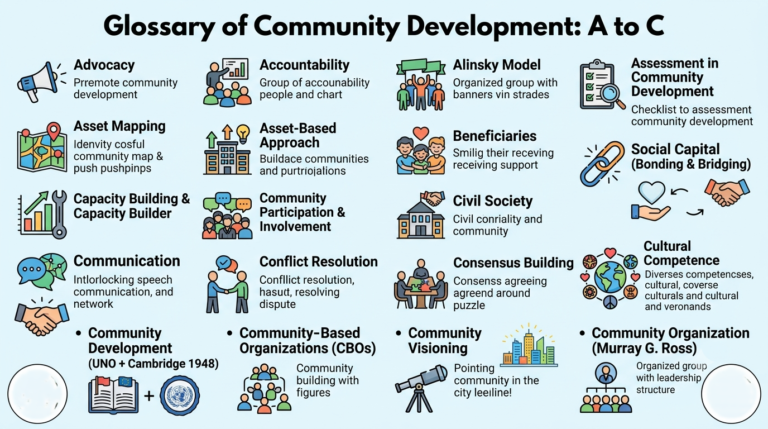
Beneficiaries
The individuals or groups who directly benefit from a community development project.
Bonding Social Capital
which strengthens ties among similar individuals, and bridging social capital, which connects diverse individuals and expands access to resources and opportunities.
Capacity Builder
Capacity builders enhance the abilities of individuals and organizations to take charge of their development. They focus on training and resource management, enabling long-term self-sufficiency.
Capacity Building
Capacity building refers to developing skills, abilities, and resources in individuals and communities to address challenges effectively and achieve sustainable development.
Characteristics of Community by Warren
Warren identified key characteristics of community including locality, local provision of services, social interaction, common ties, and social control. He emphasized that a community functions through both horizontal ties among local units and vertical links to outside systems.
Civic Participation
Involvement of individuals in political or social activities to influence community improvement.
Civil Society
Civil society refers to the space occupied by voluntary organizations, non-governmental bodies, community groups, and citizens’ associations that operate independently of the government and private sector. It plays a vital role in advocating for rights, promoting social welfare, and holding institutions accountable.
Classical Perspectives in Community Development
Classical perspectives in communiy development focused on identifying and addressing the problems and deficits within communities. These perspectives is a more traditional approach.
Communication
Communication is the process of exchanging ideas and information through common languages and symbols.
Community Capacity
Community capacity is the ability of members to identify, address, and solve shared challenges. It involves skills, knowledge, leadership, and participation.
Community Development
According to UNO it is a process by which the efforts of the people are united with the governmental authority to improve their economic, social and cultural condition. According to Cambridge Summer Conference (1948):“Community development is a movement design to promote better living for the whole community with the actual participation and on the initiative of the community”.
Community Development Corporations (CDCs)
Community Development Corporations stand out as a specific type of CBO that focuses on local issues like housing, economic development, and social services.
Community Involvement
Engage residents in the mapping process to ensure that a diverse range of voices and perspectives are included.
Community Organization
By Murray G. Ross (1967) “a process by which a community identifies its needs or objectives, gives priority to them, develops confidence and will to work at them, finds resources (internal and external) to deal with them, and in doing so, extends and develops cooperative and collaborative attitudes and practices in the community”. According to Harper “Bring about and maintain progressively a more effective adjustment between social welfare resources and social needs”.
Community Participation
Community participation is the active involvement and engagement of community members in decision-making processes, planning, and implementation of initiatives aimed at improving their lives.
Community Services
Community services are donated as services or activity that is performed by someone or a group of people for the benefit of the public or its institutions.
Community Visioning
Community visioning is a participatory process that helps people dream together about what they want their community to become.
Community
Ogburn & Nimkof defined community as the “total organization of social life in a limited area.” Arthur Dunham defined community as “a group of people who live in a thickly populated area and show their common and share life through/by their customs, traditions, and way of conversation.”
Community-Based Organizations (CBOs)
Community-Based Organizations (CBOs) are non-profit entities formed to address local issues and improve the quality of life for residents by mobilizing resources and promoting community engagement.
Conflict Resolution
Methods and strategies used to address disputes within or between communities peacefully.
Consensus Building
A collaborative process where all parties work toward agreement on shared goals or solutions.
Contemporary Perspective in CD
Contemporary Perspective in CD focused on problems rather than recognizing the inherent strengths within individuals and communities.
Cultural Competence
Understanding and respecting the cultural differences and traditions within a community when planning or implementing programs.
Glossary of Community Development – D to G
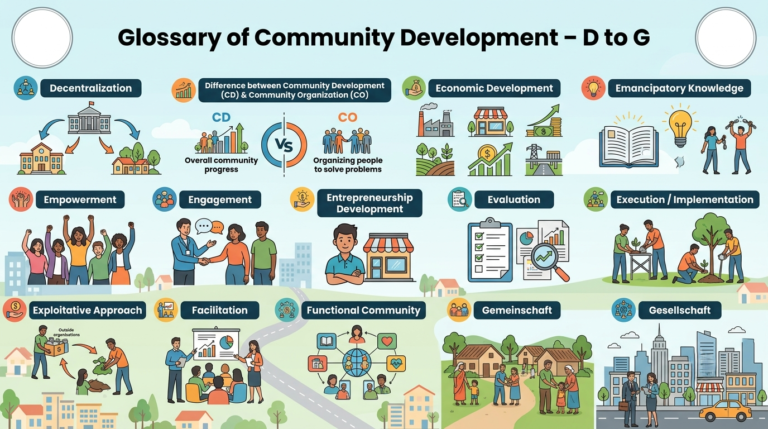
Decentralization
The transfer of decision-making powers from central authorities to local communities or governments.
Difference between CD and CO
Community development is a process designed to create conditions for economic and social progress for the whole community with its active participation and fullest reliance upon community initiative. Community organization, on the other hand, is a process by which a community identifies its needs, ranks them, develops confidence to work on them, finds resources to deal with them, takes action, and develops cooperative and collaborative attitudes.
Economic Development
Economic development is defined as the process of creating wealth by mobilizing human, financial, physical, and natural resources to produce marketable goods and services.
Emancipatory Knowledge
A combination of technical and hermeneutic knowledge, aimed at liberation and collective action.
Empowerment
Empowerment is the process of enabling individuals or communities to gain control over their lives and make decisions that affect their social, economic, and political well-being.
Engagement
Engagement is the foundational stage of social work with communities, focusing on building rapport and establishing trust with community members, organizations, and stakeholders.
Entrepreneurship Development
Supporting individuals or groups in starting or expanding small businesses to boost local economies.
Evaluation
Evaluation is the process in which the community worker reviews the progress of the program. This involves identifying obstacles and difficulties that may have delayed or hindered the project.
Execution / Implementation
It involves putting the plan into action. This is where the actual work takes place, and the community becomes actively involved in welfare activities or programs.
Exploitative Approach
The exploitative-oriented approach in community development focuses on using the community’s resources for the benefit of external parties, often with little regard for the community’s welfare.
Facilitation
Guiding group discussions and activities to help communities identify and achieve their goals.
Functional Community
A functional community is a group of people connected by a shared purpose, interest, or function rather than physical location. Members collaborate around common goals such as health, education, or livelihood, regardless of where they live.
Gemeinschaft
Gemeinschaft refers to a close-knit community bound together by strong personal relationships, shared values, and a deep sense of belonging. It is characterized by emotional ties, mutual cooperation, and a collective identity rooted in tradition and kinship.
Gesellschaft
Gesellschaft describes a modern, impersonal society where relationships are formal, contractual, and based on individual self-interest rather than emotional bonds. It is typical of urban, industrialized settings where social interaction is driven by roles and transactions.
Glossary of Community Development – H to M
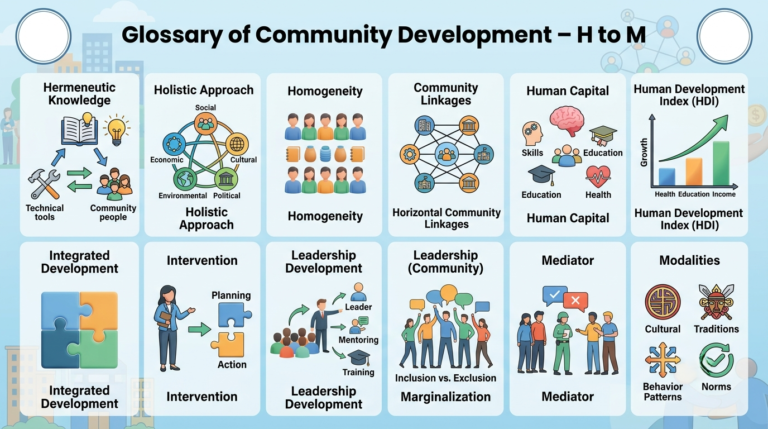
Hermeneutic Knowledge
Practical knowledge that interprets technical expertise and relates it to individuals, families, and communities.
Holistic approach
Holistic approach in community development means addressing the interconnected social, economic, environmental, cultural, and political needs of a community in an integrated and inclusive manner.
Homogeneity
Homogeneity the quality in a group of people or things of being all the same or all of the same type.
Horizontal Community Linkages
Horizontal community linkages refer to the connections and relationships between different organizations, groups, and institutions operating at the same local level within a community. These linkages promote coordination, resource sharing, and collective action among community stakeholders.
Human Capital
The knowledge, skills, and health that people possess which contribute to community development.
Human Development Index (HDI)
A composite statistic measuring a country’s average achievements in health, education, and income.
Integrated Development
Coordinated efforts that combine social, economic, and environmental development activities.
Intervention
Intervention involves implementing the strategies developed during planning. Social workers take on the role of coordinators, mobilizing resources, engaging stakeholders, and putting plans into action.
Leadership Development
Activities and programs that help individuals gain the skills needed to lead effectively within their communities.
Leadership in Community Development
Leadership in community development refers to the ability of individuals or groups to guide, inspire, and mobilize community members toward achieving common goals for the betterment of the community.
Marginalization
The process through which certain groups are pushed to the edges of society and denied full access to resources and decision-making.
Mediator
Mediators resolve conflicts within or between groups, promoting peace and collaboration. They address misunderstandings and work toward win-win solutions.
Modalities
Modalities refer to the cultural norms, traditions, and societal patterns that shape people’s behavior.
Glossary of Community Development – N to R
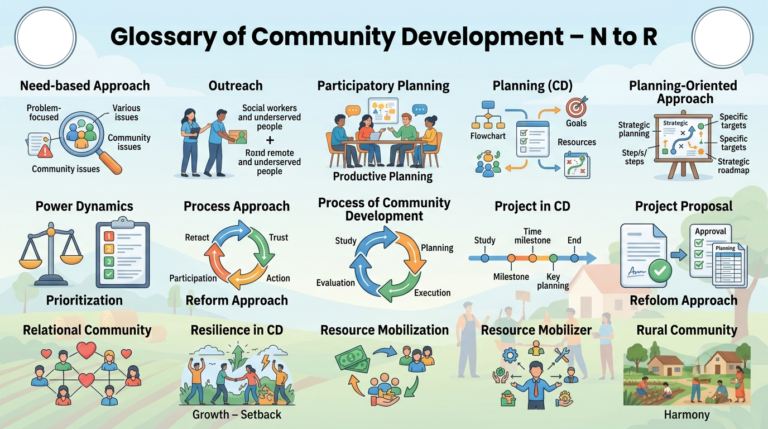
Need-based Approach
Need-based Approach focuses on identifying and addressing the issues, problems, and needs that a community faces. This is the traditional method.
Outreach
Activities designed to connect with and support people who might not otherwise have access to services or information.
Participatory Planning
A planning approach that directly involves community members in shaping development initiatives.
Planning in Community Development
Planning in community development refers to a systematic, organized process of setting goals, identifying community needs, allocating resources, and outlining actions to bring about desired social, economic, and environmental improvements in a community.
Planning Oriented Approach
The planning-oriented approach focuses on systematic planning, goal-setting, and strategic development for a community. This approach involves careful assessment of the community’s needs, setting clear objectives, and developing a detailed plan to address these needs over a defined period.
Power Dynamics
The balance or imbalance of influence and control among individuals or groups within a community.
Prioritization
Ranking community issues to decide which should be addressed first based on urgency or impact.
Process Approach
The process-oriented approach emphasizes the participation of the community in every step of the development process. It focuses on building relationships, trust, and a sense of ownership among community members.
Process of Community Development
The community development process involves four basic steps: study, planning, execution, and evaluation. These steps help a social worker gather accurate information about the community, design programs based on their needs, implement them effectively, and assess their outcomes.
Project in CD
A project is a time-bound intervention consisting of a set of planned and interrelated activities executed to bring about a beneficial change.
Project Proposal
A project proposal is a detailed account of a succession of activities intended to solve a particular problem.
Reform Approach
The reform-oriented approach in community development focuses on changing and improving existing systems, institutions, and structures within the community to make them more efficient, equitable, and just.
Relational Community
A relational community is defined by the social bonds, trust, and interpersonal relationships that connect its members rather than geographical boundaries. It emphasizes mutual support, shared experiences, and a sense of belonging among individuals.
Resilience in CD
Resilience in CD is a reactive quality, where the focus is on how well a community could bounce back after a setback.
Resource Mobilization
Resource mobilization is the process of gathering financial, human, and material resources to support community development initiatives.
Resource Mobilizer
Resource mobilizers identify and secure resources needed for development projects.
Rural Community
Rural Community is defined as “a group of people living in a contiguous geographical area and interacting to meet their needs.”
Glossary of Community Development – S to Z
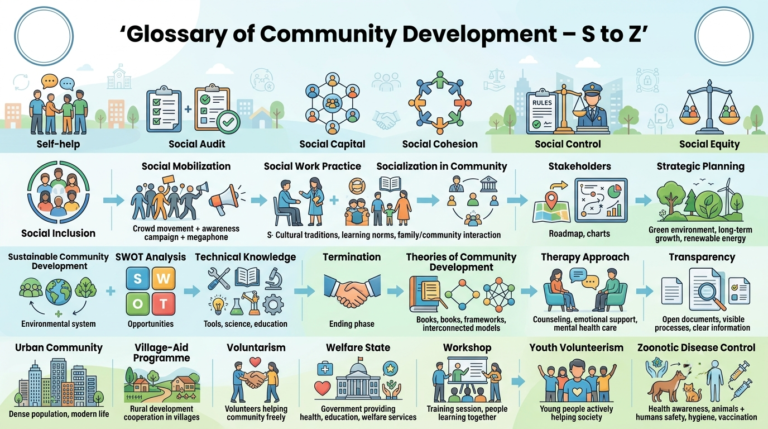
Self-help
Self-help refers to initiatives determined by community members to solve problems and meet their needs using their resources, skills, and collective efforts.
Social Audit
A process in which community members evaluate the effectiveness and transparency of development programs.
Social Capital
Social capital refers to the networks of relationships, trust, and norms within a community that enable collective action.
Social Cohesion
The sense of solidarity and trust that binds a community together, promoting peace and cooperation.
Social Control
Social control ensures compliance with community norms and values, maintaining order and harmony.
Social Equity
Social Equity focuses on ensuring that all community members, especially marginalized groups, have access to resources, opportunities, and decision-making processes.
Social Inclusion
Social inclusion is the process of ensuring equal participation and benefits for all community members, regardless of background.
Social Mobilization
Social mobilization is the process of engaging and organizing community members, groups, and institutions to take collective action toward achieving a common social goal. It builds awareness, strengthens participation, and empowers communities to drive sustainable development from within.
Social Work Practice with Communities
Social work practice with communities is a dynamic and multidimensional process that seeks to address systemic challenges, promote social well-being, and empower communities through collective action.
Socialization in Community
Socialization in community involves the transmission of norms, values, and traditions within a community, guiding the development of attitudes and behaviors.
Stakeholders
Individuals or groups who have an interest or investment in a community development project (e.g., community members, NGOs, government).
Strategic Planning
Strategic planning is a process where a community creates a detailed plan to achieve its vision. It involves analyzing the current situation, defining objectives, and allocating resources effectively to reach a desired future state.
Sustainability
Sustainability in community development emphasizes meeting present needs without compromising the ability of future generations to meet their own needs, focusing on long-term solutions.
Sustainable Community Development
Sustainable community development is a holistic approach to building and improving communities in a way that meets the needs of the present without compromising the ability of future generations to meet their own needs.
SWOT Analysis
A SWOT analysis (Strengths, Weaknesses, Opportunities, Threats) is a strategic planning tool that can guide assessments.
Technical Knowledge
The scientific and technological expertise often perceived as rational and objective.
Termination
Termination is the gradual end of the social worker’s involvement with the community.
Theories of Community Development
The seven major theories of community development are: Social Systems Theory, Conflict Theory, Structural-Functional Theory, Human Ecology Theory, Social Capital Theory, Empowerment Theory, and Asset-Based Community Development Theory. Each provides a unique lens for understanding how communities change, grow, and address their challenges.
Therapy Approach
The therapy-oriented approach in community development focuses on addressing the psychological and emotional needs of individuals within the community. It aims to help people heal from trauma, improve mental health, and build resilience.
Transparency
Openness in sharing information and decisions, ensuring accountability in community processes.
Urban community
Urban community is defined as a group of people living in contiguous geographical area and enjoying greatest benefits of institutions of the society in order to fulfill their unlimited needs.”
Village-Aid Programme
The Village-Aid Programme was a rural development initiative in Pakistan launched in the 1950s aimed at improving living conditions through community participation and self-help. Its key features included local leadership development, provision of basic services, and mobilizing villagers to collectively address their development needs.
Voluntarism
The use or involvement of volunteers in carrying out community development work.
Welfare State
A system of government in which the state assumes responsibility for promoting the social and economic well-being of citizens through services such as health, education, and social security.
Workshop
A participatory educational session designed to build the knowledge, skills, and capacities of community members or stakeholders.
Youth Volunteerism
The voluntary contribution of time, skills, and effort by young people to improve community welfare without expecting financial reward.
Zoonotic Disease Control
Community health measures aimed at preventing diseases transmitted between animals and humans through public awareness, sanitation, vaccination, and environmental management.