
What is Environmentalism in Social Policy?
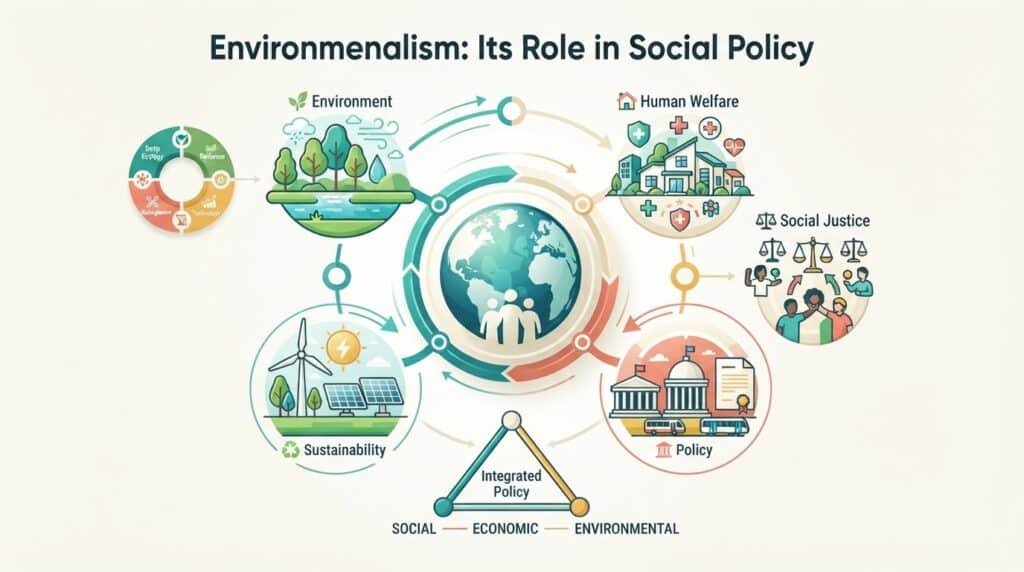
Environmentalism in social policy refers to the integration of ecological concerns into welfare and social justice frameworks. It recognizes that environmental conditions; air quality, housing standards, access to green spaces, and resource availability directly shape people’s quality of life, health outcomes, and social opportunities (Roberts, 2010).
Environmentalism in social policy looks at how harm to the environment and efforts to protect it impact different groups of people, especially those who are vulnerable or disadvantaged. Unlike traditional environmentalism, which mainly focuses on saving nature, this approach considers how environmental problems like pollution or climate change affect people’s health, jobs, and quality of life, especially for poorer or marginalized communities.
This approach involves three key dimensions:
- First, understanding how environmental factors (pollution, poor housing, climate change) create or worsen social problems like ill-health and poverty.
- Second, analyzing how environmental policies impact social equity; ensuring green initiatives[1] don’t disadvantage marginalized communities.
- Third, creating solutions that protect the environment while ensuring fairness and equality for all people (Cahill, 2003).
Scope of Environmentalism in Policy
Environmental issues have become more important in political and social discussions, forming a set of ideas called “Green politics[2].” This approach rejects the traditional political agenda and focuses on alternative concerns. The main goals of Green politics are to protect the environment, manage natural resources carefully, and think about how humans relate to nature.
Green politics goes beyond just conserving nature. It calls for new ways of organizing society, with a focus on self-reliance, community living, and cooperation. Even in areas like social policy, ecological views are used to shape new policies and practices. It is also important to recognize that environmental problems will be a key issue for future policies, even if we don’t know yet how big the problem will be (O’Riordan, 1996).
Environmental Factors and Human Welfare
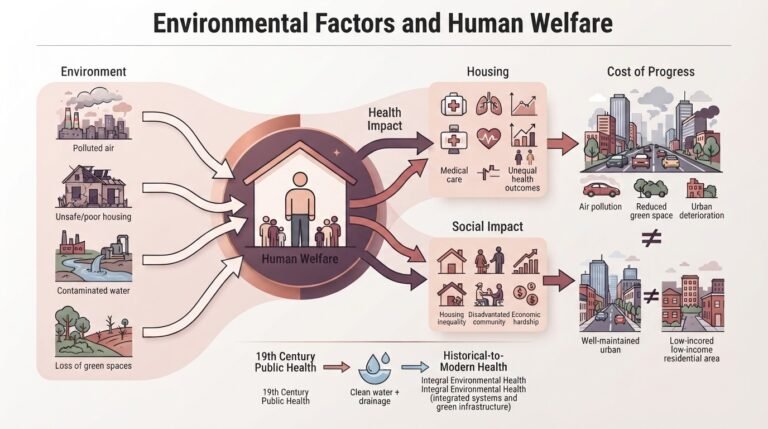
Environmental conditions are attached with human well-being, particularly regarding health and housing. Historically, nineteenth-century public health reforms focused on environmental improvements such as building drains and improving water supplies recognizing that physical surroundings directly impact population health.
This connection still exists today. Studies show that health inequalities are closely linked to environmental factors, meaning that modern medicine can’t fix the harm caused by poor environmental conditions. Housing, a key part of people’s surroundings, highlights this link: poor housing is often found in marginalized communities, showing how environmental damage and social exclusion overlap (Kerekes, Marjainé, & Kocsis, 2018).
In wealthy societies today, some call it the “costs of progress”; pollution, traffic, loss of green spaces, and reduction of resources. More car use, often due to the spread of workplaces and lack of public transport, makes air pollution and urban decay worse. At the same time, poorer populations live in neglected areas, facing both environmental injustice and economic disadvantage.
Ideological Perspectives
Support for Green politics is found across the political spectrum, but those who practice it take four main approaches to addressing environmental challenges:
- Deep Ecologists believe in a “natural morality,” suggesting that society should change to live within the planet’s limits. They challenge the focus on constant growth and call for a complete change in how humans relate to nature.
- Self-Reliance advocates want small, independent communities that use simple technology. They believe in giving local people control over their resources and decisions.
- Environmental Managers believe we can achieve sustainable development by improving current systems, using better rules, technology, and market solutions.
- Cornucopians[3] (technological optimists) believe that human creativity and technology will solve environmental problems, seeing them as challenges to be fixed with innovation, not by changing society.
Understanding these views helps explain policy debates, as disagreements usually come from different beliefs about how humans should relate to nature and whether technology can fix problems (Mohan et al., 2024)
Policy Conflicts and Environmental Sustainability
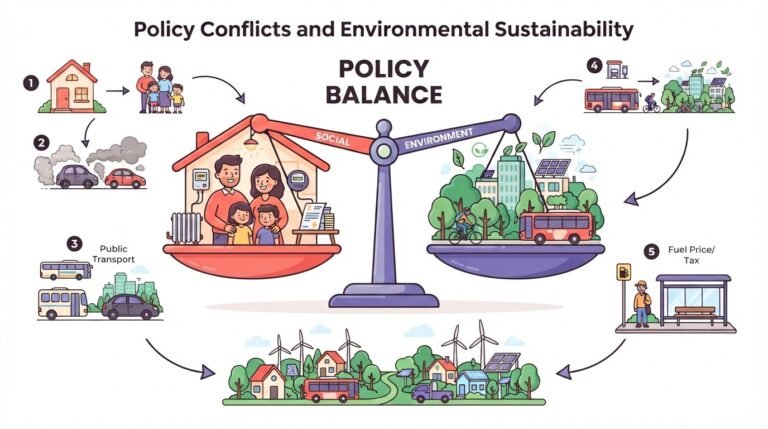
The idea of environmental sustainability is now part of the UN’s Sustainable Development Goals, replacing the old Millennium Development Goals. This has impacted policies on everything from housing to transportation planning. Social planners are now including green ideas, like improving energy use, building better public transport, and creating eco-friendly communities. However, environmental and social goals often clash, creating real challenges for policymakers.
For example, lowering VAT[4] on home energy helps poor families keep their homes warm, which is good for social policy. However, it goes against environmental goals because it encourages more energy use.
On the other hand, high fuel taxes reduce car use and cut greenhouse gas emissions, helping climate goals, but they unfairly affect low-income people in rural areas who don’t have good public transport options. It shows that environmental policies are never fair to everyone, so it’s important to carefully consider how they affect everyone (Dai et al., 2024).
Integrated Policy Analysis
To understand these different interests, we need to look at social, economic, and environmental factors together. Policymakers call this “triangulation,” where they examine problems from different angles to find conflicting trends and possible ways to work together. Successful solutions are possible.
For example, Costa Rica shows that strong environmental protection can go hand-in-hand with better social outcomes. Denmark’s shift to wind energy created jobs and reduced pollution (Dunn, 2015).
Conclusion
For social policy practitioners, environmentalism presents both challenge and opportunity. While environmental and social objectives sometimes conflict, they share fundamental concerns about sustainability, well-being, and intergenerational equity. The task is not choosing between environmental protection and social justice but creatively designing policies that advance both simultaneously. The integration of environmental and social policy remains one of the defining challenges of contemporary governance, requiring both technical expertise and commitment to equity.
[1] Green initiatives refer to actions or projects that aim to protect the environment and promote sustainability.
[2] Green politics is a political approach focused on environmental protection, sustainability, and social justice.
[3] Cornucopians are people who believe that technology and human innovation can solve environmental problems and that there are no limits to growth or resources.
[4] VAT stands for Value Added Tax. It is a tax added to the price of goods and services at each stage of production or distribution.
References
- Cahill, M. (2003). The environment and social policy. Routledge.
- Dai, J., Hiung, E. Y. T., Destek, M. A., & Ahmed, Z. (2024). Green policymaking in top emitters: assessing the consequences of external conflicts, trade globalization, and mineral resources on sustainable development. International Journal of Sustainable Development & World Ecology, 31(6), 653-667.
- Dunn, W. N. (2015). Public policy analysis: An integrated approach. Routledge.
- Kerekes, S., Marjainé Szerényi, Z., & Kocsis, T. (2018). Sustainability, environmental economics, welfare. Corvinus University of Budapest.
- Mohan, C., Robinson, J., Vodwal, L., & Kumari, N. (2024). Sustainable Development Goals for addressing environmental challenges. In Green chemistry approaches to environmental sustainability (pp. 357-374). Elsevier.
- O’Riordan, T. (1996). Environmentalism on the move. Companion encyclopaedia of geography. The environment and humankind, 449-478.
- Roberts, J. (2010). Environmental policy. Routledge.