
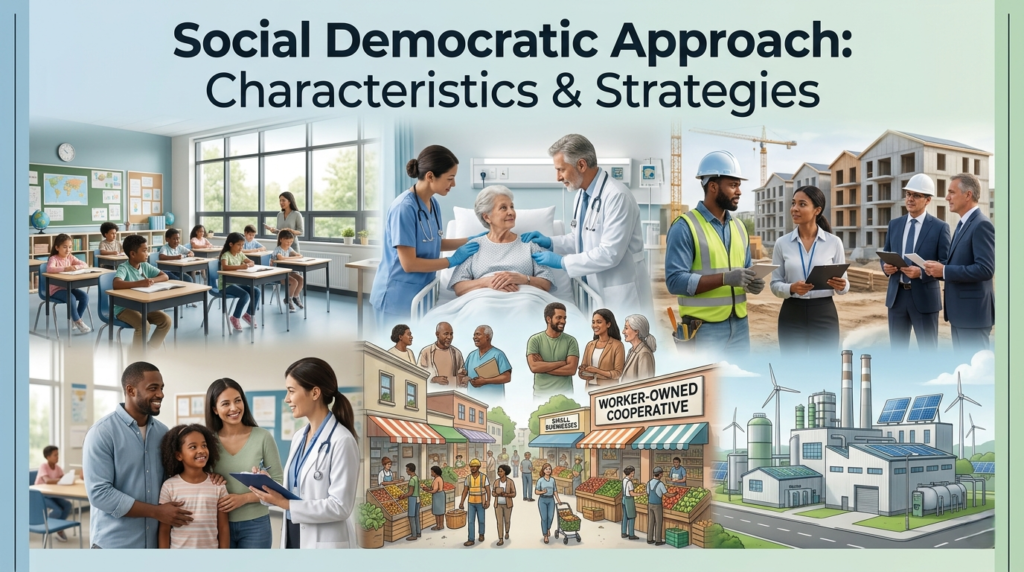
Social democracy is defined as a set of political beliefs based on the acceptance of the necessity for collective social action and social protection in a mixed economy[1].
Origin and Development
Social democracy is a political belief that originally aimed to peacefully change society from capitalism to socialism through legal and democratic processes, rather than through revolution.
In the second half of the 20th century, it became more moderate, focusing on government regulation of businesses and strong social welfare programs instead of full state ownership. It shares some roots with communism, based on the ideas of Karl Marx and Friedrich Engels, but rejects violence and totalitarian rule.
After World War II, social democratic parties came to power in several Western European countries, such as West Germany, Sweden, and Britain, where they helped build the foundations of modern welfare systems.
Over time, the movement shifted away from the idea of taking over all businesses and industries, and instead focused on regulating them to promote economic growth and fairer distribution of wealth.
Democracy was no longer seen as a tool of the ruling class, as Marxists had argued, but as an essential part of achieving socialist goals. Through these changes, social democracy gradually became a more practical and moderate alternative to both pure capitalism and communism.
Characteristics and Core Values
Core Ideals (Equality, Protection, Openness)
This approach emphasizes the political values of equality, openness, and participation. Along with other left-wing[2] ideologies, social democracy emphasizes the values of freedom and equality. The left wing generally supports welfare, public provision, collectivism, and the institutional model of welfare.
Collective Action and Social Responsibility
Social democrats, similar to socialists, believe in collective action, focusing on enabling people to act and reducing disadvantage. The philosophical foundation of the social democratic approach is
closely linked to the institutional model of welfare, which assumes that dependency and need are normal parts of social life. This model recognizes social responsibility for these conditions and dictates that general provision should be made accordingly.
Historically, the mainstream of socialism (which shares core values with social democracy) was based on collectivist social movements.
Social Democratic Welfare State Models
In models classifying welfare systems, social democratic régimes are typically associated with the most committed position in relation to welfare.
Examples of the social democratic model, such as Sweden, are renowned for the comprehensiveness and generosity of their social services and social security benefits. Social welfare in these states tends to be inclusive and available to all on an equal basis.
Social Democratic Welfare Strategies
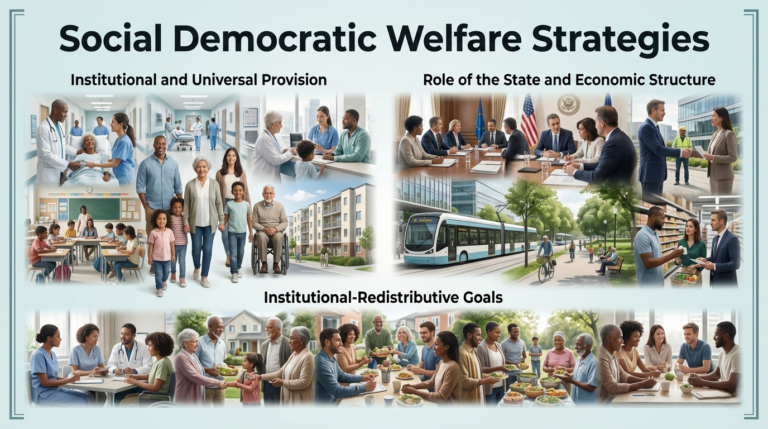
Institutional and Universal Provision
The commitment to inclusive welfare means that social democratic states favor universal social welfare provision. Universality implies that everyone has basic needs that can often be supplied more simply and effectively through general provision to everyone.
This strategy aims to establish a society where every citizen has a right to basic services, which is the root of the ‘institutional’ model of welfare.
Role of the State and Economic Structure
Social democracy accepts the necessity for collective social action within a mixed economy. While promoting collective action, social democratic thought differs from pure socialism in key ways regarding the state’s role:
- Individualism and State Restriction: Many social democrats are categorized as individualists who stress the liberty of the individual and may often seek to restrict the role of the state.
- Mitigation vs. Removal: Some social democrats do not aim to remove inequality entirely but seek only to mitigate its effects through social arrangements that protect people from the worst consequences of the market. This mitigatory approach is considered to better describe Richard Titmuss’s views than classifying him as a Fabian socialist[3].
Institutional-Redistributive Goals
The “institutional-redistributive” model, closely related to the social democratic approach, adds the objective of redistribution, which is concerned with equalizing resources between people.
Although left-wing ideas usually support egalitarian redistribution (equal sharing of wealth), in reality, welfare systems in different countries don’t always fully follow this goal. This is because each country’s welfare system is based on a mix of different ideas and principles, not just equality.
Historical Influence and Contemporary Relevance

Dominance in Academic Study (Titmuss)
The academic study of social policy in Britain was mainly based on social democratic principles. This approach was strongly influenced by Richard Titmuss, who promoted a left-of-center[4], planned, and rather paternalistic system of state welfare during the 1950s and 1960s.
Titmuss’s ideas emphasized that the market often fails to meet people’s needs that selective social services are not enough, and that collective and universal approaches to welfare are better.
Policy Implementation Examples (UK Devolution)
When power was given to Scotland and Wales (devolution) in the UK, both started making policies that support traditional welfare values. For example, they brought back student maintenance grants and provided free personal care for older people in Scotland.
These steps show that they care about social investment and that devolution may help bring back the old social democratic way of beliefs.
Common Criticism of Social Democracy
- The services which are provided to every individual that may not be need or demand of any particular individual.
- According to conservatism and liberalism, social democracy interferes in the market mechanism because a huge budget badly affects the economy.
- Social democracy encourages high taxation that unable people to invest that caused low production in the country.
- It is unaffordable, particularly as the population ages putting more demands on pensions and health care provision.
[1] Mixed economy combines features of capitalism (private businesses) and socialism (government control).
[2] Left-wing ideology means a way of thinking that focuses on equality, social justice, and support for the poor or working class
[3] A Fabian socialist is a person who believes in achieving socialism gradually and peacefully, not through revolution or violence.
[4] Left-of-center means having political or social views that support moderate left-wing ideas, but not as extreme as far-left or socialist views.