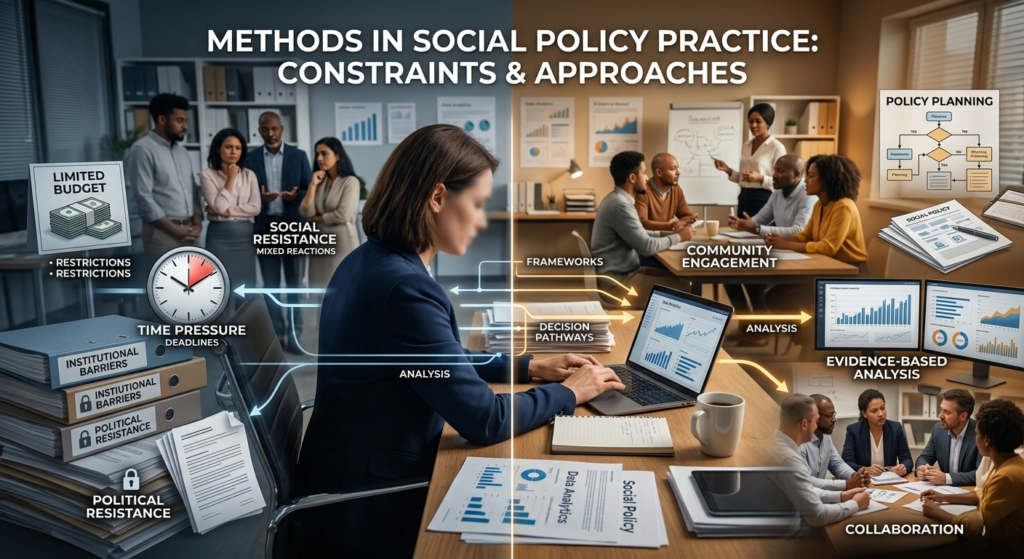
In social policy, methods refer to the practical approaches, procedures, and instruments employed to design and implement policies. These methods are crucial as they illustrate the transition of policies from conceptualization to implementation. This influences the utility and efficacy of social services.
Why Policy Aims and Methods Often Diverge?
It may seem clear that methods should fit with a policy’s goals, but this isn’t always the case. There are many reasons why this mismatch can happen.
Hidden Goals
The declared objective of a policy may not reflect its true intent. The “War on Poverty” in the United States encompassed not just poverty alleviation but also the resolution of racial conflicts and the engagement of citizens in the political process.
The Influence of Factions and Ideologies
Groups of people with solid convictions or common beliefs and assumptions frequently influence policy formulation. During periods of affluence, individuals assert that social care services provide them with greater autonomy and options. However, during recessions, these services are purported to assist the government in reducing expenditures.
Bargaining and Agreement Formation
Policy creation frequently entails dialogue, bargaining, and compromise, which may result in ideas or outcomes that lack logical coherence with the original concept. For example, an increase in hospitals is necessary, medications should be more affordable, and physicians ought to be sent to remote regions.
Following discussions and negotiations, the administration has resolved to construct a new stadium in the city to facilitate sports participation and promote public health.
The Rational Model
The “rational model” of policy-making says that planners should carefully look at different ways to reach their goals, taking into account their costs and effects. But this model is not often possible in the real world. Such a thorough examination takes a lot of time, money, and is often based on speculation, which is more than what policymakers can do. Instead, policymakers usually look at a number of “possible alternatives.“
How strong a policy is, which means whether it can change if problems come up, is an important point here. People usually think that policies that force decision-makers to stick to one path with no way to change it are risky.
Constraints on Method Selection
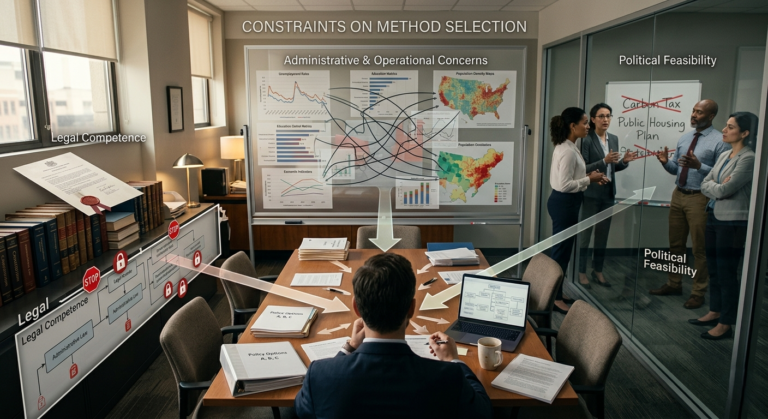
The goal of a policy or a rational examination of alternative choices do not invariably dictate the tactics employed. It is significantly influenced by various constraints:
Legal Competence
The organization’s legal power and capacity will dictate the permissible acts. Constitutions or fundamental laws constrain governmental actions, hence legitimizing their conduct.
Political Feasibility
Values and ideologies significantly influence policy, leading to the dismissal of certain ideas as inappropriate or even “unthinkable” due to inflexible mindsets. The concept of “non-decision” illustrates that certain issues are entirely overlooked due to their absence in the prevailing political dialogue.
Administrative and Operational Concerns
Not all problems are easily resolvable. Some problems lack a singular, straightforward solution due to their complexity and dynamic nature. Unemployment is associated with factors such as education, the economy, technology, and population density in a region. This indicates that a singular solution will be ineffective.
Ultimately, methodologies are efficacious solely when they correspond with the specific issue and circumstance. This frequently entails implementing modifications that are pragmatic rather than adhering strictly to theoretical frameworks.
Key Methods in Social Policy Practice
Social policy practice uses a number of systematic methods to make sure that policies are made, put into action, and evaluated in the best way possible. These methods make sure that decisions are based on facts and that policies work.
Policy Analysis and Research
Policy analysis is the basis for good social policy practice. It involves carefully looking at current policies and judging possible new ones. This method uses literature reviews, comparative studies, and feasibility analyses to figure out how policies work and what effects they might have.
Researchers use both quantitative and qualitative methods to collect evidence, look for patterns, and find the best ways to do things. Surveys, interviews, and focus groups are examples of data collection methods that can help us understand how well policies work and how different groups of people feel about them.
Stakeholder Engagement and Consultation

Engaging all stakeholders makes sure that a lot of different points of view are taken into account when making and carrying out policies. This method means identifying key stakeholders, such as service users, community groups, professional associations, and advocacy networks.
Public hearings, advisory committees, citizen panels, and online platforms that encourage a lot of participation are all examples of consultation methods. To be successful, you need to be aware of other cultures, be able to communicate clearly, and be truly committed to using stakeholder feedback to make policy.
Pilot Programs and Demonstration Projects
Pilot programs let policymakers try out changes on a small scale before putting them into full effect. This method entails the formulation of controlled experiments, the selection of representative populations, and the establishment of explicit success metrics.
Demonstration projects are great ways to learn because they help find problems with implementation and improve program design. Pilot results help make decisions about scaling and changing policies, which lowers the risks that come with making big policy changes.
Impact Assessment and Evaluation
Impact assessment looks at the effects that policies have on target groups and society as a whole, both good and bad. This method uses a number of different evaluation designs, such as randomized controlled trials, quasi-experimental studies, and longitudinal analyses.
Evaluators look at the results of policies, how well they work, and how they affect different groups. Regular cycles of monitoring and evaluation make it possible to make evidence-based changes to policies and keep things getting better.
Advocacy and Policy Communication
Effective advocacy uses research results to make policy suggestions that can be put into action and gets people to support policy change. This method includes writing interesting stories, making policy briefs, and talking to the media and people who make decisions.
Strategic communication helps different people understand complicated policy issues and makes sure that evidence gets to the people who can make changes.
Conclusion
Social policy methodologies serve as the connection between altruistic intentions and tangible outcomes. The rational model provides a useful framework for analysis; nevertheless, in practice, factors such as legal constraints, political viability, and administrative intricacies frequently restrict the feasible choices available to policymakers.
A disparity between a policy’s articulated objectives and its actual implementation does not necessarily constitute a failure. This frequently arises from the complex realities of governance, negotiation, and conflicting interests.
Consequently, effective social policy practice necessitates a combination of comprehensive research, genuine stakeholder participation, meticulous testing, and continuous review. Policies are significantly more likely to effectuate genuine and enduring social transformation when they are judiciously selected and adaptable when necessary.