
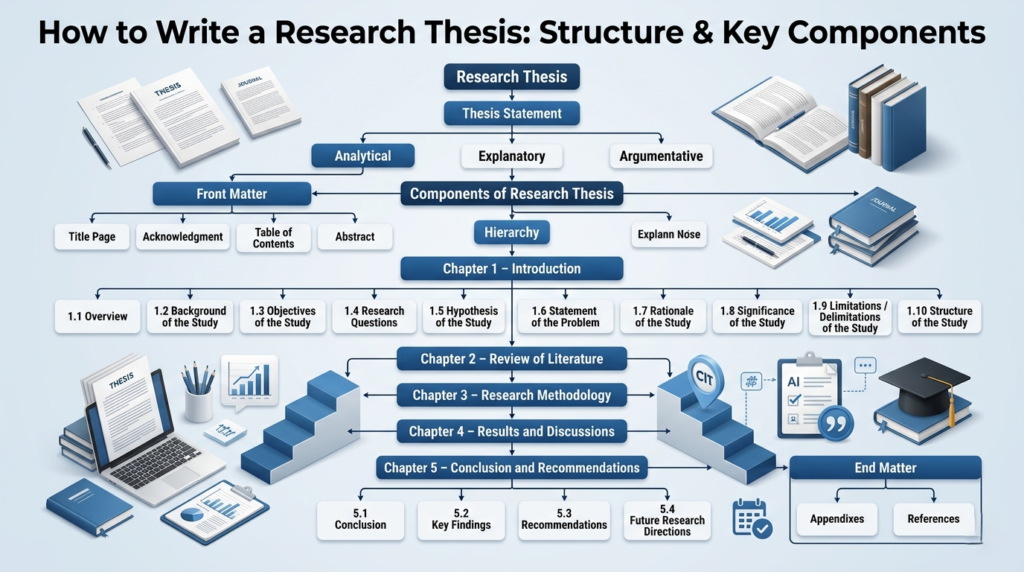
Research Thesis
A research Thesis, or dissertation, is a document submitted supporting candidature for an academic degree or professional qualification presenting the author’s research and findings. The two terms are often used interchangeably but carry distinct meanings in different academic traditions.
In most countries, a thesis refers to the document submitted for a master’s degree, while a dissertation refers to the document submitted for a doctoral (PhD) degree. Regardless of terminology, both documents require the candidate to demonstrate original scholarly contribution, methodological rigor, and command of the relevant field of knowledge.
Thesis Statement
A thesis statement is a concise sentence that summarizes the central argument, claim, or purpose of the study. It is typically placed at or near the end of the introductory section and serves as the organizing proposition around which the entire document is structured. Every subsequent chapter, argument, and piece of evidence should relate back to and support the thesis statement.
Effective thesis statements possess the following qualities:
- Concise: An effective thesis statement should be concise and attention-grabbing, avoiding unnecessary detail. It should express the central argument clearly and directly in one or two sentences.
- Contentious: A strong thesis statement makes a claim that requires evidence or analysis to support it, rather than stating an obvious or universally accepted fact. It should invite intellectual engagement and scholarly debate.
- Coherent: All points stated in the thesis statement must be verified, elaborated, and supported in the subsequent sections of the work. There must be logical consistency between the thesis statement and the overall argument of the document.
Types of Thesis Statement
There are three main types of thesis statements: analytical, argumentative, and expository.
Analytical
In an analytical paper, the researcher breaks down an issue or idea into its component parts, evaluates each part critically, and presents this structured breakdown and evaluation to the audience. An analytical thesis statement identifies the subject being analyzed and states the conclusions drawn from the analysis.
Example: “An analysis of social media usage among Pakistani university students reveals that platform preference, frequency of use, and content type are shaped primarily by peer norms rather than individual psychological traits.”
Expository
In an expository piece of writing, the researcher explains or describes a subject, phenomenon, place, person, event, or process to the audience in a clear and informative manner, without making a contestable argument. An expository thesis statement identifies the subject and indicates what will be explained.
Example: “This study describes the process through which internally displaced persons are resettled under Pakistan’s national rehabilitation policy, examining the administrative, logistical, and social dimensions of the process.”
Argumentative
In an argumentative assignment, the researcher makes a rational, contestable claim about a topic and justifies this claim with specific evidence in order to persuade readers of its validity. An argumentative thesis statement clearly states the position being defended and the primary line of reasoning.
Example: “Structural unemployment in rural Punjab is primarily a product of inadequate vocational training infrastructure rather than individual skill deficits, and addressing it requires institutional reform rather than behavioral intervention.”
Components of Research Thesis
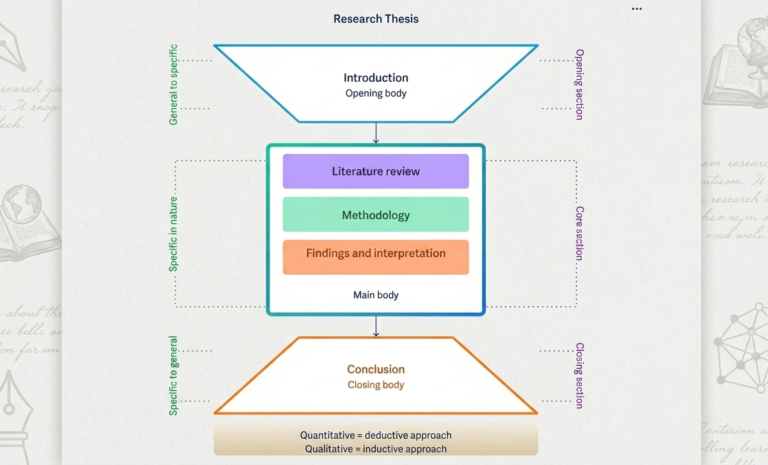
Title Page
The initial page of the document comprises the dissertation title, the candidate’s name, department, institution, degree program, and submission date. Some institutional formats also require the name of the supervisor, the student’s registration number, and a declaration that the work is original.
The title should be precise, informative, and free of unnecessary jargon — it is the first element indexed by academic databases and must accurately reflect the scope and focus of the study.
Declaration
The declaration is a signed statement by the candidate affirming that the work submitted is their own original research, that it has not been submitted previously for any other degree or qualification, and that all sources have been properly acknowledged.
Most universities require this page immediately after the title page. Without it, the thesis is considered incomplete for formal submission.
Acknowledgment
The acknowledgments section is dedicated to expressing gratitude toward individuals and institutions that provided assistance, guidance, or support during the research journey including supervisors, funding bodies, participants, and family members. While the tone may be personal, it should remain professional. Acknowledgments are typically limited to one page.
Table of Contents
The table of contents lists all chapters, sections, and sub-sections of the thesis with their corresponding page numbers. It must be generated after the final draft is complete to ensure page numbers are accurate. In a well-structured thesis, the table of contents itself provides a logical outline of the argument and the research design.
List of Tables and Figures
This component is a standard requirement in most institutional thesis formats. A separate list of all tables, charts, graphs, maps, and figures with their titles and page numbers must be provided after the table of contents. This enables readers and examiners to locate specific visual data quickly.
List of Abbreviations
A glossary of all abbreviations, acronyms, and specialized terms used in the thesis must be provided. This is particularly important in multidisciplinary or policy-oriented research where technical shorthand may not be universally familiar to all readers.
Abstract
An abstract is a brief, self-contained summary of the thesis that provides the reader with a concise and comprehensive understanding of the study’s purpose, methodology, findings, and conclusions. It functions as a shorter, standalone version of the entire document and is placed at the beginning of the thesis, though it is written after the research is complete.
It typically begins with a brief description of the topic, followed by the research objectives, methodology, key findings, and concluding remarks. For master’s and doctoral theses, abstracts generally range from 300 to 500 words, though the exact requirement varies by institution and degree level.
The abstract must be written with care because it is independently indexed in academic databases and often serves as the sole basis on which other scholars decide whether to access the full document.
Chapter 1 – Introduction
The introduction should be broad in nature, covering all relevant aspects of the selected topic arranged logically. It moves from a general orientation to a specific articulation of the research problem. The length of the introduction is typically 10 to 15 pages for a master’s thesis, though this varies by degree level and institutional requirements.
The introduction must establish four things clearly for the reader: what the study is about, why it matters, what gap it addresses, and how it is structured. Every sub-section of the introduction should contribute to this purpose.
1.1 Overview
The overview introduces and defines the selected topic in an engaging and informative manner. It is not restricted to parenthetical citation style the researcher may use both parenthetical and narrative citation formats as appropriate, in accordance with the prescribed style guide of the institution or supervisor.
The introduction should open with a thought-provoking statement, a compelling statistic, or a surprising fact that captures the reader’s attention and immediately establishes the relevance of the topic. The researcher should relate the topic to broader social, political, or academic issues. Relevant sub-dimensions of the topic such as types, causes, contributing factors, or contextual roles may be discussed under numbered sub-headings (1.1.1, 1.1.2, 1.1.3, etc.).
1.2 Background of the Study
The background of the study describes the historical context and the broader environment of the selected topic, relating it to past events, policy developments, or legislative frameworks relevant to the research problem. Identifying major prior studies and their findings at this stage helps expose significant gaps in existing knowledge that the present study aims to address.
The background should be distinguished clearly from the literature review: the background provides a macro-level historical narrative explaining how and why the problem emerged; the literature review critically evaluates specific prior academic studies. Conflating the two weakens both sections and is a common structural weakness in submitted theses.
1.3 Objectives of the Study

Research objectives specify what the study aims to achieve. They are derived from the gaps identified in the literature and must be directly aligned with the research questions and the overall research problem. Objective statements should be concise and clear.
They must begin with precise, measurable action verbs such as: to examine, to investigate, to assess, to analyze, to explore, to compare, to determine, or to identify. Vague verbs such as “to know” and “to find out” lack academic precision and are inappropriate in formal scholarly writing.
Objectives should follow the SMART framework i.e. Specific, Measurable, Achievable, Relevant, and Time-bound and should generally not exceed five in number.
1.4 Research Questions
Research questions are interrogative statements that the researcher must address through the study. They are directly linked to the research objectives, each objective typically corresponds to one or more research questions and together they function as the guiding framework of the research.
Research questions should be clear, concise, and directly relevant to the study problem. They may use interrogative forms such as what, why, how, to what extent, and in what ways. Research questions should be neither too broad (making them unanswerable within the study’s scope) nor too narrow (making them trivial).
In quantitative research, research questions are typically accompanied by hypotheses. In qualitative research, open-ended research questions replace hypotheses, as the aim is to explore meaning, experience, and context rather than to test predetermined predictions.
1.5 Hypothesis of the Study
A hypothesis is a formal, testable statement that predicts a specific relationship between an independent variable (the presumed cause or predictor) and a dependent variable (the presumed effect or outcome). Example: “Poverty negatively influences school attendance among children in rural areas” here poverty is the independent variable and school attendance is the dependent variable.
Hypotheses are formally expressed in two complementary forms: the null hypothesis (H₀), which asserts that there is no statistically significant relationship or difference between the variables under investigation, and the alternative hypothesis (H₁), which asserts that such a relationship or difference does exist.
It is H₀ that is subjected to statistical testing. A null hypothesis is not simply a “disproved hypothesis”, it is the default position of no effect that the researcher attempts to refute through empirical evidence. If statistical evidence is sufficient to reject H₀, then H₁ is supported.
Hypotheses may be directional (predicting the direction of a relationship, e.g., “higher poverty leads to lower school attendance”) or non-directional (predicting that a relationship exists without specifying its direction).
Each variable used in a hypothesis must be operationalized that is, the researcher must clearly define how it will be measured or observed in the study. Hypothesis testing is a feature of quantitative research; in qualitative studies, research questions guide the inquiry instead.
1.6 Statement of the Problem
The statement of the problem is a justified articulation of the research issue. The researcher must describe the current scenario of the selected issue and logically explain why it warrants investigation. It should clearly define the problem, identify the gap in existing knowledge, and justify why the study is significant and worthy of being conducted.
The topic must be logically related to social issues or problems in society. A well-constructed problem statement follows a funnel structure moving from the broad context of the issue, through evidence of its scale and impact, to the specific gap the research will address. It must demonstrate that the problem is real, consequential, and insufficiently addressed by prior research.
1.7 Rationale of the Study
The rationale articulates the overall situation of the research problem, including the prevailing gaps in existing scholarship, and justifies why the study is necessary at this time. The researcher must clearly mention the problem being addressed, explain its impacts on society and the relevant field, and justify how the study will contribute to knowledge.
While the statement of the problem identifies what the problem is, the rationale explains why it is worth investigating now it makes the intellectual, social, and practical case for undertaking the research. A strong rationale demonstrates that the study is timely, original, and consequential for the field.
1.8 Significance of the Study
The significance of the study explains how the research will be beneficial and for whom. The researcher must explain the importance of the research and its potential impacts on individuals, practitioners, policymakers, and wider society. This should be argued logically and supported with citations.
Significance should be articulated along two distinct dimensions: theoretical significance (how the study advances academic knowledge, fills a gap in the literature, refines an existing theory, or proposes a new conceptual framework) and practical or policy significance (how the findings can be applied by practitioners, institutions, or policymakers to address real-world problems). Addressing only one dimension, or conflating the two, weakens the scholarly justification of the study.
1.9 Limitations / Delimitations of the Study

The researcher must indicate both the limitations and delimitations of the study. Limitations are the factors beyond the researcher’s control that may affect the scope, accuracy, or generalizability of the findings such as restricted access to data, time constraints, small sample size, or reliance on self-reported data.
Delimitations are the boundaries that the researcher consciously sets for the study such as a specific geographic area, time period, age group, or thematic focus representing deliberate choices about what will not be included. The reasons for both must be clearly discussed and justified.
Acknowledging limitations and delimitations is not a weakness, it is a mark of scholarly integrity. Examiners and reviewers expect a candid and reflective discussion of the study’s boundaries.
For example, a limitation might be: “Due to access constraints, the study was restricted to a sample of 120 respondents from two districts, which limits the generalizability of findings to the wider provincial population.” A delimitation might be: “The study is delimited to female respondents aged 18–35 residing in urban areas of Punjab, as the research specifically examines urban female experiences of marital conflict.”
1.10 Structure of the Study
At the end of Chapter 1, the researcher must describe the overall structure of the thesis, how many chapters are included and what each chapter covers. Each chapter should be described in a separate paragraph, specifying its key sections and their purpose within the overall research design.
This section is sometimes referred to as the “organization of the study” or “chapter outline.” It serves as a roadmap for the reader, making the logic and sequence of the entire document transparent. A typical structure might read: “Chapter 2 presents a thematic review of the relevant literature and develops the conceptual framework guiding the study.
Chapter 3 describes the research methodology, including the research design, sampling strategy, data collection instruments, and analytical procedures. Chapter 4 presents the findings and discussion. Chapter 5 synthesizes the conclusions, offers recommendations, and identifies directions for future research.”
Chapter 2 – Review of Literature
The literature review is a critical and logical evaluation of past studies directly relevant to the research topic. It involves synthesizing an overview of each relevant work drawn from books, peer-reviewed journal articles, reports, theses, and credible institutional sources organized in coherent thematic paragraphs under subheadings that correspond to the primary themes identified in the literature.
The subheadings must be concise, accurately represent the theme they address, and follow a coherent logical sequence. Under each sub-section, the researcher documents major findings related to the theme, highlights agreements and contradictions across studies, and identifies gaps and unresolved issues.
A literature review is not merely a descriptive catalogue of prior studies. It must be analytical and critical demonstrating how the body of existing knowledge leads logically to the gap the current study addresses. Each study reviewed should be evaluated for its methodological strengths and weaknesses, theoretical contributions, and contextual relevance.
The literature review should build a coherent cumulative argument that culminates in a clearly articulated justification for the present study. The theoretical background is also a required part of Chapter 2, involving the identification and discussion of the theory or theories relevant to the research problem. A distinction must be drawn between the theoretical framework and the conceptual framework.
The theoretical framework refers to the established theory or theories from the existing literature that the study draws upon to explain the phenomenon under investigation. For example, Social Learning Theory, Structuration Theory, or Capital Theory. The conceptual framework, by contrast, is a researcher-constructed visual or narrative model that maps the specific variables, concepts, and their hypothesized relationships as they apply to the present study.
Both must be explicitly articulated and justified. Presenting a conceptual framework diagram showing the relationships between independent variables, mediating/moderating variables, and the dependent variable is standard practice in quantitative theses and increasingly expected in mixed-method work.
Citations in the literature review are usually written in narrative style (author name as part of the sentence), though parenthetical style (reference in parentheses after the statement) may also be used to present supporting evidence. Researchers should use a consistent citation style throughout and draw sources from recent, peer-reviewed, and credible academic databases such as Google Scholar, Scopus, JSTOR, Web of Science, or PubMed.
Sources should generally be no more than 10–15 years old unless foundational or seminal works are being cited. Over-reliance on textbooks, non-peer-reviewed websites, or sources lacking DOIs is a common weakness identified during thesis examination.
Chapter 3 – Research Methodology
The methodology chapter explains the systematic plan for conducting the research. It is written in headings and sub-headings in a thesis. The researcher must explain the nature of the study (qualitative, quantitative, or mixed-method), the geographical area and individuals or groups selected for data collection, the sampling technique, the tools of data collection, and the data analysis techniques and procedures.
This chapter depends entirely on the nature of the study and the type of data collection i.e. primary or secondary. The methodology chapter must address the following components explicitly:
Research Paradigm
The philosophical underpinning of the study; positivist (objective, value-free measurement of reality), interpretivist (subjective, meaning-based understanding of social phenomena), or critical (oriented toward exposing and transforming power relations). The paradigm chosen must be explicitly stated and justified, as it determines the entire methodological approach of the study.
Research Design
The overall strategy structuring how data will be collected, analyzed, and interpreted such as survey design, case study, experimental, correlational, phenomenological, ethnographic, or grounded theory. The research design must be justified in relation to the research questions and objectives.
Population and Sampling
The target population must be clearly defined. The sampling technique must be specified and justified; probability sampling methods (simple random, stratified, systematic, cluster) are used when generalizability is required; non-probability methods (purposive, snowball, convenience, quota) are used in qualitative or exploratory studies.
The sample size must be justified, and for quantitative studies the basis of sample size determination (e.g., Yamane’s formula, power analysis) should be stated.
Data collection Instrument
The specific tool used such as questionnaire, interview schedule, interview guide, observation checklist, or focus group discussion guide must be identified and justified. The instrument’s validity (the degree to which it measures what it intends to measure) and reliability (the consistency of results across repeated applications) must be addressed. Pilot testing of the instrument should be reported, including any modifications made as a result.
Ethical Considerations
The researcher must address: informed consent (participants must voluntarily agree to participate with full knowledge of the study’s purpose), confidentiality and anonymity (participants’ identities and responses must be protected), the right to withdraw (participants may exit the study at any time without penalty), and compliance with the institutional ethical review board (ERB/IRB) requirements.
Without ethical approval documentation, many universities will not accept a thesis for examination. The conceptual framework is more appropriately presented and developed in Chapter 2 (Review of Literature), where it emerges from the theoretical and empirical literature.
In Chapter 3, the conceptual framework may be referenced and operationalized explaining how each concept or variable is measured but it should not be introduced for the first time in the methodology chapter.
Chapter 4 – Results and Discussions
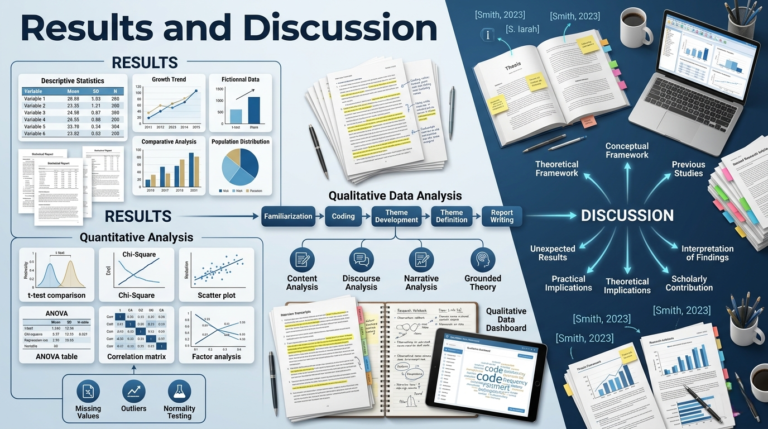
In quantitative studies, all collected data are presented in tables, charts, or figures and interpreted in relation to the obtained statistical results. This section provides the explanations of applied statistical tests, giving the reader a clear understanding of the findings.
Commonly used inferential tests in social science research include the T-test (comparing means between two groups), Chi-square (examining relationships between categorical variables), and Regression analysis (predicting a dependent variable from one or more independent variables).
Additional tests widely used in social science theses include ANOVA (Analysis of Variance, used to compare means across three or more groups), Pearson or Spearman correlation (measuring the strength and direction of relationships between variables), and factor analysis (used to identify underlying constructs in scale-based data).
Before applying inferential tests, data must be screened for missing values, outliers, and normality assumptions. It is incorrect to state that “there is no specific procedure for analyzing qualitative data.” Qualitative data analysis follows well-established systematic procedures that must be explicitly adopted and justified.
The most widely used method is thematic analysis, which involves six phases: familiarization with the data, generation of initial codes, searching for themes, reviewing themes, defining and naming themes, and producing the report.
Other established qualitative analysis approaches include content analysis (systematic categorization of textual or visual content), discourse analysis (examining language use, power, and ideology), narrative analysis (interpreting personal stories and lived experiences), and grounded theory analysis (building theory inductively from the data through open, axial, and selective coding).
The chosen method of qualitative analysis must be explicitly named, described, and justified in the methodology chapter. The discussion section whether integrated with results or presented separately must do more than restate findings.
It should interpret the findings in light of the theoretical and conceptual framework, compare them with prior studies reviewed in Chapter 2, explain unexpected or contradictory results, articulate the theoretical and practical implications of the findings, and acknowledge the study’s limitations.
This is the section that most directly demonstrates the researcher’s analytical depth and scholarly contribution. In competitive peer review and thesis examination, a weak discussion section is the most frequently cited reason for major revisions.
Chapter 5 – Conclusion and Recommendations
5.1 Conclusion
The conclusion provides a synthesis of the study’s key findings in direct relation to the research questions, objectives, and the original research problem. Each research question may be addressed in a separate paragraph to demonstrate clearly how the study has answered what it set out to investigate.
The conclusion is not merely a summary or repetition of findings already stated in Chapter 4. It must demonstrate what the study has contributed to knowledge — answering the fundamental scholarly question: what do we now know that we did not know before this study was conducted? It should also briefly restate the theoretical and practical significance of the study’s outcomes.
5.2 Key Findings
This section presents the principal findings of the study obtained through the research instrument and analytical procedures. Findings may be discussed from the viewpoint of their contribution to theoretical knowledge, their alignment or divergence with prior literature, or their practical significance.
They may be presented in flowing prose or in clearly labeled points. Key findings should be stated precisely and linked back to the specific research objectives and questions formulated in Chapter 1. Vague or overly generalized statements of findings weaken the scholarly contribution of the thesis and make it difficult for examiners to assess whether the objectives have been achieved.
5.3 Recommendations
Recommendations are directed to relevant stakeholders such as policymakers, practitioners, institutions, or communities on the basis of the research findings. Recommendations must be specific, actionable, and directly derived from the data.
Generic recommendations that are not grounded in the findings of the study (e.g., “the government should improve education”) are academically unacceptable. Each recommendation should identify who should act, what action is required, and why the evidence supports that action.
5.4 Future Research Directions
After conducting the study, the researcher is positioned to identify gaps, unresolved questions, and areas that require further investigation. These should be explicitly noted as directions for future research. Future research directions should be specific and grounded in the limitations and findings of the current study not generic suggestions.
They may include: replication of the study in different geographical or demographic contexts, investigation of variables not included in the current study, application of different methodological approaches to the same problem, or longitudinal follow-up of the phenomena studied.
Appendixes
All supporting material for data collection and presentation is attached in the appendices including the questionnaire or interview schedule, any permission or ethical approval letters obtained from relevant authorities, sampling frames or lists used for data collection, maps, consent forms, and any other supplementary documents.
Each appendix must be labeled (Appendix A, Appendix B, etc.), given a descriptive title, and cross-referenced at the appropriate point in the main body of the thesis. The appendices do not count toward the word limit in most institutional guidelines.
References
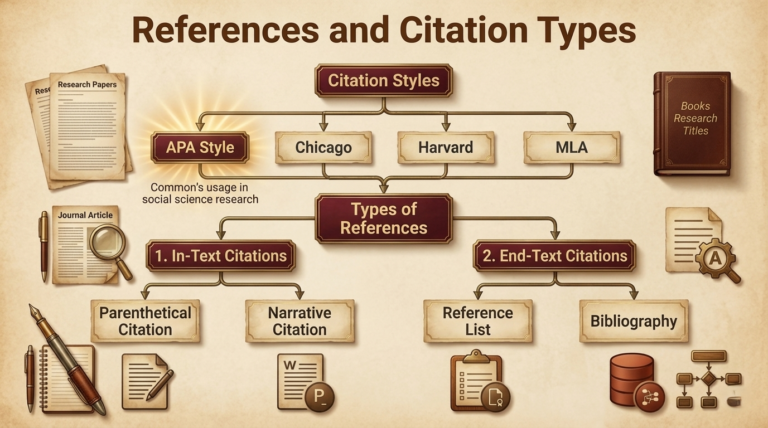
A reference list includes the full bibliographic details of all sources cited within the thesis, arranged alphabetically by the author’s last name. The APA (American Psychological Association) style is widely adopted in social science research in Pakistan and internationally.
However, researchers must always comply with the specific citation style required by their institution or supervisor whether APA, Chicago, MLA, or Harvard as requirements vary. In a book or report reference, the title of the work is italicized; in a journal article reference, the name of the journal is italicized.
Under APA 7th edition, the current standard the following rules apply: author names are written as last name followed by initials only (not full first name); article titles use sentence case (only the first word, the first word after a colon, and proper nouns are capitalized).
The volume number is italicized and the issue number follows in parentheses without italics; and a DOI (Digital Object Identifier) or stable URL must be included for all journal articles where available. The DOI is a mandatory requirement in APA 7th edition and is frequently omitted in error.
Researchers are strongly advised to use reference management software such as Zotero, Mendeley, or EndNote to maintain citation accuracy and consistency throughout a thesis of this length. Manual citation management across a full dissertation substantially increases the risk of formatting errors, omissions, and inconsistencies all of which are identified and penalized during formal examination.