
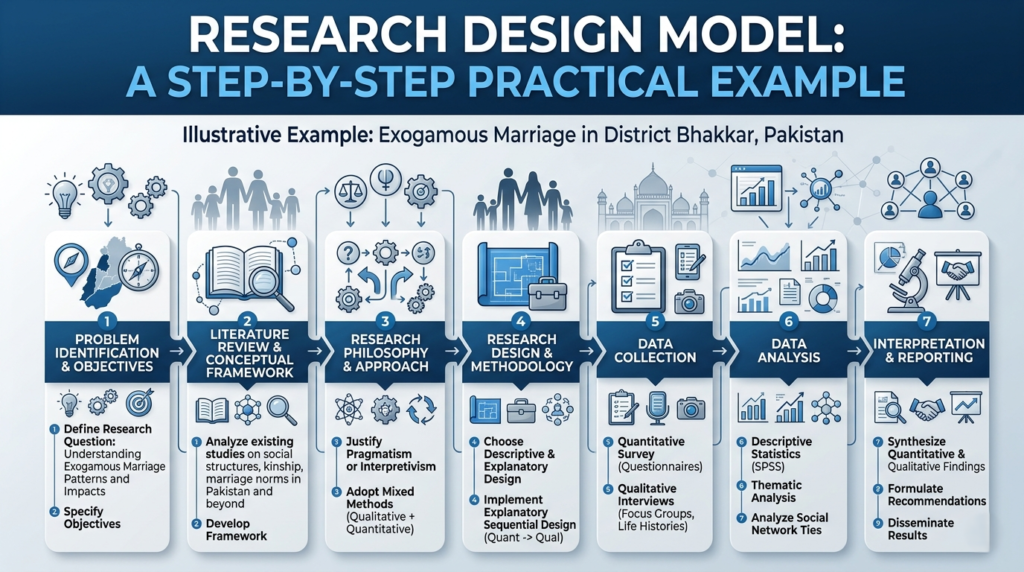
Research design is the backbone of any scientific study, providing a structured framework for collecting and analyzing data. This research design model demonstrates the step-by-step application of its core principles, using the topic of exogamous marriage in District Bhakkar, Pakistan as a practical illustrative example.
Step 1: Selection of a Research Problem
Marriage is a fundamental social institution that reflects the cultural, economic, and psychological fabric of any society. In Pakistani society, marriage patterns have traditionally been governed by endogamy the practice of marrying within one’s kinship group, biradari (patrilineal clan/brotherhood), or caste.
However, evolving social dynamics, particularly the expansion of higher education, are gradually reshaping these patterns. Exogamous marriage is the practice of contracting marriage outside one’s kinship group, clan, or caste is increasingly being observed among educated families in various districts of Punjab, including District Bhakkar.
- Research Topic: “Trend towards exogamous marriage in the educated families of District Bhakkar, Pakistan”.
- Purpose of the Study: The main purpose of this study was to examine and understand the socio-economic and psychological trends towards exogamous marriage in the educated families of District Bhakkar, and to assess how dissatisfaction with endogamy contributes to this shift.
- Scope: This study was limited to the socio-economic and psychological causes of exogamous marriage among educated families of District Bhakkar. It does not represent the broader rural or uneducated population of the district and is confined to families in which at least one spouse holds a minimum of a Bachelor’s degree.
Conceptual and Operational Definitions
- Exogamous Marriage: Marriage contracted outside one’s kinship group, brotherhood (biradari), tribe, or caste as defined by cultural and social norms.
- Endogamous Marriage: Marriage contracted within one’s defined kinship group, brotherhood (biradari), or caste the historically dominant form of marriage in Pakistan, including cousin (consanguineous) marriage.
- Educated Families (Operational Definition): For the purposes of this study, an educated family is one in which at least one spouse holds a minimum of a Bachelor’s degree from a recognized institution.
- Trend (Operational Definition): A measurable directional change in marriage preferences and practices observed among respondents, assessed through their self-reported attitudes, experiences, and perceptions.
Step 2: Review of the Literature

The literature review, a critical element of research design, directs the development of objectives and hypotheses, identifies gaps, and positions the current study in the context of the body of existing knowledge. The selected topic was thoroughly reviewed in relation to peer-reviewed journal articles, sociological literature, government census data, and credible academic websites.
Academics have conducted a comprehensive examination of Pakistani marriage trends. Pakistan is acknowledged for having one of the highest prevalence rates of consanguineous (endogamous) marriage in the world, with estimates spanning from 50 to 70 percent across the country (Shami et al., 1994; Bittles, 2012). Endogamy, notably first-cousin marriage, is maintained in Pakistani society to preserve family unity, combine resources, and strengthen brotherhood (biradari) ties.
The progressive alteration of these tendencies has been increasingly observed by researchers. Hussain (2009) discovered that the increase in urbanization and education in Punjab was associated with a decrease in cousin marriages among newer generations. Charsley (2006) posits that educated women, in particular, exhibit a greater degree of autonomy when selecting a companion, frequently opting for exogamous partnerships that provide a wider social network and less familial influence.
Sathar and Kazi (2000) establish a positive correlation between women’s education and their autonomy in making marital decisions in Pakistan, positing that higher education serves as a catalyst for attitudes toward exogamy. Weiss (2012) posits that Pakistani adolescents are exposed to a diverse array of social situations as a result of professional networking, globalized ideas, and intercity mobility for higher education. This exposure reduces the social pressure to marry within the brotherhood (biradari).
According to numerous studies (Bittles & Black, 2010), endogamy is associated with an increased prevalence of autosomal recessive genetic disorders in the progeny of consanguineous unions. The increasing awareness of these health issues among educated populations justifies the trend toward exogamous marriage.
There is a scarcity of literature, particularly regarding the Bhakkar region, in spite of this information gathering. The absence of localized research necessitates the current investigation. The literature review had an impact on the design of the data collection method, the study’s objectives, and its assumptions.
Note: The in-text citations presented in this section are dummy.
Step 3: Objectives of the Study
- To identify and examine the socio-economic reasons behind the trend of exogamous marriage in educated families of District Bhakkar.
- To study the psychological reasons and motivations for preferring exogamous marriage.
- To examine the perceived negative consequences of endogamous marriage that motivate educated families toward exogamous unions.
- To investigate the impact of education and social mobility on the population’s perspectives on exogamy.
- To evaluate the variations in the perspectives of male and female participants regarding exogamous marriage based on their gender.
Step 4: Theoretical Framework
A theoretical framework offers a conceptual perspective for evaluating and comprehending the subject matter of the study. This work is underpinned by the subsequent theoretical perspectives:
- Social Exchange Theory (Blau, 1964; Homans, 1958): This theory posits that individuals select their spouses based on the perceived advantages and disadvantages of the available alternatives. In accordance with this theory, educated families may opt for exogamous marriages over endogamous unions due to the former’s potential for greater economic stability, larger social networks, emotional compatibility, and fewer family conflicts.
- Modernization Theory (Parsons, 1951; Inkeles & Smith, 1974): Modernization theory holds that industrialization, urbanization, and education progressively erode traditional social structures including kinship-based marriage norms and promote more individualistic and rational forms of social behavior, including exogamous mate selection.
- Theory of Planned Behavior (Ajzen, 1991): This theory asserts that behavioral intentions such as the decision to marry outside one’s biradari are shaped by three factors: individual attitudes toward the behavior, subjective social norms, and perceived behavioral control. Higher education is expected to positively influence all three factors in favor of exogamy.
Step 5: Hypothesis of the Study
- H₁: The higher the perceived economic benefits of exogamous marriage, the greater the trend towards exogamous marriage among educated families of District Bhakkar.
- H₂: The more pronounced the perceived negative effects of endogamy, the higher the trend towards exogamous marriage.
- H₃: Higher levels of education are positively associated with more favorable attitudes toward exogamous marriage.
- H₄: Female respondents show a stronger preference for exogamous marriage compared to male respondents.
Null Hypotheses
- H₀₁: There is no significant relationship between perceived economic benefits and the trend toward exogamous marriage.
- H₀₂: There is no significant relationship between the perceived negative effects of endogamy and the trend toward exogamous marriage.
Step 6: Research Methodology
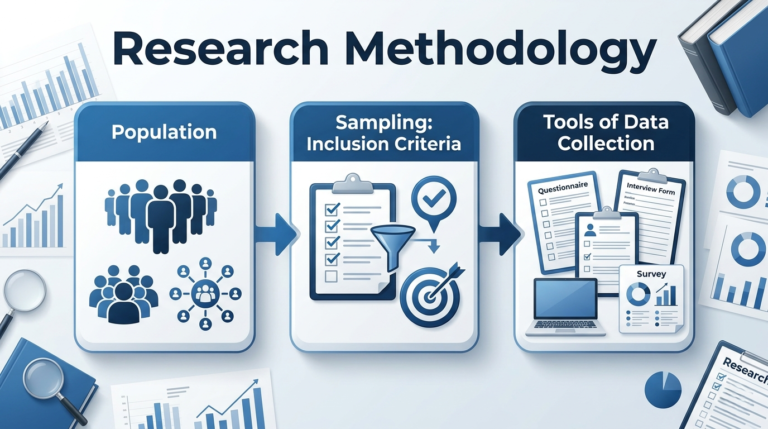
Every social researcher implements and follows a specific and systematic procedure of study. In this research, a quantitative research methodology was employed. Specifically, a cross-sectional correlational survey design was adopted, in which data were collected at a single point in time from a predefined sample population in order to examine relationships between variables.
Sampling
A purposive (non-probability) sampling technique was used to select respondents. The total sample comprised 80 respondents 40 male and 40 female drawn from educated families of District Bhakkar. The equal gender stratification was intentional, designed to enable gender-based comparative analysis of attitudes toward exogamy.
Inclusion Criteria
- Permanent residents of District Bhakkar.
- At least one spouse in the household holds a Bachelor’s degree or higher from a recognized institution.
- Currently married or previously married at least once.
- Age range: 20–55 years.
Tools of Data Collection
A self-structured, closed-ended questionnaire was the primary tool of data collection. The questionnaire was deemed the most appropriate instrument given the literate nature of the respondent population, as it ensures standardization across respondents, guarantees anonymity on a culturally sensitive topic, and facilitates efficient data collection within the study’s time and budget constraints.
Step 7: Constructing the Study Tool
A self-structured questionnaire was developed according to the nature and objectives of the study. Themes extracted from the literature review were used as benchmarks to formulate questions. The questionnaire was organized into the following four sections:
- Section A – Demographic Information: Age, gender, education level, occupation, monthly household income, marital status, and type of marriage (exogamous or endogamous).
- Section B – Socio-Economic Factors: Items assessing perceived economic advantages of exogamous marriage, financial independence, employment status, and economic constraints associated with endogamy.
- Section C – Psychological Factors: Items measuring individual autonomy in spouse selection, emotional compatibility preferences, fear of genetic health risks, and level of parental influence.
- Section – Effects of Endogamy: Items that assess respondents’ perceptions of the adverse consequences of endogamous marriage include health issues associated with consanguinity, social network restrictions, and family strife.
A 5-point Likert scale (1 = Strongly Disagree, 2 = Disagree, 3 = Neutral, 4 = Agree, and 5 = Strongly Agree) was employed for each attitudinal component in order to facilitate quantitative analysis.
Pre-Testing (Pilot Study)
A pilot study was conducted with 15 respondents from the same group who were excluded from the final sample to evaluate the questionnaire’s reliability, relevance, and clarity. The instrument’s reliability was evaluated using Cronbach’s Alpha coefficient; an internal consistency criterion of α = 0.70 was deemed acceptable (Nunnally, 1978). The content was evaluated by two sociology specialists to ensure its accuracy.
Subsequent to the pilot study, substantial modifications were implemented to clarify repetitive or ambiguous elements. After the questionnaire was completed, it was distributed to all 80 participants, which consisted of 40 males and 40 women.
Step 8: Ethical Considerations
The following ethical protocols were observed throughout the study:
- Informed Consent: Prior to participating in the study, each participant was apprised of its objectives. Each subject provided verbal informed consent.
- Anonymity and Confidentiality: No personally identifiable information was recorded. In order to guarantee complete respondent anonymity, questionnaires were assigned numerical identifiers.
- Sensitive Topic Management: Respondents were explicitly informed that their responses would be used solely for academic purposes, as the practice of marriage in District Bhakkar is culturally sensitive.
- Right to Withdraw: Participants were advised that they could withdraw from the study at any time without incurring any consequences.
Step 9: Data Collection and Analysis

Data were collected through personal visits to respondents’ households in District Bhakkar. After informed consent was obtained, questionnaires were distributed and collected in the same session to maximize response completeness.
After collecting the relevant data, the study progressed through the following sequential stages:
- Editing: All completed questionnaires were checked for incompleteness, inconsistencies, or errors.
- Coding: Responses were numerically coded for entry into IBM SPSS Statistics (Version 26).
- Classification and tabulation of data by variable categories.
- Statistical Analysis: The following statistical techniques were applied:
- Descriptive statistics encompass frequency distributions, percentages, averages, and standard deviations for each variable.
- The Chi-Square Test of Independence is used to investigate the presence of correlations between categorical variables, including marital type and gender.
- Pearson Correlation Analysis: To evaluate the intensity and direction of relationships between psychological and economic variables and the predisposition to exogamy (H₁ and H₂).
- Samples that are distinct t-Test: To compare the opinions of respondents on exogamous marriage between men and women (H₄).Regression analysis: To ascertain which independent variables are most effective in predicting the exogamy trend.
- Verification of Hypotheses: All hypotheses were tested at a significance level of p ≤ 0.05.
- Findings, conclusions, and recommendations.
Step 10: Limitations of the Study
The following limitations are acknowledged:
- Limited Sample Size: The sample size of 80 respondents restricts the statistical power and generalisability of the results to the broader population of District Bhakkar.
- Non-Probability Sampling: The statistical extrapolation of results from the sampled population is not feasible due to the potential for selection bias in purposeful sampling.
- Cross-Sectional Design: The inability to draw inferences about causality is a consequence of the data being collected all at once; longitudinal data would be more effective in capturing trends over time.
- Self-Report Bias: Responses to sensitive questions about marriage preferences may be influenced by social desirability, particularly in a conservative cultural context.
- Restricted Scope: The study focuses exclusively on educated families and does not account for attitudes among less educated or uneducated populations of the district.
Step 11: Time Frame and Budget
The duration of this study was three months (September 2023 to December 2023). The total estimated expenditure was PKR 17,000, distributed across the following categories:
- Printing and stationery (questionnaire reproduction): PKR 3,000
- Field transportation (household visits across District Bhakkar): PKR 7,000
- Data entry and SPSS analysis: PKR 3,000
- Miscellaneous expenses: PKR 4,000
- Total: PKR 17,000