
Research Process
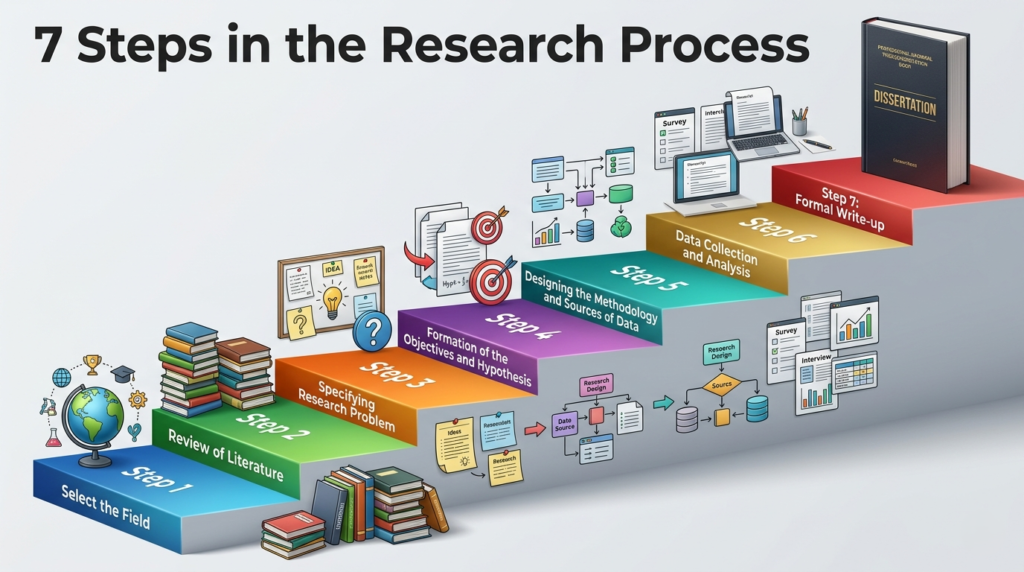
The steps of research process refer to the stages of conducting research. It involves the following steps:
- Select the field
- Review of literature
- Specifying Research Problem
- Formation of the objectives and hypothesis
- Designing the Methodology and Sources of Data
- Data collection and analysis
- Formal write-up
Step-1. Selection of the Field
The first step in the research process is identifying a broad problem area. This first step is crucial and should be framed as a problem statement rather than as a question. The field should be selected on the basis of interest. This process often involves a problem that needs a solution.
It begins with keen observation, curiosity to know, and a desire to sort out. Researchers might draw inspiration from personal experiences, social challenges, or discrepancies in prior findings.
At this stage, the researcher should also determine the nature and purpose of the research. Research may be classified as pure (basic) research, which aims to generate new theoretical knowledge, or applied research, which seeks to solve a specific practical problem.
Additionally, the researcher should consider the underlying research paradigm i.e. positivist (objective, measurable reality), interpretivist (subjective, meaning-based), or critical (aimed at social transformation) as this will shape the entire methodology of the study.
Step-2. Review of Literature
The literature review is concerned with reviewing the existing literature on particular fields. It gives us a view of previous studies in that area. Also, it reveals those areas which need to be addressed and which have already been discussed.
It provides deep information regarding your topic. A literature review is considered the most integral part of the research process because it reveals a gap in knowledge, a variation in current research, or a practical problem that needs a solution.
Literature can be drawn from primary sources (original research articles, theses, official reports) and secondary sources (textbooks, review articles, encyclopedias). Researchers should use reputable academic databases such as Google Scholar, JSTOR, PubMed, and Scopus to retrieve relevant material.
The review may be narrative (broad, integrative) or systematic (structured, criterion-based). A key outcome of the literature review is the development of a conceptual or theoretical framework; a structured set of concepts and relationships that guides the research design and interpretation of findings.
Step-3. Specifying Research Problem
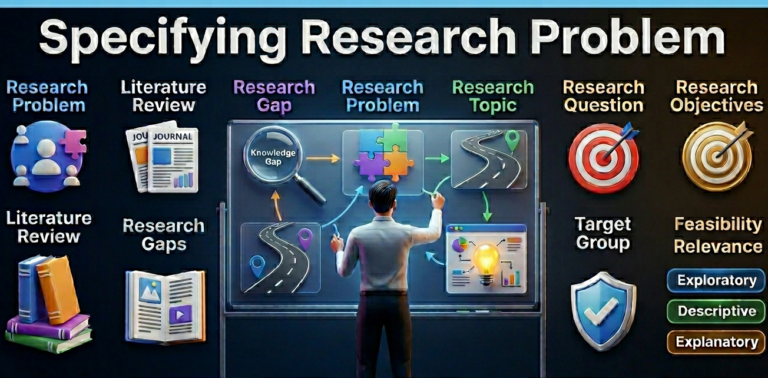
In any research, you must define your problem and note the dimensions of the issue, the target group affected, the political context, and the anticipated outcomes. A problem that a researcher may need to justify in his research. So that it may be clear why the researcher takes this problem to investigate, what the motivations are, why it is necessary to be researched, and how the research is fruitful for society.
It is formulated with the help of a literature review that identifies key concepts, terms, scope of study, research questions, and objectives. Through a precise definition of the problem, researchers develop a strong basis for the entire research process, ensuring that the research is focused and reachable. It should be attractive and shocking for the reader.
Decide whether your research is exploratory, descriptive, or explanatory. The topic should be short and clear. It is important to distinguish between a research problem (the broader issue to be investigated), a research topic (the focused subject area derived from the problem), and a research question (the specific interrogative statement guiding the inquiry). A well-formulated research problem must arise from a demonstrated gap in existing knowledge.
Also, remember that your topic must be relevant, researchable, feasible, attractive, concise (meaning the scope should be manageable within the available time and resources not open-ended or excessively broad), and ethical.
Selection Criteria for a Topic
Criteria to consider when selecting a topic:
- Availability of literature — sufficient prior work must exist to support a literature review
- Availability of respondents — the target population must be accessible for data collection
- Scope or benefits for society — the research must offer practical or theoretical value
- Experience of the researcher — the researcher should have adequate background knowledge in the selected area
- Availability of resources — including sufficient time frame and financial support
Example: Topic Statement: “Effects of Marital Infidelity on Spouse”
Step-4. Formations of Objectives and Hypothesis
The next step in the research process is to develop research objectives. Any research has some objectives, and it proceeds to achieve them. So, objectives should be clear and have relevance to what you want to find and the gaps revealed through the literature review. These objectives basically guide the directions of the study.
Objectives are commonly written using action verbs such as “to explore,” “to examine,” “to assess,” “to compare,” or “to identify.” They should be SMART; Specific, Measurable, Achievable, Relevant, and Time-bound. The objectives should not be more than five.
Example:
- To find out the socioeconomic effects of infidelity on spouses.
- To investigate the psychological effects of infidelity on spouses.
- To suggest measures for mitigating marital infidelity.
Development of the Hypothesis
A hypothesis is a tentative, testable statement that predicts a relationship between two or more variables specifically, between an independent variable (the presumed cause) and a dependent variable (the presumed effect). Example: “People do not send their children to school due to poverty” here, poverty (independent variable) is predicted to influence school non-attendance (dependent variable).
Hypotheses are formally expressed in two forms: the null hypothesis (H₀), which states that there is no significant relationship or difference between variables, and the alternative hypothesis (H₁), which proposes that a significant relationship or difference does exist.
It is the null hypothesis (H₀) that is statistically tested during data analysis. It is never simply a “disproved hypothesis,” but rather a formal statement of no effect that the researcher attempts to reject through empirical evidence.
Hypotheses can also be directional (predicting the direction of a relationship, e.g., “greater poverty leads to lower school attendance”) or non-directional (predicting a relationship exists without specifying its direction).
It is important to note that hypothesis formulation is primarily applicable to quantitative research. In qualitative research, researchers instead use research questions to guide the inquiry, as qualitative studies explore meaning and experience rather than test predetermined predictions.
The hypothesis should be developed according to the research questions and objectives of the study, and only those variables that are practically testable should be included.
Example:
- H₁: There is a significant relationship between marital infidelity and divorce.
- H₁: Higher levels of marital infidelity are associated with greater emotional distress among spouses.
Step-5. Designing the Methodology and Sources of Data
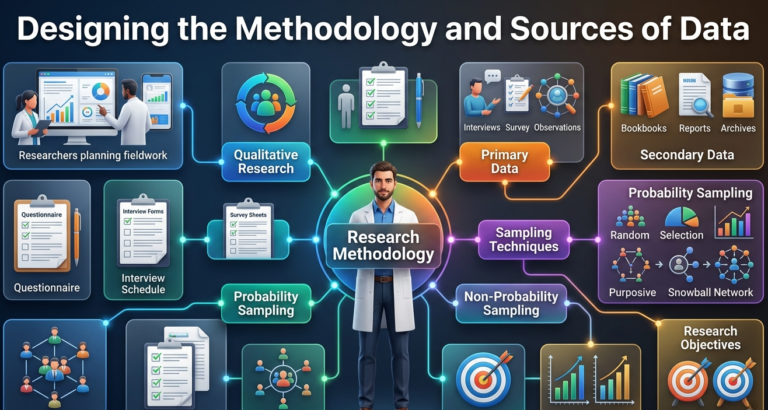
At this stage, research methods are identified, including the determination of human and geographical research, sampling techniques, sources of data collection, and nature of research method, i.e., qualitative or quantitative.
Qualitative research seeks to understand meaning, experience, and social phenomena in depth through non-numerical data, while quantitative research measures variables numerically to identify patterns, relationships, or causal effects.
Data sources are classified as primary data (collected directly by the researcher for the current study through instruments such as questionnaires, interviews, or observations) and secondary data (already existing data from sources such as census records, government reports, published statistics, or prior research). The researcher must justify which type is appropriate for the study objectives.
Sampling techniques must be clearly specified. Probability sampling methods (simple random, stratified, systematic, cluster) ensure that every member of the population has a known chance of selection and allow for generalization. Non-probability sampling methods (purposive, snowball, convenience, quota) are used when a random sample is not feasible, particularly in qualitative research.
This step requires a lot of care to identify all valid sources. In this way, a researcher anticipates all expected outcomes during field visits and makes contingency plans accordingly. This step includes the development of an instrument or tool for data collection (in the case of primary data), such as a questionnaire, interview schedule, or interview guide.
Any instrument developed must be assessed for validity (the degree to which the instrument measures what it is intended to measure) and reliability (the consistency of the instrument in producing stable results under the same conditions). The focus of the instrument is to fulfill the objectives of the study.
Step-6. Data Collection and Analysis
Pretesting
Pretesting (also called a pilot study) commonly aims to test the research instrument before going into the field for data collection. It helps to verify the tool’s clarity, identify ambiguous questions, and make improvements before the full data collection begins.
Analysis of Data
After collecting the data, it needs to be analyzed to generate findings. For quantitative analysis, different statistical software packages are used. The Statistical Package for Social Sciences (SPSS) is widely used for social science research. Other tools include R, Stata, and Microsoft Excel for statistical analysis.
ANOVA (Analysis of Variance) is a statistical test used to compare means across three or more groups. NVivo is a software package designed specifically for qualitative data analysis, not quantitative analysis. For qualitative analysis, different approaches are adopted, such as ethnographic analysis, grounded theory, and case study methodology.
Thematic analysis is one of the most widely used qualitative methods, involving the systematic identification, organization, and interpretation of patterns (themes) across a dataset. Qualitative data analysis also involves a process of coding such as assigning labels or categories to segments of text, images, or observations which is often supported by software such as NVivo or ATLAS.ti.
Interpretation of Data
After analysis, data is interpreted. It involves the explanation of applied tests, which gives the reader a clear understanding of the results obtained. Commonly used statistical tests in social science research include the T-test (comparing means between two groups), Chi-square test (examining relationships between categorical variables), and Regression analysis (predicting the value of a dependent variable from one or more independent variables).
For qualitative studies, interpretation is guided by the specific qualitative approach adopted for instance, thematic categories are interpreted in grounded theory, while cultural meanings are interpreted in ethnography.
Step-7. Formal Write-up

Formal write-up is the process of report writing following a prescribed academic format for organizing the research into a composed, publishable form. The standard structure is as follows:
- Abstract — a concise summary of approximately 150–250 words covering the research problem, methodology, key findings, and conclusions.
- Table of Contents — a structured list of all chapters, sections, and sub-sections with corresponding page numbers, enabling easy navigation through the document.
- List of Tables and Figures — a separate listing of all tables, charts, graphs, and figures included in the report, with their titles and page numbers.
- List of Abbreviations/Acronyms — a glossary of all shortened forms and technical abbreviations used throughout the document.
- Introduction — presents the background of the study, the statement of the problem, significance of the study, scope and limitations, and an overview of the report structure.
- Review of Relevant Literature — a critical synthesis of existing scholarship and the theoretical lens guiding the study.
- Research Methodology — covers research design, paradigm, population and sampling, data collection instruments, validity and reliability, and ethical considerations.
- Study Findings and Interpretations — presents analyzed data through tables, figures, and narrative explanation aligned with the research objectives.
- Discussion — interprets findings in relation to the literature review and theoretical framework, explaining agreements, contradictions, and implications.
- Conclusions and Recommendations — summarizes key findings and offers practical or policy-level suggestions based on the research outcomes.
- References — a complete list of all cited sources formatted in a standard style such as APA, MLA, Chicago, or Harvard.
- Appendices — supplementary materials such as questionnaires, interview guides, consent forms, raw data tables, or supporting documents that are too detailed for the main body.