
Marxism and Social Policy
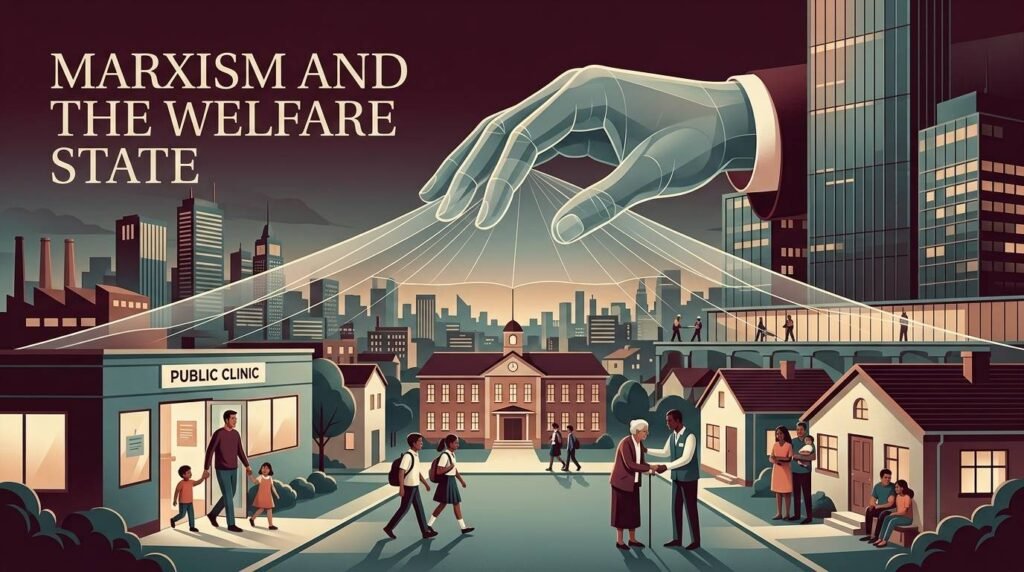
Marxism[1] or radical socialism, offers a distinct perspective on social policy and welfare programs. But this view does not see welfare as simply assistance; it analyses welfare in terms of power struggles and class conflict in capitalist society.
From this perspective, the welfare state or welfare policies may seem to benefit the public, but they are actually intended to sustain the capitalist system (Lister et al., 2024). That is:
- On many occasions, the government offers people privileges (free education, free healthcare, financial assistance, etc.), and it appears to do so out of pure compassion. In reality, however, the intention is to keep people from rebelling against the government; that is, to maintain stability in the social system.
- The Government provides temporary relief through welfare policies but does not tackle the underlying causes of injustice and class inequality.
- This approach sees welfare as a political device, which is used by the powerful classes to keep control and dominance of society.
What is the Marxist Perspective?
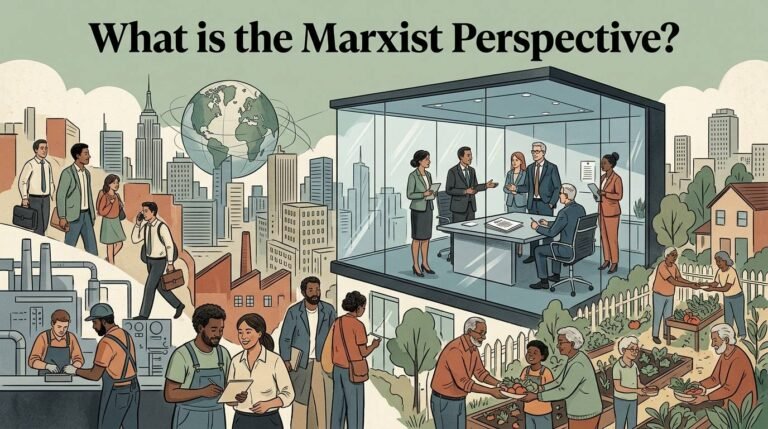
The basic premise of Marxism philosophy is a struggle between two primary classes: the bourgeoisie and the proletariat. Marxism philosophy holds that society is a field of conflict between two main classes: the bourgeoisie, who own capital (businesses), and the proletariat, who work for wages.
From this perspective, any aspect of society including welfare, social policies is dedicated to meeting the requirements of the capitalist market economy (Sewell, & Woods, 2015).
Marxism’s ultimate goal was to achieve a society free of exploitation of others’ labour. All would give and take, and get their just rewards. Radical[2] socialist[3] or egalitarian thinkers take this a step further and argue that society should strive to make things almost equal for all by shrinking differences in income, status, and wealth.
There is also socialistic socialism with a moral dimension (Ethical or Christian). This view argues that there is more than one unfairness: a moral one. They believe a more equal society fosters more robust communities, with people truly feeling connected to and caring for each other, and that is what they mean by Gemeinschaft.[4].
The Marxist analysis uses the political economy model of power. The view represented in this model is that decisions on key policies are dominated by large companies and capitalist interests. Government authorities and the civil service elite are closely intertwined with the business elite; consequently, the rich are in control.
This model is also a world model. Internationally, globalization has increased disparities between the rich and the poor and made more wealth accrue to an ever-smaller number of people. This ever-widening divide may lead to global conflict.
Materialist Critique
Radical Socialist critiques are material in that they emphasize the real, the physical, and society’s inequalities. This is a materialist critique of the differences that persist in the quality of essential services. All hospitals are not created equal. Housing does not provide equal safety and comfort. Educational opportunities in schools vary.
These differences matter because they show that, despite a welfare state, inequality remains. The Marxism on social policy focuses on power and class relationships as the principal features for understanding social policy, emphasizing that these relationships and conflicts are not random but part of the capitalist system (Pemberton, 1983).
How Welfare Controls the Working Class?
From this point of view, the welfare state and social security system are instruments of social control. These systems do not actually benefit the working class, the powerless and the weak, but keep them in place in the capitalist system.
In the 1970s and 1980s, it was noted that the working classes were calling for more ‘welfare services’ and increased social security payments. They predicted that this growing demand would create a basic crisis for capitalism, since it would be impossible to meet it and still earn a profit (Redman, 2021).
Contradictory Functions of the Capitalist State
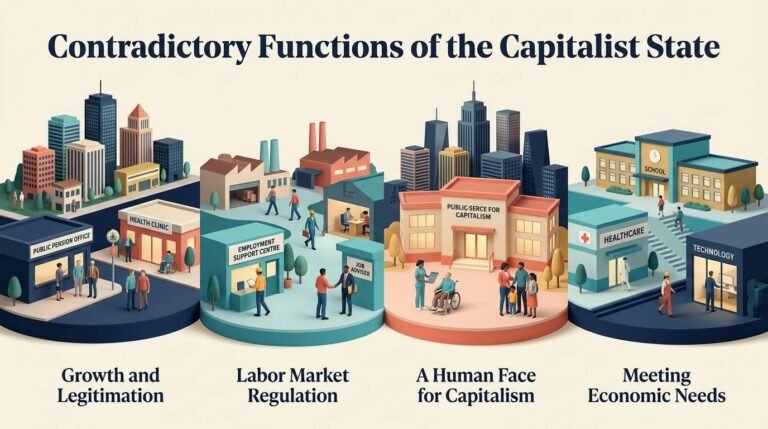
Under Marxism theory, the state has to undertake several contradictory functions:
Growth and Legitimation
Government assistance to businesses to grow and make profit. Meanwhile, it offers welfare benefits such as pensions, health care, and unemployment benefits to appear fair. These services facilitate people’s acquiescence to capitalism, although it generally benefits the rich more than ordinary workers.
At the same time, the state plays two opposing roles: enhancing profit opportunities for the capitalist class and adopting welfare measures to maintain public contentment and ensure the system runs smoothly.
Labor Market Regulation
The welfare state helps to regulate the labour market by cushioning the blow when the job market changes due to economic fluctuations and/or restructuring of businesses, thereby reducing the insecurity of the jobless. Job security buffers and counter-cyclical policies stabilize society through economic change.
A Human Face for Capitalism
Welfare programs contribute to the modulation of political crises because they give the capitalist system a more human face and more fairness. But in reality, it is only an illusion. It is unfair to blame the capitalist system on those whose wealth, power, and resources it is used to benefit.
Therefore, welfare policies make it appear “humane” and “just” to reduce public anger or rebellion, or else the system would cease to operate.
Meeting Economic Needs
The capitalist economy needs an educated and healthy workforce that’s able to adapt to new technologies. The welfare state is not primarily a place of compassion for its recipients, but a place where capitalism needs it to operate efficiently (Ponlantzas, 2017).
The Predicted Crisis That Didn’t Happen
In the 1970s and 1980s, Marxism predicted that the growing expenses of welfare services and the growing demand for welfare benefits would lead to a “fiscal crisis” in the future. This crisis could bring capitalism’s contradiction to the fore and even trigger its collapse. However, this forecast didn’t occur as expected (Wilson, 1980).
Overall social trends have undergone fundamental transformation and restructuring in the modern welfare state, not least in Britain since 1992, but this hasn’t led to the widespread social crisis Marxists predicted.
Defending the Welfare State
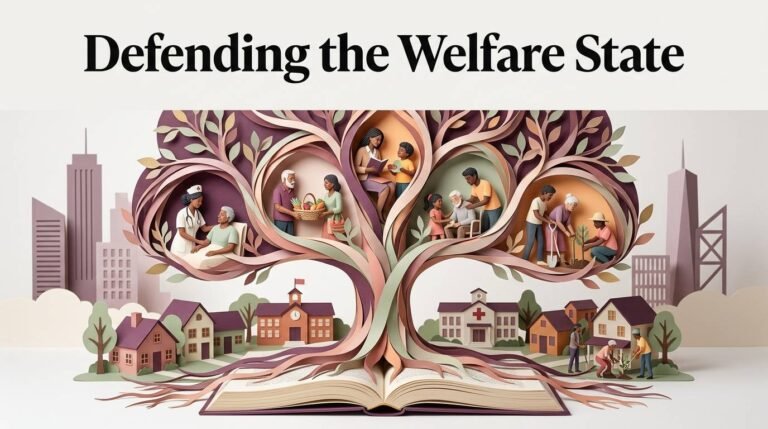
This posed an intriguing situation for the “Left-Wing” thinkers. They were aware that the welfare state has been known to cover up social injustice and to aid the capitalist system. But they still think it is worth supporting. Why? Because the welfare state is based on good moral values like helping others, caring for the community, and working together for the common good.
These values are superior to the selfish individualism which is fostered by pure capitalism. The welfare state, therefore, despite its problems and its support for capitalism, represented an important concept: society’s collective responsibility for the well-being of all its members (Benner, & Vad, 2000).
Conclusion
A Marxism or Radical Socialist analysis of welfare policies provides a new paradigm for evaluating welfare policies. It asks us to consider the deeper meaning and implications of these policies and how they help to keep power structures intact. Some forecasts were inaccurate; however, this viewpoint remains useful for examining inequality, power, and the relationship between capitalism and social welfare today. Developing these concepts not only helps us think critically about social policies but also questions whether they serve everyone’s interests or mostly benefit those already in power.
References
- Lister, R., Patrick, R., & Brown, K. (2024). Understanding theories and concepts in social policy. Policy Press.
- Sewell, R., & Woods, A. (2015). What is Marxism?: an introduction to Marxist theory. Wellred Books.
- Pemberton, A. (1983). Marxism and Social Policy: a critique of the ‘contradictions of welfare’. Journal of Social Policy, 12(3), 289-307.
- Redman, J. (2021). From welfare to warfare: class struggle on the margins (Doctoral dissertation, Sheffield Hallam University).
- Ponlantzas, N. (2017). The problem of the capitalist state. In Karl Marx (pp. 295-306). Routledge.
- Wilson, E. (1980). Marxism and the welfare state. New Left Review, 122, 15-20.
- Benner, M., & Vad, T. B. (2000). Sweden and Denmark: defending the welfare state. Welfare and work in the open economy, 2, 399-466.
[1] Marx’s Class Conflict Theory is 1848, through The Communist Manifesto, though he continued expanding on these ideas later in Das Kapital (published in 1867).
[2] Radical social work means a type of social work that focuses on challenging and changing the social and political systems that cause inequality, poverty, and injustice — rather than only helping individuals cope with their personal problems.
[3] Radical socialist are the political thinker who believes in completely transforming society to achieve full social and economic equality by removing capitalism and private ownership of wealth. A radical socialist wants major social and political change, not just small reforms.
[4] Gemeinschaft (a German word introduced by sociologist Ferdinand Tönnies) refers to a type of society based on close personal relationships, shared values, and mutual care.