

Focus Group Discussion (FGD)
“Focus Group Discussions (FGD) are a qualitative approach to gain an in-depth understanding of social issues from a group of people.” The method aims to obtain data from a purposely selected group of individuals rather than from a statistically representative sample of a broader population.
Focus groups offer a high degree of flexibility and adaptability, allowing researchers to tailor the discussion to address specific research objectives or adapt to emerging themes and ideas. The open-ended nature of focus group discussions enables researchers to explore unanticipated topics. Focus groups also encourage richer group discussions and increase meaningful interaction among participants. It is purely a qualitative approach for data collection.
A group of people who have sufficient knowledge or information is approached, and the researcher makes decisions on the selected issues and phenomenon. Sometimes, the researcher pays some amount to a trained moderator to facilitate and guide the discussion effectively.
For this purpose, locations must be secured, and the researcher should show great respect to the participants as they are usually well-informed or highly qualified in the relevant field. Television Talk shows are commonly cited on TV are the best examples of FGD in everyday life.
Types of Groups in FGD
Natural Groups
Natural groups includes several individuals who were part of a pre-existing formal or informal group, such as family or friends, colleagues, senior citizens, women’s self-support groups, neighborhoods, or educators, prior to the study.
Facilitating a focus group discussion with a natural group may uncover inconsistencies and similarities between verbal expressions and behavioral actions, along with the reactions and remarks of other participants. Given their pre-existing relationships and shared experiences, interactions within these groups are typically more open, genuine, and contextually informed.

Expert Groups
Expert groups comprise individuals with specialized, extensive expertise, knowledge and experience relevant to the research subjects. Groups such as social workers serving in specialized field, nurses, or pharmacy vendors are generally smaller than traditional focus group discussions and are employed to get extremely specialized and technically detailed information, despite potential variability in participant responses.
The specific expertise of expert group members renders their contributions exceptionally relevant for research requiring technical complexity and professional understanding.
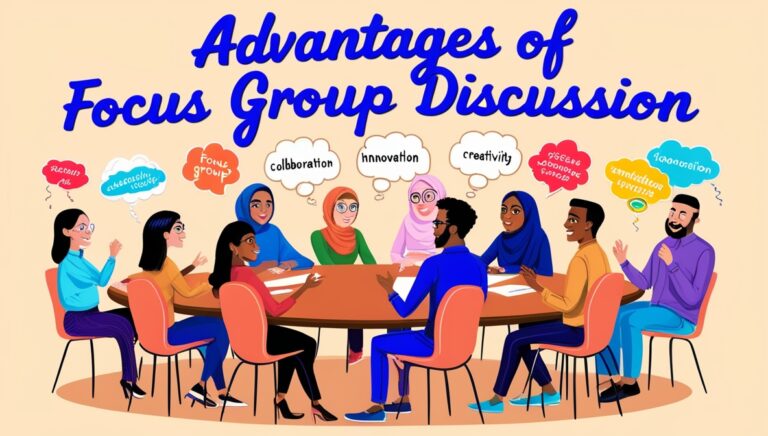
Advantages of FGD
Delivery of a Diverse Range of Responses
Focus groups offer an effective method for assessing respondents’ reactions to novel concepts. Participants in these events can offer prompt and diverse insights that may enhance the proposed ideas. This strategy assists in identifying societal problems and proposing solutions for improvement, allowing academics to gain significant insights into contemporary social concerns and challenges.
Validate Insights Acquired from Alternative Methodologies
Qualitative research methodologies can yield substantial data regarding a concept. Nevertheless, data obtained through these sources may occasionally appear impersonal or lacking validity. If the results from prior studies appear in doubt, a focus group can either validate or reject the insights acquired through alternative methods.
Upon cataloging the replies from a focus group session, researchers can either further their exploration of an idea or implement essential modifications to meet the primary issues highlighted in the discussion.
Economical Method for Acquiring Information
Focus groups can now be conducted online due to the accessibility of web conferencing tools. This benefit allows researchers to get a larger sample size, have more discussions, and assess critical issues without the limitations of alternative qualitative methodologies. Focus groups are a notably economical and accessible approach to qualitative data collection.
Facilitate Time-Saving Opportunities
A focus group offers an organized framework that facilitates the rapid collection of numerous opinions or input in a brief timeframe. The approach allows moderators to cover numerous parts of a notion without going through the time-consuming procedure of conducting multiple personalized interviews individually to acquire the same information.
Increase the Knowledge of Group Participants
Focus groups offer a distinctive method for knowledge development, as individual responses generally build upon each other. Individuals may offer their viewpoints, while the experiences of others in the group might either enhance or challenge the original idea presented.
This collaborative flow of ideas enables individuals to contemplate views and solutions they would not often have reached alone, so enhancing the overall quality of the data gathered.
Ensures Anonymity for Participants
Despite members registering for a focus group with their name and other personal details, a degree of anonymity is preserved during the discussion. As participants typically lack familiarity with one another, they are motivated to offer more open responses regarding sensitive and challenging subjects.
When moderators obtain a variety of open responses, it facilitates the examination of social, cultural or economic factors pertinent to the research topic.
Cost-Effective Method for Conducting Research
Focus groups can be expensive when conducted across diverse neighborhoods and demographics. Nevertheless, if investigators seek precise information regarding the course of their efforts, this qualitative methodology can serve as a cost-effective and efficient means of obtaining real-time feedback.
When researchers require essential information from the biggest feasible cohort within a limited timeframe, focus groups are generally a more cost-effective alternative to conventional qualitative methodologies.
Offers Rich Data
Surveys and questionnaires provide researchers with quantifiable data for the assessment of a certain concept. Focus groups facilitate collaborative brainstorming among participants to generate innovative ideas and strategies. This technique yields more comprehensive and complex feedback by incorporating various aspects of human behavior along with the varied views and experiences of the participants.
Disadvantages of FGD
- Obtaining a truly representative sample can be challenging. Focus groups are typically seen as lacking external validity because of their limited sample sizes.
- The limited sample size precludes the assurance of respondent anonymity, perhaps affecting their willingness to communicate openly.
- The depth of analysis may provide a challenge, as obtaining genuine thoughts on controversial issues can be difficult.
- There is significant potential for inaccuracy in data processing and a high likelihood of observer dependency in deriving conclusions. One must use careful to avoid selectively choosing comments that align with a predetermined conclusion.
Principles for FGD
Facilitating a focus group discussion presents significant challenges for new researchers, particularly for individuals who lack prior experience in this methodology. This section will outline strategies and methodologies designed to assist new researchers in achieving success in their focus group discussions.

Develop open-ended Questions
As previously indicated, yes/no questions are not appropriate for achieving the objectives of focus group discussions. Conversely, the implementation of open-ended questions is likely to yield advantageous outcomes.
Open-ended questions represent a category of inquiries that do not yield a definitive correct answer for respondents; rather, all responses are derived from the individual perspectives of the participants. In this context, the open-ended questions may take the form of inquiries regarding experiences, opinions, recommendations, or other subjective matters.
Avoid Inquiring about the Justification
After posing open-ended questions to elicit opinions, many researchers tend to incorporate -why questions. Although this question is not prohibited, prior research suggests a preference for utilizing “how” in place of “why”. The use of the term “why” is likely to psychologically direct participants towards providing what they perceive as the correct answer, rather than responding from their own viewpoints.
In alignment with the objectives of the focus group discussion, it is essential that the types of questions posed do not create a sense of oppression among participants, thereby facilitating the expression of their opinions.
Formulate Simple Questions
In consideration of the diverse backgrounds of the participants, it is essential that the questions posed to them are understandable to all individuals involved. Therefore, the questions ought to be simple, straightforward and concise, ensuring that they can be comprehended and responded to accurately by both parties.
Conversely, the utilization of complex vocabulary may result in inefficiencies for the moderator, particularly if participants request clarification or further elaboration on the questions presented. Therefore, from a time-based perspective, employing simple words is beneficial.
Be Careful while Presenting an Example
The role of a moderator is to refrain from influencing the responses provided by participants. It is advisable for a moderator to refrain from expressing personal opinions during the session and to exercise cautiousness when providing examples. Giving an example pertinent to the question serves to guide the discussion, as participants may be influenced or affected by the example that is presented.
Therefore, if the moderator be requested to provide examples, it would be advisable for them to present examples that are not directly related to the subject matter. For instance, could you provide an example of the specific skills developed at the University to align with industry requirements?
Instead of addressing the full range of student competencies relevant to the industry, a researcher might say that the training program prepares students for administrative and strategic roles, in addition to offering digital-focused courses.
Assess the Duration for Question
A moderator is required to possess effective time management skills, and the role can be enhanced by the presence of a timekeeper who consistently alerts both the moderator and participants regarding the duration of the discussion. It is advisable to establish a time allocation for each question during the formulation of the question list to facilitate early anticipation.
The core questions ought to receive greater emphasis than the introductory and transitional sections. Simultaneously, allocate minimal time for the introduction and dedicate a greater portion to the more significant aspects of the discussion. It is advisable to maintain simplicity in the formulation of opening, introduction, and transition questions.
Team-work
Each focus group discussion session should comprise a team consisting of a minimum of three individuals. In a typical scenario, one individual assumes the role of moderator, while the remaining two individuals take on the responsibilities of note-taker and timekeeper, respectively.
Two additional individuals will support the moderator in facilitating the effective execution of the session. However, advancements in technology enable the substitution of traditional note-takers and timekeepers with various applications, software, and AI-driven platforms.
Heterogeneity
To obtain comprehensive data from the focus group discussion process, it is essential to engage participants from diverse backgrounds. A greater diversity in background contributes to a more comprehensive dataset that we gather. Simultaneously, it is possible to attain the distinct perspectives and supported opinions among participants.
In certain instances, understanding this will be crucial for the research aims. Conversely, engaging in discourse on a specific subject among individuals with similar backgrounds is unlikely to yield significant outcomes, as the limited and homogeneous perspectives of the participants may hinder the depth of the discussion.
Moderator-Centered or Participant-Centered
During the focus group discussion, the moderator will be capable of discerning the specific type of focus group discussion currently taking place. Given the higher educational background of the participants and their expertise, it is expected that the discourse will largely proceed with minimal intervention from the moderator.
The participants in the focus group discussion will engage in dialogue, where the exchange of ideas, including agreement, disagreement, and support for one another’s viewpoints, is expected to occur frequently. This particular classification of focus group discussion is referred to as participant-centered FGD.
Conversely, certain participants require a more engaged approach from the moderator. In this focus group discussion format, the probability of participant interaction decreases unless prompted by the moderator. This type of focus group discussion is referred to as a moderator-centered FGD.
Facilitate Discussion to Focus on Topic
This point reinforces the preceding arguments and holds significant importance within the focus group discussion process. The role of a moderator is to refrain from directing the discussion, guiding the responses, or expressing personal opinions. Responses must be derived from the viewpoints of the participants.
In certain focus group discussions, participants display a high level of engagement and knowledge, resulting in extensive dialogue. In this scenario, it is essential for the moderator to consistently ensure that participants remain focused on the selected topic.
As previously indicated, there are instances where the moderator must intervene to prevent participants who may be speaking excessively or deviating from the designated topic of discussion.
Attentive Listening and Probing Skills
FGD enables the researcher or moderator with two fundamental skills. The skills in question pertain to listening and probing techniques. In the context of conducting a focus group discussion, it is essential to prioritize listening over speaking. As researchers engage in an FDG, there is a corresponding enhancement in their listening skills.
Simultaneously, it is essential for a moderator to explore participants’ responses more thoroughly in order to uncover the underlying opinions, ultimately facilitating the clarity of the research questions established for the focus group discussion. This activity has the potential to enhance the moderator’s ability to probe effectively. However, this point can have reciprocal effects on the researcher or moderator.
The development of moderators in focus group discussions (FGDs) can occur through training that enhances their listening and probing skills, which may not be prerequisites for initial participation. Alternatively, possessing strong listening and probing skills can facilitate moderators in effectively conducting FGDs. Any outcome is acceptable, provided that the primary goals are achieved. There is no incorrect approach.
Process of Focus Group Discussion
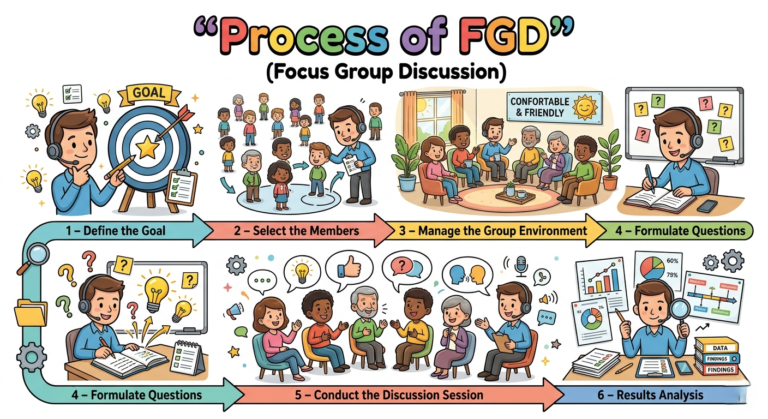
In order for a focus group to be most impactful, it’s important to follow a defined process. One way to approach focus groups is with the following six-step process:
Step 1 –Define the Goal
- Define the clear goal of the focus group and its significance in relation to the research goals.
- Clearly and precisely define the expected results.
- Assess the suitability of focus groups as a method for evaluating participant perceptions regarding the selected topic.
Step 2 –Select the Members
- Identify participants who display a clear relevance and relationship to the study topic.
- Choose a minimum of four individuals and a maximum of twelve individuals. The ideal number of participants for a focus group is typically between 6 and 8 individuals.
- It is essential to extend invitations to participants using a clear and positive communication strategy, while also clarifying the purpose and advantages associated with their involvement.
- To ensure that staff members are not afraid of criticism or reaction, choose a focus group facilitator who is impartial and not affiliated with the organization.
Step 3 –Manage the Group Environment
- Choose a meeting venue that ensures comfort, facilitates discussion, and minimizes external disturbances.
- Formulate and collect the necessary materials for the meeting, consisting of informational pamphlets and project summaries.
- It is essential to designate a specific individual to serve as the note-taker during the focus group session. This will facilitate the accurate documentation of all significant points and responses that arise during the discussion. To achieve this objective, it is essential to ensure the presence of multiple moderators within the environment.
- To effectively facilitate the discussion, it is advisable to appoint a co-moderator who can manage the technological aspects, document key points, and monitor participant interactions while you lead the inquiry process.
Step 4 – Formulate Questions
- Assess the ideal amount of questions required to effectively utilize the meeting duration while ensuring participants are not exhausted.
- Formulate comprehensive and investigative questions that look into the underlying reasons, methodologies, and implications of the research topic.
- It is essential to formulate questions that are open-ended, thereby avoiding any influence on participants that may guide them toward predetermined responses.
- Develop a systematic session agenda to facilitate a coherent and orderly progression of discussions.
Step 5 – Conduct the Discussion Session
- It is essential to explain the scope, purpose, and expected results of the focus group at the start of the session.
- It is essential to underscore that the anonymity of participants will be rigorously preserved during the dissemination of results.
- Focus the discussion on the main topics of discussion and refrain from engaging in irrelevant distractions.
- Use exploratory questions to investigate further into the primary concepts and stimulate comprehensive answers.
- Pay attention to ambiguous or unclear remarks and promptly request clarification to ensure the validity of the obtained data.
Step 6 – Results Analysis
- Analyze the documented notes and minutes to establish a consensus regarding the primary priorities.
- Analyze the data to identify consistent patterns in responses and identify overall themes that emerge.
- Examine the factors contributing to both consensus and disagreement among participants, and assess their implications.
- Compile a detailed summary report containing the main findings to disseminate among the relevant stakeholders and executives for informed decision-making.