
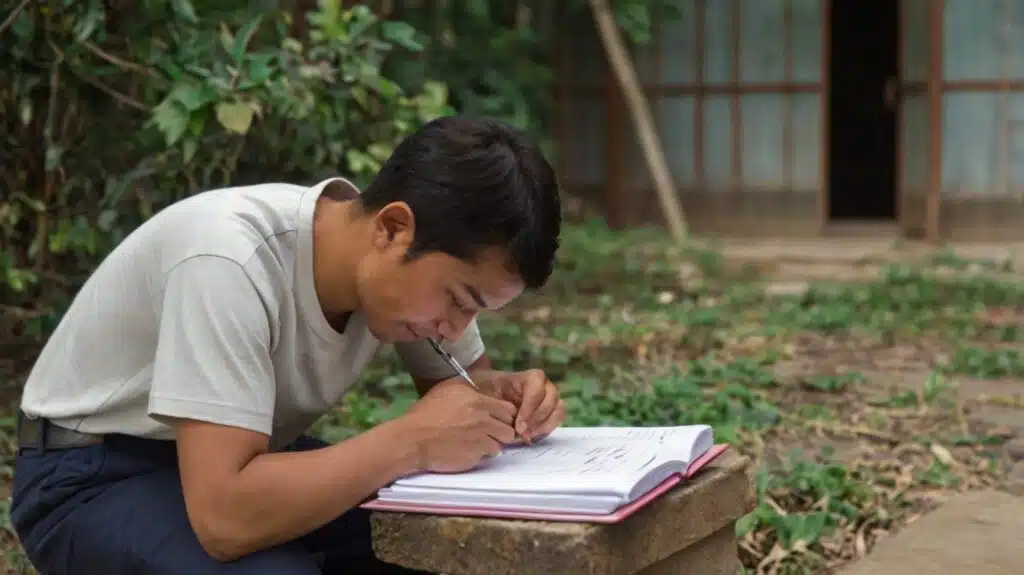
Observation is a careful and silent activity to know about the prevailing phenomenon, event, or situation. Observers and phenomena are both essential for observation.
Types of Observation
Based on the involvement and condition, there are four types of observation.
| 1 | According to Involvement | Participant Observation |
| 2 | Non-Participant Observation | |
| 3 | According to Conditions | Controlled Observation |
| 4 | Uncontrolled Observation |
Participant Observation
Participant observation is a research method in which the observer actively becomes a part of the group or phenomenon being studied. Instead of remaining distant, the researcher participates in the daily activities of the group to gain a deeper and more realistic understanding of their behavior and experiences.
This method provides a close and detailed view of the group, allowing the researcher to understand the true nature of social interactions and situations. However, it is often time-consuming, costly, and difficult, as it requires building trust and sometimes adjusting one’s role within the group.
In practice, purely non-participant observation is rarely possible because constant presence without involvement may appear unnatural or suspicious to group members. Therefore, researchers often use a combination of participant and non-participant observation to maintain balance between involvement and objectivity.
According to William J. Goode and Paul K. Hatt, participant observation is “the method employed when the investigator conceals their identity to be recognized as a member of the group.” In such cases, the observer may live and interact as a member of the group in order to study it more effectively.
Advantages of Participant Observation
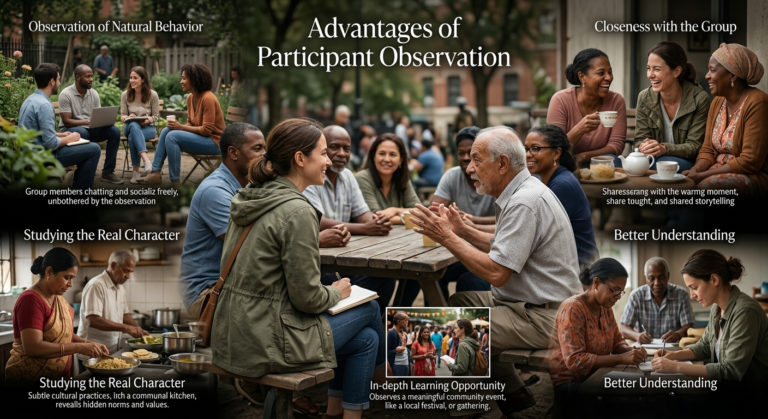
Observation of Natural Behavior
The natural behavior of respondents can be studied more effectively through participant observation. When an outsider observes a group from a distance, members feel conscious and uncomfortable, causing their normal behavior to be disrupted.
However, in participant observation, the researcher blends into the group as an active member, which makes respondents feel at ease and comfortable. As a result, they behave naturally without the pressure of being watched by a stranger, allowing the researcher to collect more authentic, genuine, and reliable data.
Closeness with the Group
In participant observation, the observer establishes a strong connection with the respondents. He maintains a close and trusted primary relationship with the group members. Consequently, he can engage in all activities from a proximate perspective, so enhancing his ability to interpret the scenario compared to a non-participating observer.
This closeness and trust also encourages group members to share sensitive and private information more openly and honestly with the researcher.
Studying the Real Character
Often, to study the actual behavior, group research requires close participation and contact with the group members. Through participant observation the observer can conduct an intensive and inclusive study of the group and gain insight into the real character of the group.
Surface-level observation from outside the group can never reveal the hidden norms, values, traditions, and informal rules that govern the behavior of group members, which only become visible through active participation.
Better Understanding
In participant observation, the observer can better understand the feelings of the respondents than an outsider. For example, a person who is actually living in a slum area can realize the feelings and hardships of the slum dwellers better than an outsider.
This deeper empathetic understanding enables the researcher to produce more meaningful, accurate, and contextually rich interpretations of the social phenomena being studied.
Provides the Opportunity to Learn In-depth
The chief advantage of participant observation is that the observer gets an opportunity to interact with the group regarding various activities. He can thus learn the significance of these activities that are actually not open for observation.
For example, if an observer participates in a religious ceremony of Muslims, such as the “Slaughter of Animals on Eid,” he can not only observe different aspects of the ceremony but also clear his doubts by asking various questions to the group members or learning more about that ceremony by discussing it with the group. It is generally easier for the respondent to describe the event on the right occasion than before or after it.
Disadvantages of Participant Observation
Lack of Objectivity
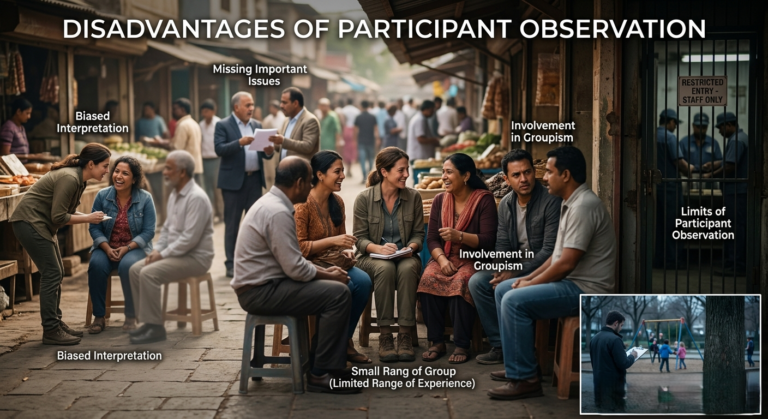
By becoming a member of a group and participating very closely in it, the observer may lose his objectivity. His emotional and sentimental association with the group undermines his impartiality and unbiased analysis. He may develop some soft corners for certain group members, and because of this, he may often justify their evil activities as just activities.
This loss of objectivity is one of the most serious limitations of participant observation as it directly threatens the scientific validity and credibility of the research findings.
Biased Interpretation
Because of his close association and emotional participation with the group members, the researcher develops a special position for himself in that group. He may be influenced or pleased by this and tends to support them blindly. Due to this, he observes things from his own personal point of view rather than a scientific point of view.
This personal bias can seriously distort the findings and lead to inaccurate and unreliable conclusions that do not truly represent the reality of the group being studied.
Misses Important Issues
Due to excessive familiarity, many crucial events appear to the participant observer with little or no significance. Therefore, he tends to miss many of the important issues. This is because familiarity breeds complacency, and the researcher may begin to take certain behaviors and events for granted without recognizing their research significance. But a stranger pays much attention even to a small thing, as this appears new to him.
Limited Range of Experience
In participant observation, the observer confines himself to a particular group. So his experience becomes very deep, but the range of his experience becomes very limited. This narrow focus means that the findings of participant observation cannot be easily generalized to other groups, communities, or social settings, which significantly limits the broader applicability and external validity of the research.
Involvement in Groupism
The active participation and proximity of the observer with the group may involve him in quarrels and factionalism within the group. He cannot avoid taking the side of one group. But if he does so, he loses his status as an impartial observer with whom everybody is ready to cooperate.
This compromises the neutrality of the researcher and destroys the purpose of the research, making it very difficult to get proper and unbiased information from all members of the group.
Limits of Participant Observation
There are certain situations in which participant observation is simply not possible. For example, it is not possible to observe criminals or prisoners. Similarly, it is practically impossible to participate in highly secretive, dangerous, or socially restricted groups, which significantly limits the applicability of this method in certain areas of social research.
Non-Participant Observation
The observer will not be part of the phenomenon but will have a distance to observe. Non-participant observation is easy due to the lack of instruments. It is done under such conditions when the observer remains outside the group and simply watches the phenomenon.
For example, a social worker watches children playing in a park from a distance to study their behavior without participating. The non-participant observation has further two types;
- Overt Non-Participant Observation: The researcher openly observes the group from a distance with the full knowledge and consent of the members being studied.
- Covert Non-Participant Observation: The researcher secretly observes the group from a distance without the knowledge or consent of the members being studied.
Merits of Non-Participant Observation
However, non-participant observation also has some advantages. The following are the merits of participant observation:
Objectivity and Neutrality
If an observer participates actively and emotionally in the event, he may try to justify the evil things of the group as just things. In this frame of mind, he cannot analyze phenomena neutrally. However, in non-participant observation, the objectivity or neutrality can be maintained.
The observer in this type of observation gives a detached and unbiased view of the group. This detachment ensures that the researcher’s personal feelings, emotions, and relationships do not interfere with the accuracy and reliability of the data collected.
Broader and Comprehensive View
Unlike participant observation where the researcher gets absorbed into the group and may develop a narrow perspective, the non-participant observer maintains a wider and more comprehensive view of the entire situation. By standing outside the group, the researcher can simultaneously observe multiple individuals, interactions, and events without being restricted to a single role or position within the group, resulting in a more complete and holistic understanding of the phenomenon under study.
More Willingness of the Respondent
Often, people do not feel shy about disclosing their secrets, weaknesses, or informal things to a stranger. However, they are always reluctant to disclose these things to a known person. Since the non-participant observer maintains the role of an outsider and stranger, respondents feel more comfortable and willing to share sensitive or personal information freely without fear of judgment or social consequences.
Careful Analysis
In participant observation, because of the familiarity with the events, sometimes the observer does not realize the significance of the same events and neglects them. However, in non-participant observation, the researcher does not even miss a minute thing. He carefully judges the merits and demerits of every phenomenon under study.
Since the researcher approaches the situation with fresh eyes and without prior familiarity, even minor details, behaviors, and patterns are noticed and recorded with greater precision and attention.
Freedom from Groupism
In non-participant observation, the researcher always maintains his impartial status. His detachment from minor conflicts helps him to carry out his research work more smoothly. As the researcher does not belong to any particular group or faction, he remains free from group pressure, bias, and favoritism, which ensures a more accurate and reliable analysis of the observed phenomena.
Replication and Consistency
Since the non-participant observer follows a systematic and standardized method of observation without getting personally involved, the observation process can be more easily replicated by other researchers. This consistency and standardization of the observation process increases the reliability and validity of the research findings, making them more credible and acceptable in the academic and research community.
Demerits of Non-Participant Observation
Subjectivity
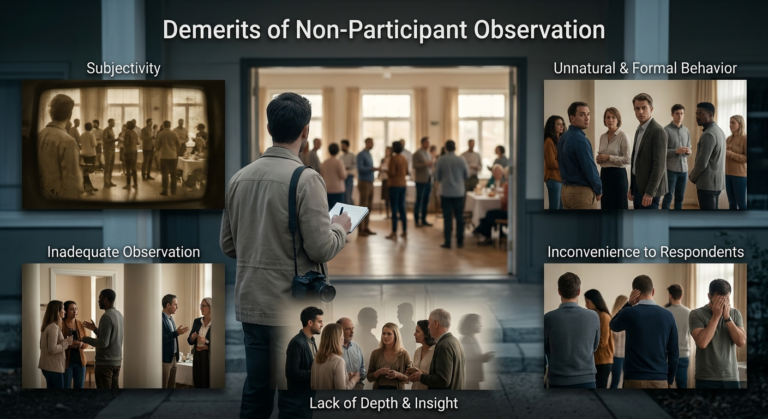
When someone is observing without participating, they don’t always know what is going on. He can’t ask the other members of the group questions to get more information. So, he just has to figure out what he sees and understand it. This lack of understanding may cause some of his findings to be biased and influenced by his own predictions, beliefs, and preconceptions.
The issue of subjectivity is particularly severe as investigator views observed behaviors through his own cultural, social, and personal perspectives, potentially resulting in misinterpretation of events, wrong conclusions, and significant loss of the overall validity and reliability of the research findings.
Inadequate Observation
The observer can only see things that happen in front of him. But that’s not enough; it’s only a small part of the whole picture. A lot of information is needed for the research. The non-participant observer cannot see many important events, private conversations, and behind-the-scenes actions because he is not a member of the group.
When he participates in the group and talks to the other members, he can learn a lot about it. This constraint makes non-participant observation inadequate as an independent research method for investigations necessitating profound and thorough understanding of group behavior and social phenomena.
Unnatural and Formal Behavior
The members of a group become suspicious of a person who observes them from outside. In front of an outsider or stranger, they feel conscious and tend to modify their natural behavior, providing only formal information in an unnatural way. This phenomenon is commonly known as the “observer effect” or “Hawthorne effect“, where people change their normal behavior simply because they know they are being watched and observed by an outsider.
It creates bias, and what the observer collects is not actual or normal behavior but only artificially constructed and socially desirable information. As a result, the data collected through non-participant observation may not truly reflect the natural and authentic behavior of the group under study.
Inconvenience to the Respondents
The members of a particular group always feel uncomfortable when they know that an outsider critically analyzes their behavior. Therefore, in some cases, certain communities and groups such as tribal communities do not allow outsiders to watch their socio-cultural activities.
This resistance and reluctance from group members can seriously limit the researcher’s access to important cultural practices, rituals, and social events, making it extremely difficult to collect complete and authentic data. It is always better for a researcher to become a member of the group in order to learn much about it.
Furthermore, the discomfort and inconvenience caused to respondents raises serious ethical concerns about the right to privacy and the principle of informed consent in research.
Lack of Depth and Insight
One of the most significant limitations of non-participant observation is that it only captures surface-level behavior and visible actions without providing any deeper insight into the motivations, feelings, attitudes, and personal experiences of the group members.
Since the researcher does not interact or engage with the group, he remains unable to understand the underlying reasons behind the observed behaviors, resulting in shallow and superficial findings that lack the depth and richness required for comprehensive qualitative research.
Controlled Observation
When observation takes place according to pre-arranged plans, with a structured experimental procedure, it is called controlled observation, which is generally done in the laboratory under controlled conditions. In a controlled study, the researcher pre-determines and controls the study variables and determines the location, the time, the participants, and the tools used to complete the study.
The primary purpose of controlled observation is to eliminate the influence of external and confounding variables, ensuring that the findings are accurate, reliable, and scientifically valid.
Uncontrolled Observation
An observation that takes place in natural conditions where the situation is not created by the observer himself is called uncontrolled observation. That is why it is also called naturalistic observation. It takes place in a natural setting without the influence of external or outside control.
Since the researcher does not manipulate or interfere with the natural environment, uncontrolled observation provides a more realistic and authentic picture of human behavior as it occurs in everyday life.
Steps of Conducting Observation
Choose the Field
Before going into the field, choose the right one and learn enough about the research setting, the group you will be observing, and the phenomenon you will be studying.
Make Preparation
Gather all the materials you need and make all the plans you need. This includes making checklists for observations, tools for recording, and any other tools needed for systematic data collection.
Access the Field
The observer needs to be in the area where the phenomenon is happening from the start. When doing participant observation, the researcher should fit in with the group without drawing too much attention to themselves. But if you’re not a participant, don’t let people realize you’re watching them. This could make them change how they normally act and give you false information.
Observe Required Information Only
Stay focused and don’t pay attention to unnecessary and extra data. The researcher must follow carefully to the observation guide, documenting solely those behaviors, events, and interactions that are relevant to the research objectives, while avoiding distractions and unnecessary details.
Leave the Field
Carefully and systematically record every part of the phenomenon, and then leave the field with respect. Before leaving the field, the researcher should make sure that all of their observations are properly recorded. If they wait too long to do this, they might lose important details and get wrong data.
Principles of Writing an Observation
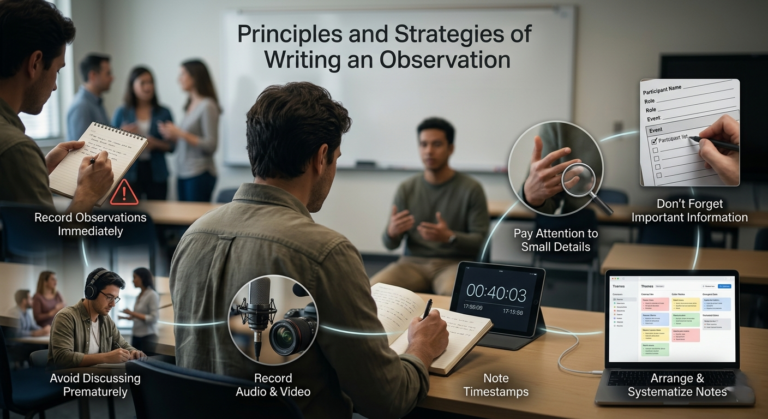
Record Observations Immediately
Write down what you see during your research session as soon as you can. If you can’t finish the task, make sure to write down what you learned right after the session. At that time, they will be more accurate and easier to remember. Delayed recording greatly raises the chance of forgetting important information and adding memory bias to the research.
Avoid Discussing Observations Prematurely
It is important to wait until you have written down all of your observations on your own before talking about the session with your teammates, especially if you are on a research team. Talking about something too soon could change how you remember and understand it.
Once you’ve finished writing up your notes, it’s important to talk about what you saw with your team. Working together to analyze the data helps you find patterns and trends more easily.
Record Audio and Video
It’s important to always record the audio during your sessions. Adding video recording, if possible, helps to get a better picture of the situation. This lets you look closely at facial expressions, body language, and any other factors that may have been missed when you were watching live.
Note Timestamps
Recording timestamps can help you remember important things that happened during your session. Timestamps help the researcher find and go back to specific times during data analysis, making sure that important events are not missed or misplaced in the order of observation.
Pay Attention to the Little Things
Pay attention to the little things you see. Sometimes, small actions and signs can have a big effect on the overall results of the study. For example, someone who doesn’t have a mouse pad might have gotten angry while trying to use your site. These small but important details can give you a lot of information about how the participant felt and acted that you might not have noticed otherwise.
Don’t Forget About Important Things
During the observation session, it’s important not to forget about important things. Doing research can be very interesting and fun. So, you might forget to write down important information, like the name and role of your participant, during the research session.
Using structured observation templates, checklists, and generic forms can help make sure that all important information is collected and that the data collection process stays organized and thorough.
Arrange and Systematize Your Notes
After you finish taking notes, sort and systematize them in a way that makes them easier to analyze. Put similar observations together, look for new themes and patterns, and make sure that all the data you collect is properly labeled, dated, and stored so you can look back on it and analyze it later.