What is the Third Way?
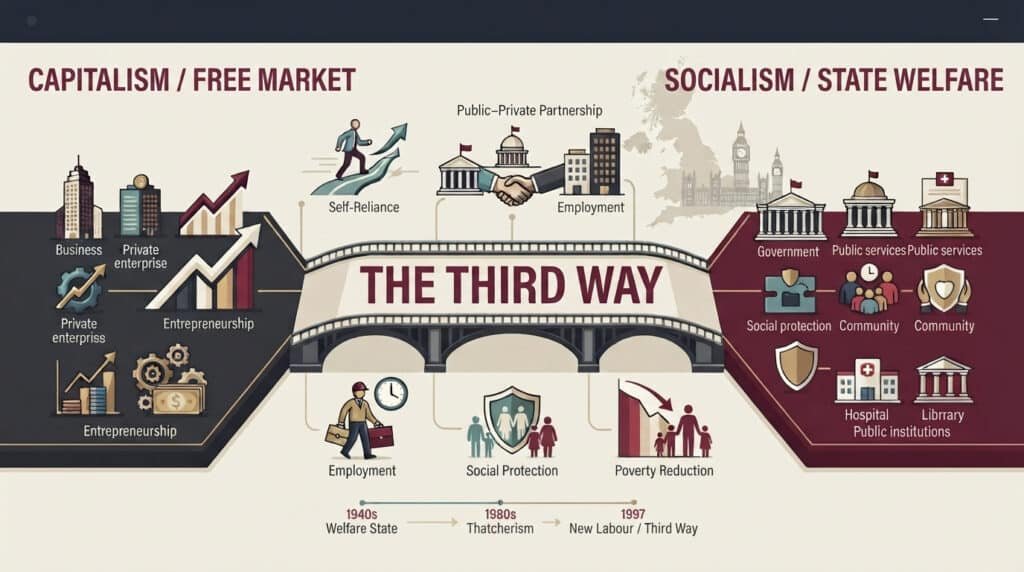
The Third Way means a middle path between capitalism (free market economy) and socialism (government control). It tries to combine the best parts of both, encouraging business and economic growth (like capitalism) while also ensuring social welfare, equality, and public support (like socialism).
The “Third Way” became a popular political idea when the ‘New’ Labour party won a major victory in Britain’s 1997 elections. Tony Blair and his team introduced this approach as a fresh way of thinking about how government should handle the economy and society. The main idea was simple: combine the best parts of two different political traditions that had shaped Britain for decades (Thau, 2023).
The Third Way tried to bring together two seemingly opposite approaches. On one side was the comprehensive welfare state created in the 1940s, where government provided many services to citizens.
On the other side was Thatcherism from the 1980s, which favored free markets and less government involvement. The Third Way aimed to create a “partial synthesis” – a middle ground that took useful elements from both (Spicker, 2014).
Escaping Old Political Labels
Tony Blair and New Labour insisted that the Third Way was something genuinely different. They argued it wasn’t just ‘Old Labour’ socialism with a new name, nor was it the laissez-faire, free market approach that the Conservative party preferred. This positioning was deliberate and strategic.
New Labour wanted to distance itself from the neo-liberal policies that Margaret Thatcher and John Major had championed. However, they also recognized that purely left-wing policies wouldn’t win elections in the modern era (Seaton, 2025).
The challenge was to keep traditional Labour voters happy while attracting new supporters from the middle class who were tired of Conservative rule but nervous about socialist policies.This strategy worked remarkably well.
The Third Way secured votes from people who traditionally supported Labour, while also winning over voters who might have chosen the Liberal Democrats or even Conservatives. By appealing to a broader range of voters, New Labour created a winning coalition (Pitts, 2022).
Dependency to Self-Reliance
A main idea of the Third Way was to change how people depended on government assistance. The policy tried to move away from what critics called a “dependency culture” where people relied too much on state benefits and instead create a system that helped people become more self-reliant (Blakemore, 2013).
It didn’t mean abandoning people in need. The goal was to support them in ways that made them more independent over time. The Third Way also focused on strengthening families, seeing them as the foundation of society. The belief was that stronger, more independent families would need fewer government services, which would help both families and the state budget.
Partnership between Public and Private Sectors
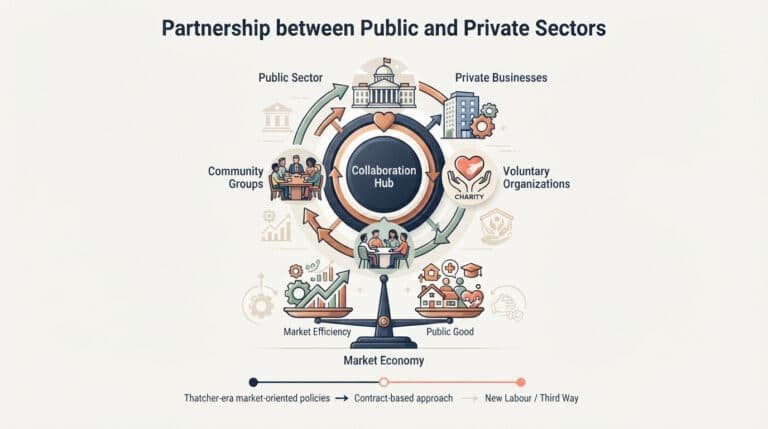
The Third Way introduced a new approach to providing welfare and public services. Rather than having government do everything alone, New Labour promoted partnership between different sectors. This meant the public sector would work alongside private businesses, voluntary organizations, and informal community groups.
This collaborative approach worked within a market economy that New Labour wanted to improve through enterprise and business growth. The government believed that markets could help deliver public services, but they needed to be properly managed to serve the public good.
Interestingly, the Third Way also took some ideas from the New Right’s view that social welfare had become too expensive. New Labour agreed with some of these concerns and continued the contract-based, market-oriented policies started by Thatcher’s government (Spicker, 2014).
The Middle Ground on Employment
When it came to jobs and the economy, New Labour positioned the Third Way as occupying the middle ground. On one extreme was old-fashioned socialism, with its emphasis on government control and planning. On the other extreme was individualistic market liberalism, which left workers vulnerable to market forces with minimal protection.
The Third Way claimed to offer a better alternative that combined market efficiency with social protection. This meant supporting businesses and economic growth while also protecting workers through policies like the National Minimum Wage (Blakemore, 2013).
Practical Policies and Real-World Impact
In practice, the Third Way government often favored pragmatic solutions. Their guiding principle was simple: “whatever works” is the best policy. This flexible approach led to several notable initiatives aimed at reducing poverty and social exclusion.
Key policies included:
- Tax credits for working families with low incomes
- The National Minimum Wage to ensure fair pay
- Specific commitments and programs to reduce child poverty
- Initiatives to help unemployed people find work
These measures showed that the Third Way was more than just political expression – it translated into real policies affecting millions of people’s lives.
Criticism on Third Way
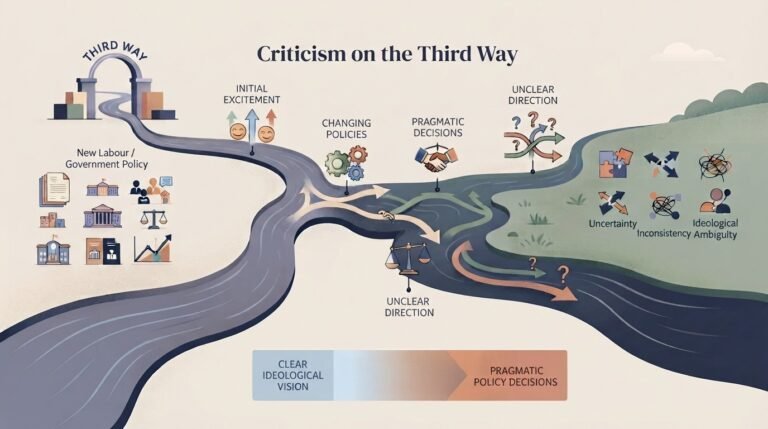
Despite these achievements, the Third Way faced significant criticism. Observers noted that New Labour’s policies resembled “Water moving in circles and twists, like a river that turns here and there instead of flowing straight in one direction.” The government’s approach seemed to shift and change rather than following a clear, consistent path.
After the initial excitement, people heard less and less about the “Third Way” as a concept. The government increasingly justified its decisions simply as “pragmatic” rather than part of a grand ideological vision. This shift led some critics to suggest that New Labour never had a truly clear direction to begin with (Martin, & Bastow, 2019).
Academic Perspectives and Criticisms
Scholars have argued about whether the Third Way was really a new idea or just a mix of old ones. Some compared it to the “mixed scanning” model, which means using different methods together to make decisions. Others disagreed.
Giddens (2013) strongly criticized it, saying the Third Way was “neither new nor clear.” He believed it simply took ideas from both the Old Left and the New Right without creating anything original. Critics also said that, even with the new name, government social policies mostly followed the same direction as the earlier Conservative governments, and no big change actually happened.
Final Assessment
Many experts believe that calling New Labour a “Third Way government” does not fully explain the complexity of its ideas and policies. The government mixed different ideologies, such as welfare paternalism and postmodern government ideas, creating an approach that was hard to define. The legacy of the Third Way is still debated.
It helped New Labour win elections and introduce key social policies, but people still argue whether it was a truly new political philosophy or just practical politics with attractive language. What is clear is that the Third Way marked an important time in British politics when traditional political lines were changing, and leaders were looking for new ways to face modern problems while keeping public support.
References
- Blakemore, K. (2013). Social policy. Berkshire: Open University Press.
- Giddens, A. (2013). The third way and its critics. John Wiley & Sons.
- Pitts, F. H. (2022). Contemporary class composition analysis: The politics of production and the autonomy of the political. Capital & Class, 48(1), 23–48. https://doi.org/10.1177/03098168221139284
- Martin, J., & Bastow, S. (2019). Third way discourse: European ideologies in the twentieth century. Edinburgh University Press.
- Sanchez, E., & Wickham-Jones, M. (2024). Stuart Hall, the New Left, and the Labour Party. Contemporary British History, 39(2), 251–285. https://doi.org/10.1080/13619462.2024.2424906
- Seaton, J. (2025). Marquand and MacDonald. The Political Quarterly, 96(3), 454–462. https://doi.org/10.1111/1467-923x.13569
- Spicker, P. (2014). Social policy: theory and practice. Bristol: Policy Press.
- Thau, M. (2023). The Group Appeal Strategy: Beyond the Policy Perspective on Party Electoral Success. Political Studies, 72(4), 1653–1674. https://doi.org/10.1177/00323217231220127