
Reverse Racism
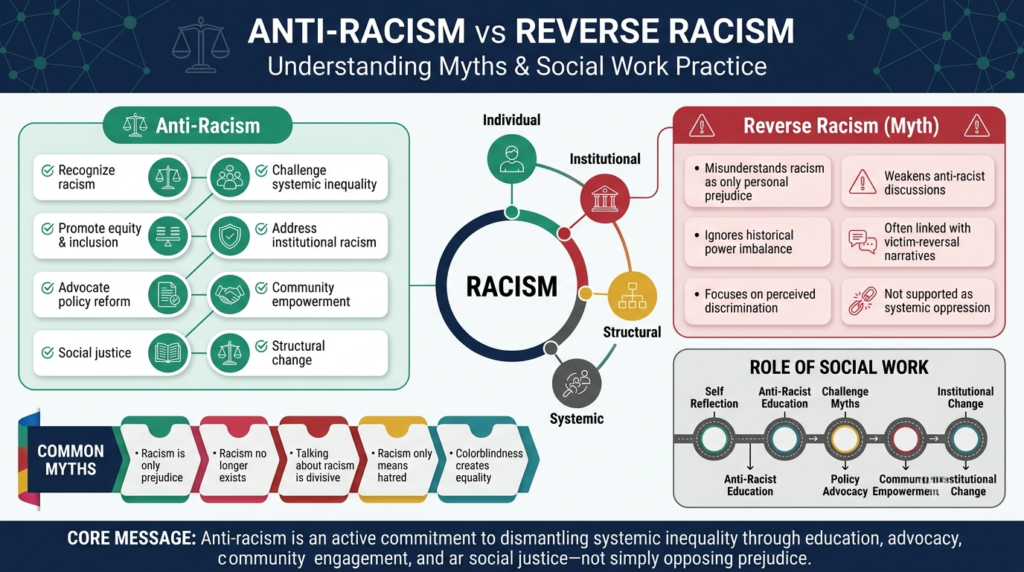
This idea of “reverse racism” has become a popular yet problematic rhetoric that implies that racism can be directed at dominant racial groups in many contexts, which means white people can be victims of racism from people of color. This idea is used to claim that white people are victims, particularly in academic or social spaces related to racism, even though there is no real evidence of racist oppression against dominant groups (Ortiz et al., 2024).
Some white college students, for instance, might feel oppressed in race-related classrooms or discussions, or that they are being “silenced” in such settings, according to research. But such statements often focus on racist stereotypes and misconceptions about racism as a system of power, instead of racism as a personal prejudice.
This rhetoric is frequently used to perpetuate existing racial order and silences or derides meaningful discussions about racial justice, as well as to use victim–perpetrator reversals, which are prevalent in far-right ideology (Hellström, 2026; Ortiz et al., 2024).
Anti-Racism
Anti-racism is an active effort to recognize, challenge, and eliminate racism in all its forms – individual, institutional, and systemic. It is not only about awareness of prejudice but also about promoting social justice, which involves addressing power imbalances in historical, structural, and political contexts.
Anti-racism requires a critical awareness of systems of inequality, such as institutions and policies, which sustain racism and create inequities for racialized groups. For instance, grassroots anti-racism organizations not only oppose racist attitudes but also institutionalized racism in border regimes and colonial legacies by recognizing the complex history between racial inequalities and state power e.g. in Berlin or Brazil (Cantave, 2024; Perolini, 2021).
Anti-racist policies, when they are in place, can be ineffective due to the rarity of systematic and institutional racism, or to the fact that they may be limited to stereotypes or individual perceptions. This can move racism into the realm of ignorance and/or violence between people rather than address the historical and systemic power dynamics that create and sustain racial inequity.
In turn, certain anti-racist initiatives confirm “institutional whiteness” without addressing a wider socio-political understanding of racism (Sebastiani, 2021, 2022). Thus, the fight against racism should involve recognizing past historical injustices and inequities in power, and ongoing advocacy; education on systemic racism and structural inequities (Efimoff & Starzyk, 2023; Ndumbe-Eyoh, 2025).
Common Myths about Racism
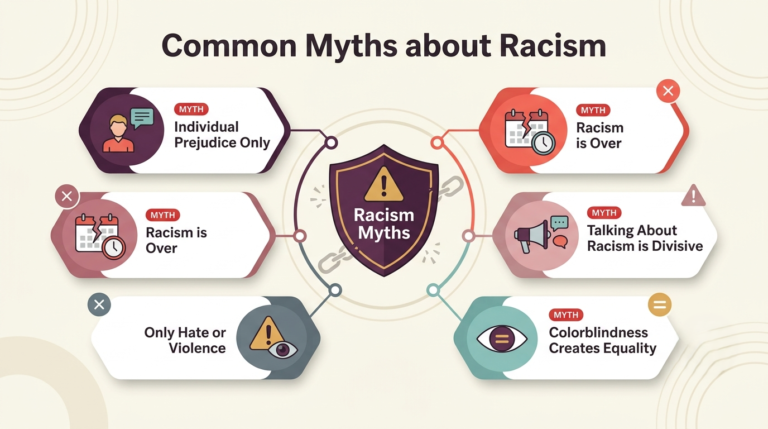
Racism is about individual prejudice or stereotypes
The tendency to overlook racism as just an interpersonal disagreement or personal bias. Racism, on the other hand, has institutional and systemic elements embedded in policies, laws, and structures that cause and maintain inequalities and exclusion (Hellström, 2026; Sebastiani, 2021).
Racism no longer exists or is a thing of the past
Another myth about racism is that it is a thing of the past or has been eliminated. Racism still exists structurally and culturally. There might be public campaigns and narratives that say racism is “solved” or “marginal” that can lead to denial of racial inequities and/or a system of racism (Gebhard et al., 2022).
The discussion of racism is divisive or anti-white
Sometimes the discussion of racism is mislabeled as divisive, or an attack on white people. But anti-racism is not about holding people accountable; it is about challenging and overturning inequitable power imbalances. Mistakes in these aspects can lead to resistance against anti-racist education and policy change (Hellström, 2026).
Racism is only about hate or violence
Racism also exists in hidden and everyday ways, as well as by being overlooked or ignored (racism of omission), and can have as much or more of an impact as overt racism or violence (Kramer et al., 2025).
Colorblindness is the best way to achieve equality
Colorblind approaches work against engaging with racial justice by being oblivious to the racial oppression that has occurred throughout history and continues today. One way to do this is to ignore the significance of race in everyday life, which can reinforce inequities (Sebastiani, 2021).
Role of Social Work in Anti-Racist Practice
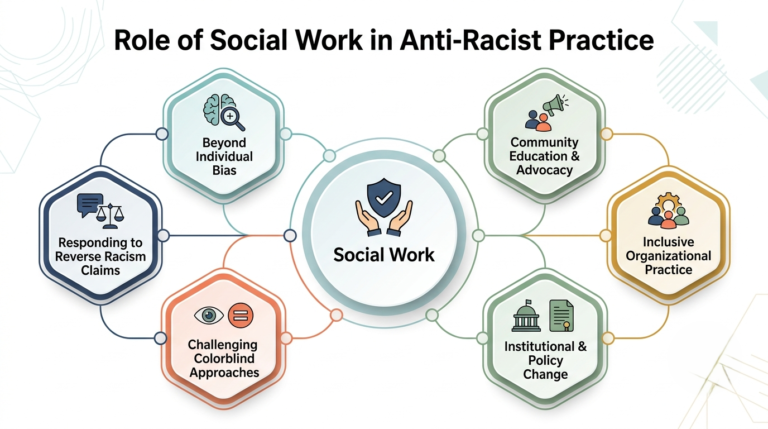
Anti-racist social work practice involves more complex, multi-level responses to systemic racism and responses to counter-narratives like “reverse racism”, challenging colorblind ideologies, challenging racial myths, and integrating anti-racism into institutional practices.
Moving Beyond Individual-Bias Models of Intervention
Although the history of social work practice has primarily focused on individual attitudes and biases, structural and systemic analyses must be incorporated into practice to achieve the goal of dismantling racism.
This dissertation highlights the necessity of embodied anti-racist practice, as evidenced by a 10-week experiential social work intervention program for white-bodied social work students to cultivate somatic awareness, skills, and tangible competencies to identify and take action to interrupt racism in real time. This embodied way of being, characterized by cognition and behavior, can help social workers overcome racial injustice in practice (Lerner, 2025).
In addition, concepts that bring together Critical Race Theory (CRT) and an anti-colonial approach offer social work practitioners conceptual tools for critiquing and disrupting white supremacy, colonialism and systemic racism in the delivery of services to clients. These models promote antiracist practice over color blind or cultural competence models that often do not acknowledge racial inequities as a political issue (Elkassem & Murray-Lichtman, 2022).
Responding to “Reverse Racism” Claims in Practice Settings
There are instances when “reverse racism” narratives about oppression of dominant racial groups may arise in social contexts and can threaten anti-racist work. Social workers must be aware of such statements as ways of rhetorically masking rather than accurately describing systemic power inequalities.
It is important to equip students and practitioners with the ability to critically analyze such claims, which leaves room for discussion of power, privilege, and systemic racism and not just prejudice. Interracial team teaching (White and BIPOC faculty co-teaching) can help social work students reflect on power and critically examine whiteness, advancing learning beyond a victim-perpetrator binary understanding (Curiel, 2021).
Challenging Colorblind Approaches in Case Work & Policy
A problematic ideology in social work practice and policy that ignores geographic and/or racial inequalities is colorblindness. Education and practices in social work are focused on naming race and addressing whiteness and institutional racism head-on rather than out of the way.
While there are limitations in colorblind models, an approach that incorporates anti-racism education across the social work curriculum – including the proposed anti-racism MSW courses and workshops – counters these limitations.
The educational interventions promote a critical consciousness to help future social workers progress from cultural competence to anti-racist praxis, and highlight racial dynamics of power within client systems and policies (Cornell, 2024; Lerner & Kim, 2024).
Dealing with myths about race in community & group work.
Racial myths and stereotypes are a driver of systemic inequities and have an impact on individual clients and communities. Social workers are responsible for being the advocates for anti-racist practice in the community, directly challenging racial myths, with strengths-based and culturally humble practices.
Interventions with African American families, for example, focus on critical consciousness and understanding of systemic oppression, and challenge the deficit-based narratives. Educating clients and communities about the origins and impacts of racism is a pathway to resilience and empowerment, and helps to collectively challenge the narratives of racism (Kaslow et al., 2023).
Integrating anti-racism into institutional/organizational practice
Anti-racist, sustainable social work means anti-racism within institutional/organizational culture. This means moving beyond performative or superficial anti-racist actions to tangible policies, accountability systems and practices within an organization that address systemic racism.
Using a critical anti-racist lens to inform social work research teams is one area in which anti-racist practice is changing professional norms and practice, challenging “white logic” that is prevalent in the academy.
Likewise, organizations place importance on workforce diversity, culturally responsive environments, and transparent response to discriminatory behaviors. This system of change is aligned with the overall ethics of social work in the pursuit of social justice and equity (Carlson et al., 2025; Kanninen et al., 2025).
Crux of Social Work Role in Anti-racist Practice
Anti-racist practice in social work includes:
- Creating competency beyond the awareness of individual biases that are embodied and action-oriented (Lerner, 2025).
- Taking critical approaches to problematizing whiteness and systemic racism (e.g., CRT, anti-colonial theory) (Elkassem & Murray-Lichtman, 2022).
- Training practitioners to question and counteract the falsehoods of “reverse racism” claims that mask and abrogate power dynamics (Curiel, 2021).
- Refusing to embrace colorblind philosophies, and instead naming and challenging race and racism in practice and policy (Cornell, 2024; Lerner & Kim, 2024).
- Addressing racial misconceptions and stereotypes in community-based culturally humble strengths-based intervention (Kaslow et al., 2023).
- Incorporating anti-racism into institutional practices and cultures in the form of policy, accountability, and environments that are inclusive to students (Carlson et al., 2025; Kanninen et al., 2025).
This multi-dimensional approach supports an integrated social work praxis that is consistent with the professional goal of combating racism and fostering equity within the individual, community, and institutional levels.
Conclusion
To sum up, anti-racism is “dismantling,” or actively challenging racism in all its forms and the systemic power dynamics and inequities that have been perpetuated over time. “Reverse racism” is a myth that is based on a misunderstanding of racism as a system of power, not just prejudice.
Many myths are associated with racism that can mask its structural nature, make anti-racist actions more difficult, and perpetuate dominant racial hierarchies. An anti-racist stance necessitates learning, transformation and recognition of the political and historical context of racial oppression.
Social workers are especially important in this process, as they can do more than respond to the individual-bias model; they can challenge colorblind practices and address racial myths in case work, group work, and communities. Finally, integrating anti-racism into institutional and organizational structures makes for a more ongoing institutional practice of dismantling racial inequity and not just an individual one.
FAQs
References
Cantave, R. (2024). Pursuing Racial Order and Social Progress: Violence, Afrophobia and “Religious Racism” in Brazil. Latin American Research Review, 59(4), 858–871. https://doi.org/10.1017/lar.2024.15
Carlson, J., Wright, K., Bagwell-Gray, M., Mendenhall, A. N., Diaz, A., Mccall, S., Williams, N. J., Akin, B. A., & Banda, L. (2025). An Anti-Racist Practice in Social Work Research Teams. Advances in Social Work, 25(1), 18–35. https://doi.org/10.18060/28154
Cornell, D. (2024). Teaching Anti-Racism to White Social Work Students. Advances in Social Work, 23(2), 278–294. https://doi.org/10.18060/26267
Curiel, L. O. (2021). Interracial Team Teaching in Social Work Education. Advances in Social Work, 21(2/3), 730–749. https://doi.org/10.18060/24176
Efimoff, I. H., & Starzyk, K. B. (2023). The impact of education about historical and current injustices, individual racism and systemic racism on anti‐Indigenous racism. European Journal of Social Psychology, 53(7), 1542–1562. https://doi.org/10.1002/ejsp.2987
Elkassem, S., & Murray-Lichtman, A. (2022). Mapping an Integrative Critical Race and Anti-Colonial Theoretical Framework in Social Work Practice. Advances in Social Work, 22(2), 628–646. https://doi.org/10.18060/24952
Gebhard, A., Novotna, G., Carter, H., & Oba, F. (2022). Racism plays a disappearing act: discourses of denial in one anti-discrimination campaign in higher education. Whiteness and Education, 8(2), 229–247. https://doi.org/10.1080/23793406.2022.2072760
Hellström, A. (2026). “You Are Not a Racist, Right?”—Racism as a Political Activity. Sociology Compass, 20(2). https://doi.org/10.1111/soc4.70170
Kanninen, A., Kalke, Y., Eid, M., & Castaneda, A. (2025). 217 Anti-racism capacity building: from evidence to action. The European Journal of Public Health, 35(Suppl 6). https://doi.org/10.1093/eurpub/ckaf180.022
Kaslow, N. J., Clarke, C., & Hampton-Anderson, J. N. (2023). Culturally humble and anti-racist couple and family interventions for African Americans. Family Process, 63(2), 512–526. https://doi.org/10.1111/famp.12938
Kramer, R., Ray, V., & Bonilla-Silva, E. (2025). Introduction to the Special Issue: Racism of Omission. Social Problems, 72(2), 331–340. https://doi.org/10.1093/socpro/spaf006
Lerner, J. E. (2025). “It’s on a Cellular Level”: Embodying Social Work’s Commitment to Anti-Racist Practice Through a 10-Week Experience with White Bodied Social Work Students. Journal of Teaching in Social Work, 45(5), 770–791. https://doi.org/10.1080/08841233.2025.2567250
Lerner, J. E., & Kim, A. (2024). Back to the (not so) Basics of Anti-Racist Education and Practice. Advances in Social Work, 23(2), 317–336. https://doi.org/10.18060/26576
Ndumbe-Eyoh, S. (2025). Beyond the reckoning: Addressing structural anti-Black racism in population and public health. Canadian Journal of Public Health = Revue Canadienne de Santé Publique, 116(Suppl 2), 63–66. https://doi.org/10.17269/s41997-025-01093-7
Ortiz, S. M., Bennet, C., Rizzo, N., & Guerrero, B. (2024). Beyond Reverse Racism: A Research Note on How White College Students Construct the Myth of Silencing in the Classroom. Sociology Compass, 18(8). https://doi.org/10.1111/soc4.13260
Perolini, M. (2021). Challenging oppression: how grassroots anti-racism in Berlin breaks borders. Ethnic and Racial Studies, ahead-of-print (ahead-of-print), 1475–1494. https://doi.org/10.1080/01419870.2021.1966066
Sebastiani, L. (2021). Problematising mainstream Spanish antiracism: race, racism and whiteness. Social Identities, ahead-of-print (ahead-of-print), 74–89. https://doi.org/10.1080/13504630.2021.1966762
Sebastiani, L. (2022). Debunking mainstream anti-racism in the Spanish context: “Anti-rumour” strategies as a case of psychology-based anti-racism. Ethnicities, 23(6), 867–885. https://doi.org/10.1177/14687968221103091