
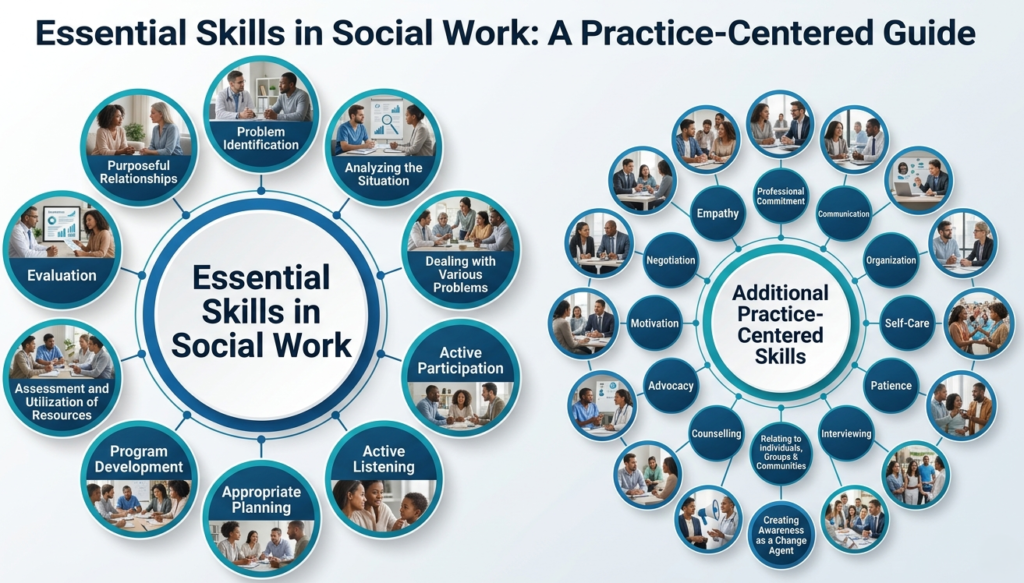
Skills in social work are the capacity to do something in a given situation. It is also the ability to apply knowledge, methods, and understanding to attain the objectives of a particular field. Skills are important for helping an individual perform better in any situation and achieve better results.
They also help to do the right thing at the right time and reduce the chance of failure. Skills are enhanced through relevant training activities. Social work as a professional practice involves many skills, which can be stated in the following lines:
Skill in Establishing Purposeful Relationships
Social relationships is one of the important skills in social work that plays a vital role when working for and with people. Without constructive and purposeful relationships, it is very tough to solve social problems. Therefore, social workers should possess the skills to build constructive relationships with and between individuals, groups, and institutions that are associated with a given problem.
They must be outspoken and authentic enough to convince people to remain in a professional relationship for a purpose, and they must be reliable and mature in their gestures to bind people in a relationship. Hence, developing rapport with the individual can only achieve the desired ends.
Skill in Problem Identification
Problem identification involves critical thinking which is one of the vital skills in social work. A social worker must be able to think critically and multidimensional while identifying a social problem. The last mistake on the part of the social worker may create havoc in the problem-solving process. At the identification level, practical aspects of the problem should be given optimum care.
The social worker should be able to foresee the possible threats linked with the problem and possible ways and means to face them. The social worker must skillfully go about discovering the possible factors of the problem, the magnitude of the problem, its severity and the most appropriate solution for solving human problems.
Skill in Analyzing the Situation
Social problems arise and develop in different unwanted situations. Social situations, at times, are complex. A professional social worker has the appropriate skills to tackle those situations. The magnitude of the same kind of problem may vary in different situations. Therefore, it becomes imperative to understand the social situation in which the problem has merged.
To solve the problem, the social worker must understand the condition of individuals and their environment. Proper analysis of a situation enables social workers to understand the influence and extent of the problem. He must be skillful in judging the needs and resources and appropriate ways of taking action.
Skill in Dealing with Various Problems
Solving psycho-social problems is the prime goal of social work. After identification, the social worker makes a conscious effort to solve it. A scientific solution to problems demands a sharp presence of mind because various problems have different backgrounds and social factors.
Hence, social workers should be skillful in understanding those backgrounds and factors on a priority basis, which will help them take appropriate steps to solve the problem.
Moreover, social workers must be skillful in dealing with uncertain and problematic situations, as the goal of social work is the welfare of the vulnerable section of society. Therefore, he has to face different situations in the society. These situations compelled social workers to tackle uncertain situations.
Skill in Active Participation
The social worker should participate in all the activities established for the solution of the problem. Participation of social workers gives confidence to the affected individuals. The social worker becomes able to highlight the inner qualities and capabilities of an individual, group or community. For this purpose, the social worker must have essential knowledge and understanding about the social settings and underlying problems.
Active Listening
Active listening is essential for professionals to understand and recognize a client’s needs. Listening attentively, focusing on the conversation, posing thoughtful questions, and employing strategies like paraphrasing and summarizing are essential for building rapport and trust with individuals.
Skill In Appropriate Planning
Planning prepares the blueprint of any conscious effort. It also requires critical thinking and foresight. A social worker needs to possess such abilities to be involved in serious thinking to make appropriate planning for solving a particular problem. Making the right decision is vital for appropriate planning.
There may be a number of alternatives in the hands of the social worker, but they have to choose the most appropriate one for a problem with a particular situation. While planning, the social worker needs to be able to foresee the potential threats, resources, possibilities and impossibilities, and they must be able to relate the plan of action to the clientele’s needs while planning.
Skill in Program Development
Scientific intervention requires proper planning of program activities. A social worker possesses the skills to plan various programs looking at the needs of people. He must be skillful in helping individuals express their interests and needs and helping groups develop the programs they want. Through program media, they attempt to reach and solve the problems that arise out of various needs.
The social worker needs to involve people in developing specific program. He encourages people to express their opinions when selecting a program because they know what will help them meet their needs better. Social workers should be able to understand the widespread concept of democratic values in society, which calls for a wider scope of participation of the people in their development.
During the implementation of the program activities, the social worker with skills in human relationships guides the people to undertake the activities with cooperation and coordination among the people. They also play a liaison role between the people and the welfare agencies.
Skill in Assessment and Utilization of Resources
To solve any problem, there is a need for some kind of human or material resources. Proper assessment and utilization of resources are equally important skills in social work. No resource is unlimited. Therefore, it is required that the right amount of resources is utilized at the right time through the right person.
Social workers attempt to make optimum use of resources for the larger interest of needy people. Social workers are skilled in mapping the internal resources of the concerned individual, group, or community, tapping the external resources, and tactfully mobilizing those resources for the benefit of the people.
The social worker must be skillful in assessing the need and resources and their utilization in a prescribed manner. Proper assessment and utilization of resources enable social workers to escape from wastage of resources.
Skill in Evaluation
Evaluation is one of the most important skills in social work. Through evaluation, we measure and judge the success or failure of the program. The social worker guides the stakeholders in effectively examining their efforts. He tries to find loopholes in the program and suggests improvements in the weak areas.
The social worker must be skillful in maintaining and evaluating the necessary record. He should also have the skills to evaluate the implemented plans to identify the gaps and ensure the plan’s success. Generally, a program is evaluated through the yardstick of objectives made during planning. The program is said to be successful only if the defined objectives have been attained.
Nowadays, most development organizations adopt social auditing in the process of evaluation, where evaluation is made with the visible statements of the people for whom the program is made and implemented.
Additional Practice-Centered Skills
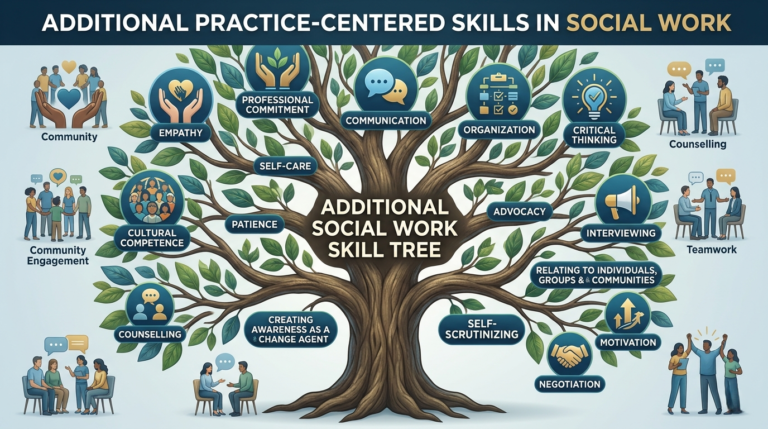
In finding a scientific solution to problems, the social worker is expected to possess the skills mentioned earlier. In this regard, frequent and systematic efforts are made during the training of social work to equip the professionals with all these skills. Besides, the social worker is also skilled in:
Empathy
Empathy involves recognizing and appreciating another person’s experiences and perspectives. The NASW describes it as the process of recognizing, comprehending, experiencing, and reacting to the feelings and thoughts of another individual. The common statement represents empathy – “Stepping into someone else’s shoes”.
Understanding that each person’s experiences, perceptions, and worldviews are distinct allows professionals to foster deeper connections and enhance their support for clients. It is an essential ability that enables professionals to assess a client’s needs by understanding their individual experiences, ensuring that services are delivered effectively.
Professional Commitment
Achieving success in this field necessitates a commitment to continuous learning throughout one’s career. It is essential for professionals in this field to uphold the values and ethics of their work, while also dedicating themselves to ongoing growth and development in their skills and knowledge.
This commitment is essential for achieving the mission of those dedicated to improving human well-being and addressing the fundamental needs of all individuals, particularly focusing on the needs and empowerment of those who are vulnerable, marginalized, and experiencing poverty.
Communication
Communication, in both its verbal and non-verbal forms, is an essential skill for those in the helping profession. The capacity to convey messages effectively to diverse individuals is crucial. Advocating for clients is a fundamental responsibility, and to fulfil this role effectively, it is essential to have a deep understanding of their needs.
It is important to be aware of body language and non-verbal cues, which involves communicating in a way that is appropriate and effective for clients, taking into account their cultural background, age, gender, literacy skills, or any disabilities they may have.
It is essential for professionals in this field to engage in effective communication with care providers, colleagues, and various agencies. Additionally, they need to ensure that documentation and reporting of information are done clearly and accurately.
Organization
Social workers often have busy schedules and a wide range of responsibilities. In addition to providing support to numerous clients, they also engage in essential tasks such as documentation, reporting, billing procedures, and collaboration. This demands for a high level of organization and the ability to priorities the needs of clients to effectively manage cases.
Disorganization and ineffective time management may lead to a social worker missing important aspects of a client’s needs, potentially resulting in unfavorable outcomes.
Critical Thinking
Critical thinking involves the capacity to evaluate information obtained through objective observation and effective communication. It is essential for professionals in this field to assess each situation with an open mind, gathering information through careful observation, engaging interviews, and thorough research.
Engaging in critical thinking and maintaining an unbiased perspective allows professionals to make well-informed decisions, recognize the most suitable resources, and develop effective plans to support those they serve.
Self-care
Engaging in activities that promote a healthy work-life balance is essential, especially given the demanding and emotionally taxing nature of the field. Prioritizing self-care can make a significant difference in managing stress and maintaining overall well-being. Self-care encompasses activities that alleviate stress and enhance overall health and well-being.
By participating in these practices, individuals can effectively prevent burnout and compassion fatigue, which is essential for maintaining a fulfilling and sustainable career. When individuals priorities their own well-being, they enhance their capacity to offer the highest quality of support to those they serve.
Cultural Competence
Collaborating successfully with clients from various backgrounds necessitates a deep respect and responsiveness to their cultural beliefs and practices. It is essential for professionals in this field to possess a deep understanding and respect for the diverse cultural backgrounds of their clients.
As emphasized by the NASW, it is important to reflect on one’s own cultural identity while actively seeking the knowledge, skills, and values that can improve service delivery to individuals with a wide range of experiences related to race, ethnicity, gender, class, sexual orientation, religion, age, or disability.
Having a non-judgmental approach and recognizing the importance of diversity and individual differences allows professionals to effectively support clients in meeting their needs.
Patience
Professionals in this field engage with a diverse range of situations and people throughout their practice. Having patience is essential when navigating complex cases and supporting clients who require extended time to achieve progress. This enables professionals to gain insight into the client’s circumstances and helps prevent impulsive choices and feelings of frustration that may result in significant mistakes and unfavorable results for the individual seeking support.
Advocacy
Social workers play a vital role in fostering social justice and empowering individuals and communities by engaging in advocacy efforts. Advocacy skills empower professionals to represent and argue for their clients, facilitating connections to essential resources and opportunities, particularly when clients are in vulnerable situations or unable to advocate for themselves.
Interviewing
Interviewing is a systematic approach to collecting important information from clients through intentional conversation. The professional engages with open-ended and probing questions to gain insight into the client’s psychosocial circumstances. It is beneficial for evaluating needs, recognizing strengths, and fostering a supportive relationship that is crucial for effective intervention planning.
Counselling
Counselling is a supportive process where the professional assists the individual in dealing with personal challenges, emotional struggles, and behavioral issues. The professional employs empathetic listening and evidence-based techniques to help the client gain understanding about themselves and enhance their ability to make informed decisions, ultimately fostering their emotional health and ability to adapt effectively.
Relating to Individuals, Groups & Communities
This skill involves the social worker’s ability to establish meaningful, trust-based professional relationships at the micro, mezzo, and macro levels of practice. By actively engaging with and being sensitive to different cultures, the professional builds connections with a variety of individuals, group members, and community stakeholders to promote collaborative problem-solving and foster social cohesion.
Creating Awareness as a Change Agent
As an advocate for change, the professional actively fosters awareness among clients and communities regarding social issues, rights, and the resources that are accessible to them. This skill encompasses educating the community, advocating for change, and raising awareness to empower individuals to confront systemic obstacles and engage actively in shaping their social surroundings.
Self-scrutinizing
Self-scrutinizing involves a continuous journey of critical self-reflection and reactive practice, where one thoughtfully considers their own values, biases, assumptions, and emotional responses. This level of self-awareness promotes ethical practice, helps avoid counter-transference, and strengthens the ability to stay objective and focused on the client throughout the intervention process.
Motivation
Motivation is the professional skill of inspiring and encouraging clients to develop their intrinsic drive toward positive change and goal attainment. The professional utilizes strengths-based approaches and motivational interviewing techniques to assist clients in overcoming ambivalence, enhancing self-efficacy, and maintaining behavioral and social change throughout the helping process.
Negotiation
Negotiation requires the ability to mediate differing interests among clients, families, institutions, and service systems to achieve outcomes that are acceptable to all parties involved. By providing unbiased support and fostering open dialogue, the professional deals with diverse needs, resolves interpersonal or systemic conflicts, and advocates for fair resource allocation and service access.
Conclusion
Having an advanced understanding of skills in social work is crucial for establishing genuine connections with clients and attaining favorable results. Through the development and refinement of these skills in social work, individuals in the field of social work have the power to create a meaningful and lasting influence on the lives of those they serve, as well as the broader communities they are a part of. Utilizing skills in social work necessitates continuous learning, self-analysis, and a dedication to ethical practice.