

A research proposal is a concise, coherent, and compact summary of proposed research. A research proposal is also known as a work plan that explains what will be studied, why it matters, how it will be conducted, where and among whom it will be carried out, and what benefits it offers.
The format of a research proposal varies between fields, but most proposals will contain at least the following elements;
Introduction
An introduction defines and describes the selected topic in a general and engaging manner. It is a general explanation of a selected topic and the researcher has to present an overview of the respective topic. It should be informative and engaging for readers.
For this purpose, start your introduction with a thought-provoking statement, surprising facts, and an appealing statement that captures the reader’s attention. Here, the researcher has to relate his/her topic to society or to any specific issue/problem.
It should consist of no more than two pages, and all statements should be logically supported with citations following the prescribed citation style of the relevant field (e.g., APA, MLA, Chicago) not exclusively parenthetical style, as any appropriate in-text citation format may be used depending on the discipline and institutional requirement.
Background of the Study
In the background of the study, the researcher describes the history and broader context of the selected topic, relating it to past events and developments relevant to the research problem. It may include an overview of relevant legislation, key historical developments, or a brief account of how the problem has evolved over time.
Unlike the literature review (which critically evaluates individual studies), the background section provides a macro-level narrative that establishes why the problem exists and why it matters.
It contextualizes the research within the wider social, political, or academic environment. Identifying major studies and their findings at this stage helps expose significant gaps in existing knowledge that the proposed study aims to fill.
Review of Literature
The literature review is a critical and logical evaluation of past studies directly relevant to the research topic. It involves writing an overview of each relevant study drawn from books, journal articles, theses, and credible websites in organized, separate paragraphs.
Sources consulted should be recent (generally within the last 05–10 years unless foundational works are being cited), credible, and peer-reviewed where possible. Researchers should prioritize sources from reputable academic databases such as Google Scholar, JSTOR, Scopus, or PubMed.
A critical outcome of the literature review is the development of a conceptual or theoretical framework; a structured set of concepts, variables, and relationships drawn from the literature that provides the analytical lens for the study. This framework guides the research design, data collection, and interpretation of findings.
Statement of the Problem
The statement of the problem is a justification of the selected topic. It should be placed before the objectives and research questions, as the problem statement establishes the foundation upon which the aims of the study are built. The researcher must describe the current scenario of the selected issue and logically explain why the topic warrants investigation.
Clearly define the problem, identify the gap in existing knowledge, and justify why this study is significant and worthy of being conducted. A well-written problem statement typically follows a funnel structure moving from the broad context of the issue to the specific gap the research will address.
Rationale of the Study
The rationale explains the overall situation of the study problem along with the gaps prevailing in the selected topic. While the statement of the problem identifies what the problem is, the rationale explains why it is worth investigating it makes the intellectual and practical case for the research.
Clearly mention the problem being addressed, explain its impacts on society and the relevant field, and justify how the study will contribute to knowledge and fill the identified gaps.
Objectives of the Study
What does the research aim to find out? Objectives define the specific aspects or dimensions of the study that the researcher intends to investigate. They are derived from the gaps identified through the literature review and the problem statement.
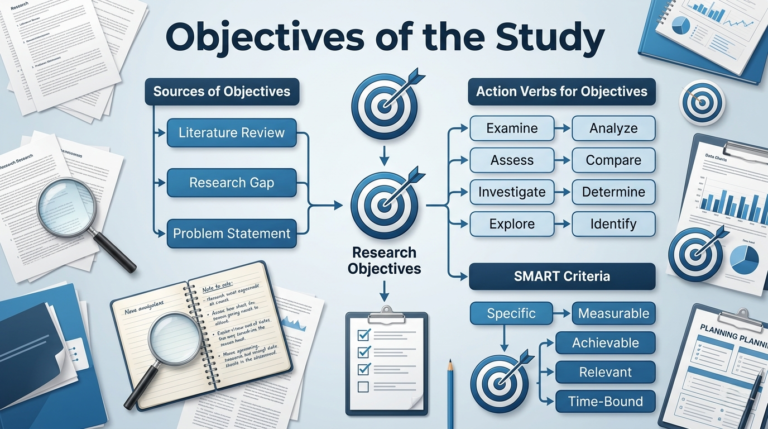
Objective statements should be concise and clear, and should begin with precise action verbs such as: to examine, to analyze, to assess, to investigate, to explore, to compare, to determine, or to identify. Vague verbs such as “to know” should be avoided as they lack academic precision.
Objectives should follow the SMART criteria, they must be Specific (clearly defined), Measurable (progress can be tracked), Achievable (realistic within available resources), Relevant (directly tied to the research problem), and Time-bound (accomplishable within the study period). The number of objectives should not exceed five.
Research Question of the Study
Research questions are interrogative statements that the researcher must address through the study. They are directly linked to the research objectives; each objective typically corresponds to one or more research questions and together they serve as the guiding tracks of the research, keeping the study focused and preventing scope creep. Research questions should be clear, concise, and directly relevant to the study problem.
In quantitative research, research questions are often accompanied by hypotheses which are testable predictions about the expected relationship between variables. In qualitative research, broader, open-ended research questions are used in place of hypotheses, as the aim is to explore meaning and experience rather than test predetermined predictions.
Significance of the Study
In this section, the researcher explains how the study will be beneficial and for whom. The importance of the research and its potential impacts must be clearly articulated and logically supported with arguments and citations.
Significance should be discussed along two dimensions: theoretical significance (how the study contributes to academic knowledge, fills a gap in the literature, or refines an existing theory) and practical/policy significance (how the findings can be applied by practitioners, policymakers, institutions, or affected communities to address real-world problems).
Limitations and Delimitations of the Study
The researcher must indicate both the limitations and delimitations of the study. Limitations are the factors beyond the researcher’s control that may affect the scope, accuracy, or generalizability of the findings such as restricted access to data, time constraints, or sample size.
Delimitations are the boundaries that the researcher consciously sets for the study such as a specific geographic area, age group, or time period representing deliberate choices about what will not be included. The reasons for both must be clearly discussed and justified.
For example, a limitation might be: “Due to time constraints, the study was limited to a sample of 100 respondents, which may affect generalizability.” A delimitation might be: “The study is delimited to female respondents aged 18–35 residing in urban areas of Punjab, as the research focuses specifically on urban female experiences.”
Research Methodology
The methodology section explains the systematic plan for conducting the research. It includes the following components:
Research Method
Explain the nature of the study i.e. qualitative (exploring meaning and experience), quantitative (measuring variables numerically), or mixed-method (combining both approaches).
Research Approach
Describe and justify the specific approach adopted. In qualitative research this may include phenomenology, ethnography, grounded theory, or case study. In quantitative research this may include experimental, survey-based, or correlational design.
Population
Define the geographical area and the individuals or groups from whom data will be collected.
Sampling
Specify the sampling technique i.e. probability-based (simple random, stratified, systematic, cluster) or non-probability-based (purposive, snowball, convenience, quota) and justify the choice.
Research Tool
The five primary tools of data collection in social science research are: (1) questionnaire, (2) interview schedule, (3) interview guide, (4) observation checklist, and (5) focus group discussion guide. Specify which tool is adopted and justify its suitability for the study. This applies when data is collected from primary sources.
Validity and Reliability
The instrument must be assessed for validity (the degree to which it measures what it intends to measure) and reliability (the consistency of results across repeated applications). Strategies such as pilot testing, expert validation, and Cronbach’s Alpha (for quantitative tools) should be mentioned.
Data Analysis
State the method of analysis appropriate to the research design. Quantitative data may be analyzed descriptively (frequencies, percentages, means) or inferentially (T-test, Chi-square, Regression, ANOVA). Qualitative data may be analyzed through thematic analysis, content analysis, or discourse analysis.
Ethical Considerations
The researcher must address: informed consent (participants must voluntarily agree to participate with full knowledge of the study), confidentiality and anonymity (participants’ identities and responses must be protected), the right to withdraw (participants may exit the study at any point without penalty), and compliance with institutional ethical review board (ERB/IRB) requirements.
References
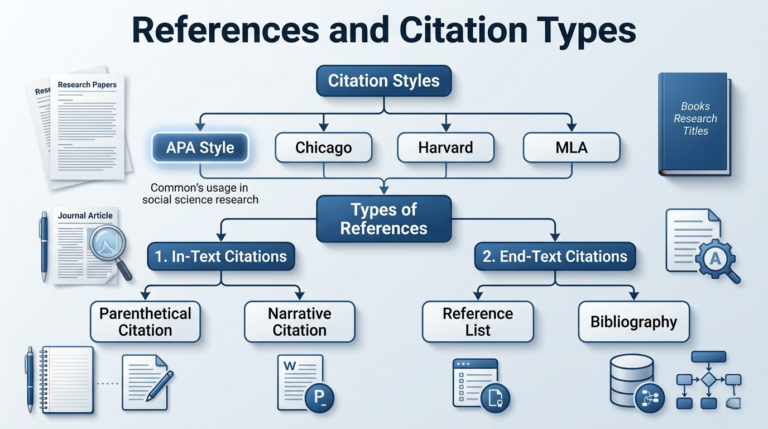
There are various citation styles such as Chicago, APA, Harvard, and MLA (Modern Language Association). However, the APA (American Psychological Association) style is common in Pakistan and social science research. In a book or report reference, the title of the work is italicized; in a journal article reference, the name of the journal is italicized.
Types of References
There are two types of references: in-text citations and end-text citations.
In-text Citations
An in-text citation is the short form of the reference that you include in the body of your work. However, there are two types of in-text citations.
- Parenthetical: This is an example of a parenthetical in-text citation (Javed, 2023).
- Narrative: Javed (2023) offered an example of a narrative in-text citation.
End-text Citation
These appear at the end of the document and take two forms i.e. reference and bibliography.
Reference
Contains the full details of all sources cited within the paper, arranged alphabetically by the author’s last name. Only sources that have been directly cited in the text are included in the reference list.
APA 7th edition Example
Javed, A. M., & Sultana, I. (2017). Women empowerment: A comparative analysis of women empowerment working in public and private organizations of Sargodha District. International Journal of Academic Research in Business and Social Sciences, 7(11), 1–15. https://doi.org/xxxxx
In APA 7th edition, the author’s first name is represented by initials only (not the full first name). The article title uses sentence case (only the first word and proper nouns are capitalized). A DOI (Digital Object Identifier) or URL must be included where available, as it is now a standard APA 7th edition requirement.
Bibliography
The bibliography is a list of all the sources that have been consulted and reviewed in the process of conducting research. A bibliography often encompasses all the sources that have been utilized, regardless of whether they were directly cited in the text. It is broader than the reference list and includes background reading that informed the study. In simple terms, all the consulted material is called bibliography.
Similarities between Bibliography and References
- Both are organized alphabetically by the author’s last name.
- Both contain similar fundamental bibliographic details (author, year, title, publisher/journal).
- Both are located at the end of the academic document.
- Both aim to prevent plagiarism and give proper acknowledgment to original authors.
- Both enable readers to access and verify the original sources.