
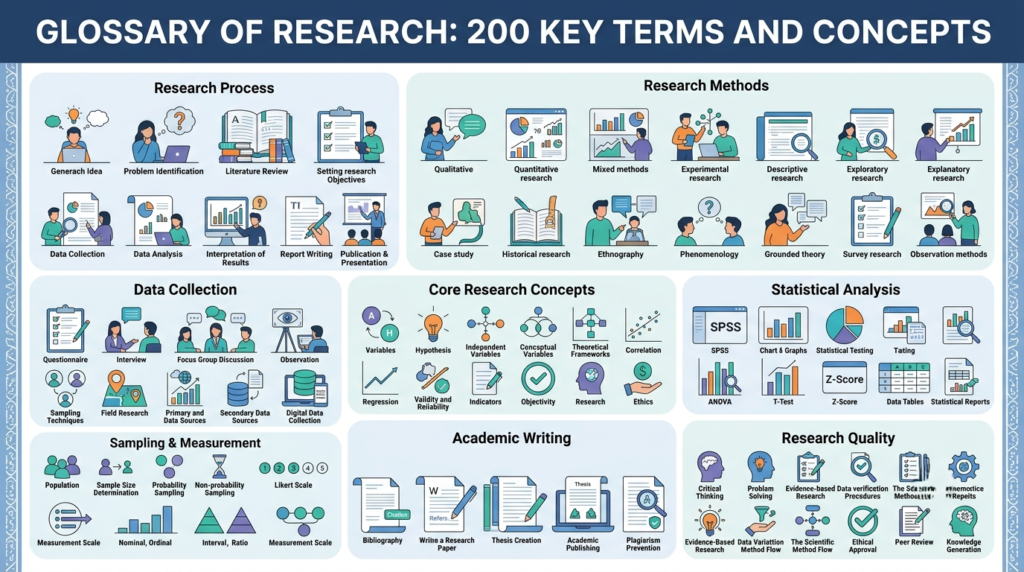
Glossary of Research – A to C
Abstract
An abstract serves as a brief summary of your research, aimed at providing the reader with a comprehensive and clear understanding of your study and its results.
Action Research
The research conducted aims for immediate application. Action research serves as a method for addressing significant local issues. Any issue that needs immediate remedy will be the focus of action research.
Active Variable
In investigations aimed at determining causality or association, there exist variables that can be altered, controlled, and manipulated by either the investigator or external parties. These variables are referred to as active variables.
Alternative Hypothesis
Among many hypotheses which is more workable is selected. An alternative hypothesis serves as an opponent to the null hypothesis.
Analysis
It is the process of converting data in to information by organizing or reorganizing facts-n-figures according to the user’s requirements.
ANOVA
Analysis of Variances: also called F-test, a statistical test, commonly used in social sciences, to test hypothesis (demographic impacts about the mean differences) and compare between more than TWO groups.
Applied Research
In applied research, the identification of the problem is crucial, and the expected results are aimed at enhancing practical solutions to the problem, ultimately leading to tangible benefits. Johada states that applied research focuses not merely on the theoretical relationships between variables; rather, it involves empirical testing in real-world settings.
Approaches of Data Collection
The way a research topic is “accessed” is called its approach. It is also the way a research setting is controlled. There are four ways to do research in the social sciences: survey, experiment, case study, and observation.
Attribute Variables
The variables that are not subject to manipulation, alteration, or control, and that represent the attributes of the study population. The examples include variables such as age, gender, educational attainment, and income level.
Axiology
Axiology represents a distinct branch of philosophical inquiry focused on the examination of judgments related to value. Axiology represents a philosophical inquiry into the valuation of entities and concepts.
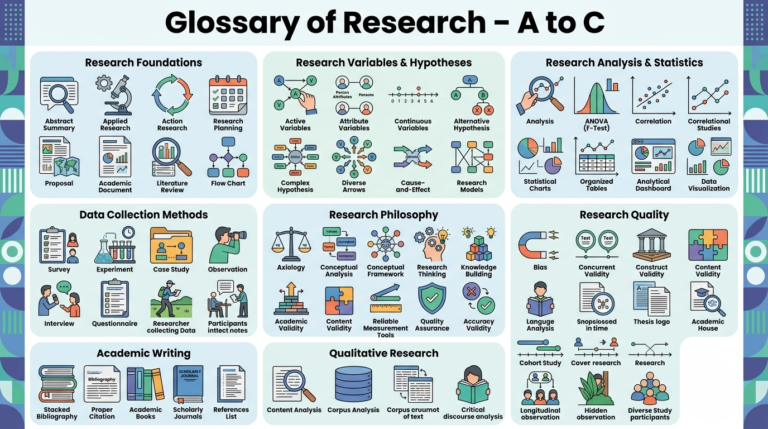
Bias
An intentional effort to either conceal or emphasize a particular finding from your investigation, or to employ a procedure or methodology that is recognized as inappropriate, yet is utilized to obtain desired information due to a personal interest in the outcome.
Bibliography
A list of the sources used in writing a document like paper article or thesis.it includes both embedded and not embedded sources. It is the listing of books, articles and other document that is alphabetically arranged according to the last name of the authors. In social sciences references are used instead of bibliography.
Case Study
The case study serves as a methodological approach for the exploration and analysis of the life of a social unit, whether it is about to an individual, a family, an institution, cultural group, a community, program, or documents.
Citation
It is the process of giving “credit‟ to data sources used in a particular academic document like paper, article or thesis.
Cohort Study
A cohort study involves the examination of distinct subpopulations, or cohorts, as they experience changes over a specified period.
Complex Hypothesis
A complex hypothesis is defined by the interrelationships that exist among multiple variables. This hypothesis indicates the existence of several independent as well as dependent variables.
Conceptual Analysis
Conceptual analysis involves the examination of concepts, terms, constructs, variables, claims, definitions, hypotheses, and theories.
Conceptual Framework
Conceptual frameworks normally focus on one element of the theoretical framework that forms the basis of your study. The latter describes the theories or topics in which your study is based, while the former describes the theoretical framework elements you select to ground your research on. Conceptual framework is the foundation of your study problem.
Concurrent Validity
The assessment of a research instrument’s effectiveness through comparison with observable criteria or reliable results is referred to as concurrent validity.
Construct Validity
It is said that a measure has construct validity if it can accurately predict how it will relate to other academic ideas. When you test for construct validity, you check to see if the variables behave in a way that supports your theory.
Content Analysis
A primary approach for the analysis of qualitative data. The process involves a systematic examination of interview contents or observational field notes to identify the primary themes that arise from the responses provided by participants or the observations recorded by the investigator. Content analysis encompasses two primary approaches: the quantitative method, which emphasizes counting and measurement, and the qualitative method, which prioritizes interpretation and understanding.
Content Validity
The process of evaluating the questions within a research instrument to determine the depth of the areas being investigated is referred to as the content validity of the instrument. The concept of content validity is related to the sufficient representation of the study’s sample. The primary objective is to assess whether all potential methodologies were employed.
Continuous Variables
Continuous variables are defined as phenomena that can assume various quantitative values, including decimal points, or as variables that can take on an uncountable or infinite set of values. For instance, variables such as age, income, and attitude score can be considered.
Controlled Observation
Observation conducted in accordance with pre-established protocols, utilizing an experimental framework, constitutes controlled observation typically performed in a laboratory setting under regulated conditions.
Corpus Analysis
Corpus analysis represents a methodological approach grounded in empirical research, extensively employed in the field of language studies, utilizing authentic linguistic data. This constitutes a digital compilation of texts, text fragments, and/or transcripts.
Corpus
A corpus refers to a systematic compilation of written texts, particularly encompassing the complete works of a specific author or a comprehensive body of literature focused on a particular topic.
Correlation
An inferential tool for measuring the association between Two Variables, indicated as “R2”. It tells nature, direction (- or +) significance and strength (equal to or less than one) between the variables.
Correlational Studies
Research initiatives that are fundamentally structured to examine the existence of a correlation between two or more variables.
Covert Research
Covert research represents a methodological approach wherein the investigator’s professional identity and scholarly objectives are concealed, either in whole or in part, from the participants engaged in the study.
Critical Discourse Analysis
Discourse analysis serves as a methodological approach for examining both written and spoken language, particularly in connection with its social context. The primary goal is to analyze the application of language in practical contexts.
Cross-Sectional Study
This process entails the examination of a sample or cross-section of a population or phenomenon, conducted at a singular moment in time.
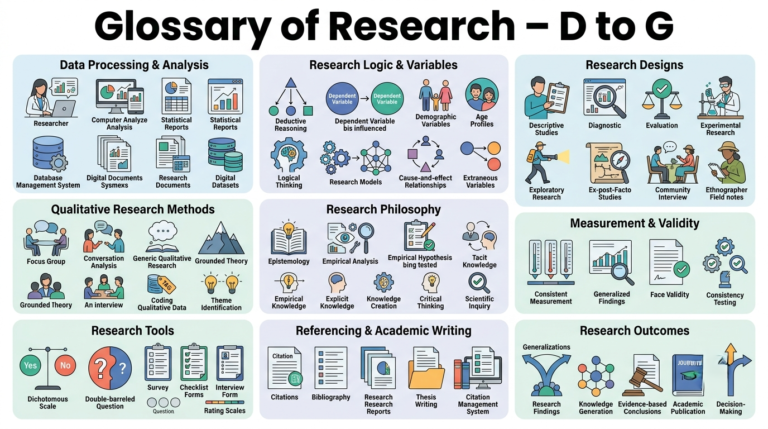
Glossary of Research – D to G
Data Analysis
The process involves transforming data, which consists of unorganized facts and figures, into information, characterized by organized facts and figures. The process fundamentally involves addressing research questions.
Data Collection
The process of data collection involves the systematic gathering of data from a variety of sources.
Data Reduction
A process to bring facts and figures in to manageable form. The qualitative are reduced through “classification” while quantitative data is arranged in to a data-matrix through “tabulation”.
Deductive Reasoning
Knowledge gained by reasoning and begins with general statements (premises) and, through logical argument, comes to a specific conclusion it is called ‘rationalism’.
Demographic Variables
Demographic Variables include demographic status or position of the respondents, like gender, residence, income, profession, status and so on.
Dependent Variables
The variable that depends upon other factors those are measured. It is the presumed effect.
Descriptive Data / Analysis
The data are organized according to the variables of research without talking about their mutual relationship is called descriptive data.
Descriptive Studies
A study in which the main focus is on description, rather than examining relationships or associations, is classified as a descriptive study. A descriptive study attempts systematically to describe a situation, problem, phenomenon, service or program, or provides information about the living conditions of a community, or describes attitudes towards an issue.
Diagnostic Research Design
In diagnostic research, the design strives to explore the reason behind an issue and find solutions to solve it.
Dichotomous Scale
Dichotomous data is defined by having only two categories or levels, such as “yes’ and ‘no’.
Discourse / Conversation Analysis
Conversation analysis is a branch of linguistics that involves the systematic analysis of verbal and nonverbal behaviors in conversation to understand how people interact with each other. It is also known discourse analysis. Conversation analysis is a specific type of discourse analysis that focuses on the structure and organization of spoken interaction.
Discourse analysis, on the other hand, is a broader field that examines language use in a range of contexts, including written texts, speeches, and media.
Double-barreled Question
A double-barreled question is a question within a question.
Editing
Data editing involves scrutinizing the completed research instruments to identify and minimize, as far as possible, errors in completeness, misclassification and gaps in the information obtained from respondents.
Empirical Analysis
(i.e. Field Survey) Analysis by using statistical tools like correlation, regression and test of significance, mostly used in Quantitative research approaches.
Empirical Hypothesis
Working hypothesis is that one which is applied to a field. During the formulation it is an assumption only but when it is part to a test it become an empirical or working hypothesis.
End-text Citation
An end-text citation is a brief form of the reference that you include at the end of your dissertation.
Epistemology
As a branch of philosophy deals with “The Sources of knowledge”. Specifically, Epistemology is concerned with possibilities, nature, sources and limitations of knowledge in the field of study.
Ethnography Research
Ethnography is a qualitative research methodology. It is the study of social interactions, behaviors and perceptions that occur within groups, organizations and communities.
Evaluation Research
Evaluation research aims at evaluating programs that have been implemented to get an objective.
Experimental Research
It involves procedure for gaining knowledge by collecting new or fresh observations under controlled conditions. It reveals causes and effect relationship of variables.
Explanatory Research
In an explanatory study the main emphasis is to clarify why and how there is a relationship between two aspects of a situation or phenomenon.
Explicit and Tacit Knowledge
Cultural knowledgeincludes both explicit knowledge (i.e., what we know and talk about) and tacit knowledge (i.e., what we implicitly know but rarely acknowledge directly).
Exploratory Research
This is when a study is undertaken with the objective either to explore an area where little is known or to investigate the possibilities of undertaking a particular research study. When a study is carried out to determine its feasibility it is also called a feasibility or pilot study.
Ex-Post-Facto Research
This type of research is used to study the varying influence of two identical factors. There will be two variables, the dependent variable and independent variable. This study will always be based on past knowledge.
External Reliability
It refers to the consistency of a procedure from one occasion to another.
External Validity
External validity refers to the extent of generalizing the results of the study to setting up the samples for other studies of the relevant field.
Extraneous Variables
The variables which are not directly related to the purpose of the study but affect the variables are known as extraneous variables.
Face Validity
When you justify the inclusion of a question or item in a research instrument by linking it with the objectives of the study, thus providing a justification for its inclusion in the instrument, the process is called face validity.
Field Research
In this research, the researcher selects the subjects and measures their behavior. Field research includes ethnography, participant observation, depth interviewing.
Focus Group Discussions
Focus group discussions are a qualitative approach to gain an in-depth understanding of social issues from group of people.
Generalization
It is also called generalizability. It refers to the degree to which you can apply the results of your study to a broader context.
Generic Qualitative Research
Generic qualitative research is a descriptive methodology aimed at understanding how individuals make meaning of a phenomenon or a situation, based on ‘what will work best’ in finding answers for the questions under investigation.
Grounded Theory
Grounded theory is a qualitative research methodology that aims to generate theories based on data that are grounded in the empirical reality of the research context.
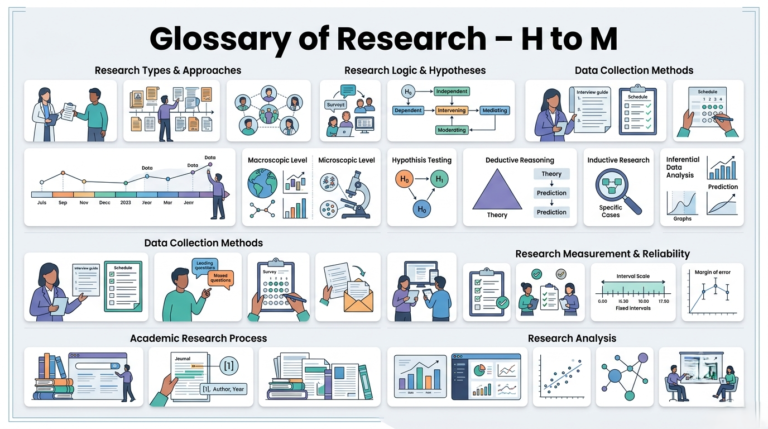
Glossary of Research – H to M
Hand delivered Questionnaire (Direct Questionnaire)
This is a type of questionnaire in which the investigator go to the field himself and hand over the pre written questionnaire to the respondents.
Heuristic Research
The researcher’s own experiences are intentionally included as part of the investigation. This approach is commonly associated with Clark Moustakas in 1990.
Historical Research
The critical examination of past events in order to borrow truth is known as historical research.
Holistic Research
The design is based upon the philosophy that as a multiplicity of factors interacts in our lives, we cannot understand a phenomenon from one or two perspectives only. To understand a situation or phenomenon we need to look at it in its totality or entirety, that is holistically from every perspective.
Hybrid Research
Hybrid research is a combination of two research techniques whether it be qualitative and quantitative or a mixture of qualitative methods, to deliver the perfect solution. It is also commonly referred to as mixed-method research.
Hypothesis
Hypothesis is a statement which can be true or falls on the basis of experiment.
Independent Variables
The variable that is stable and unaffected by the other variables you are trying to measure. It is the presumed cause.
Inductive and Deductive Research
In inductive research, the goal of a researcher is to deduce theoretical concepts and patterns from observed data. It begins with data collection and identifies patterns to form new theories or hypotheses. It is the research which moves from “specific” to the “general”.
In deductive research, the goal of the researcher is to test concepts and patterns known from theory using new empirical data. Hence, inductive research is also called theory-building research, and deductive research is theory-testing research. It is the research which moves from “general” to the “specific”.
Inductive Reasoning
Knowledge gained by sensory experiences or/and starts from specific observations and then develops a general conclusion from them. It is called ‘empiricism’.
Inferential Data / Analysis of Hypotheses
The analyses of data’s relationships between different variables of the study are called inferential analysis or testing of hypotheses. For that purpose, different statistical tools are used like correlation, regression and test of significance.
Interaction Analysis
Interaction analysis is a method for the investigation of the interactions of human beings with each other and with the objects in their environments.
Inter-disciplinary Research
It is the study of the structure and function of a particular discipline or comparison of one discipline with another. It is also called coordinated research.
Internal Reliability
It assesses the consistency of results across items within a test.
Interrater Reliability
Interrater reliability (also called inter-observer reliability) measures the degree of agreement between different people observing or assessing the same thing.
Interval Scale
The interval scale is a quantitative measurement scale where there is order, the difference between the two variables is meaningful and equal, and the presence of zero is arbitrary i.e. Thermometers.
Intervening Variable
Sometimes called the confounding variable (Grinnell 1988: 203), it links the independent and dependent variables.
Interview Guide / In-depth Interview
An in-depth interview (IDI) is a data collection process that allows interviewers to collect high-quality, detailed information from interviewees by using open ended questions or list of points.
Interview Schedule
Interview Schedule is the tool for data collection in which there is a face to face questioning between the interviewer and interviewee. It is carefully formulated documents having predetermined questions.
In-text Citations
An in-text citation is the short form of the reference that you include in the body of your work.
Key-informant Interviews
Key informant interviews are in-depth interviews to capture participants’ perspectives on the research topic. The information is collected from a wide range of people including community leaders, professionals, or residents who have first-hand knowledge.
Leading Question
A question which, by its contents, structure or wording, leads a respondent to answer in a certain direction.
Likert Scale
A Likert scale is a unidimensional scale that researchers use to collect respondents’ attitudes and opinions. It is comprised of three dimensions i.e. highest and lowest having middle as neutral point.
Literature Review
A literature review is a survey of scholarly sources (such as books, journal articles, and theses) related to a specific topic or research question. It is often written as part of a thesis, dissertation, or research paper, in order to situate your work in relation to existing knowledge.
Logical Hypothesis
A logical hypothesis is a proposed explanation possessing limited evidence. A hypothesis that can be verified logically is known as a logical hypothesis.
Longitudinal Study
A study design in which data is obtained from the same individual two or more times during a specific period of time.
Machine-assisted or Computer-aided Research
Machine assisted or computer aided research is a powerful field-tested platform/tool that allows the researcher to collect high-quality data using mobile phones, tablets, computers.
Macro-Study
An understanding of social life at a large level even at the level of whole society.
Mailed Questionnaire
Mailed questionnaires is a tool of research where a respondent sends his answers through mail to the researcher.
Margin of Error
Margin of error is the amount of error allowed for a miscalculation to represent the difference between the sample and the actual population.
Mediating Variable
A mediating variable explains how or why an independent variable influences a dependent variable. It answers the question: “Through what process or mechanism does this relationship occur?”
Micro-Study
An understanding of social life at a smalls level/unitary level.
Mixed / Multiple Methods Approach
In extremely simple terms, the mixed methods approach to social research is when you combine two or more methods to collect and analyze data pertaining to your research problem. When these methods are from both paradigms, that is, when a study uses both quantitative and qualitative methods, it is classified as mixed methods approach.
However, when these are from one paradigm only, it is called multiple methods approach. The approach is based upon the rationale that for certain situations qualitative techniques are better and for others quantitative ones are better. Hence, to get the best outcome for a research study you need to combine both approaches or use more than one method.
Moderating Variable
A moderating variable affects the strength or direction of the relationship between an independent and a dependent variable. It answers the question: “When or for whom does this relationship occur?”
Glossary of Research – N to R

Narrative Citations
Javed (2023) offered an example of a narrative in-text citation.
Narrative Research
A qualitative approach in which researcher collects and studies personal stories and life experiences of people. The focus is on understanding how individuals make sense of their own lives through the stories they tell. Aiming for an in-depth exploration of the meanings people assign to their experiences.
For example, listening to the life story of a street child or a domestic violence survivor.
Nominal Scale
The nominal scale of measurement defines the identity and property of data. This scale has certain characteristics, but doesn’t have any form of numerical meaning. Examples of nominal data include eye color and country of birth.
Non-continuous or Discrete Variables
Values that can be expressed only in digit values or information that has noticeable gaps between values is called ‘non-continuous or discrete variables’.
Non-experimental Research
Non-experimental research gets its name from the fact that there is no independent variable involved in testing.
Non-Participant Observation
The observer will not be the part of phenomenon but having a distance to observe.
Non-Probability / Non-random Sampling
In non-probability, the selection of the elements is not based on probability theory, but the personal judgment plays a signification role in the selection of the sample.
Null Hypothesis
According to Null hypothesis there is no relationship between independent variable and dependent variable.
Objectivity
Objectivity in research isthe ability of the researcher to keep their personal beliefs and biases separate from the results of their study.
Observation
Observation is a careful and silent activity to know about the prevailing phenomenon, event or situation.
Ontology
Ontology can be defined as “the science or study of being and it deals with the nature of reality.
Ordinal Scale
The ordinal scale defines data that is placed in a specific order. Likert scales are best examples.
Panel Study
Examines the same set of people each time. These are prospective in nature and are designed to collect information from the same respondents over a period of time.
Parallel forms Reliability
Parallel forms reliability measures the correlation between two equivalent versions of a test. You use it when you have two different assessment tools or sets of questions designed to measure the same thing.
Parameter
Calculated values of population are called parameter.
Parenthetical Citations
This is an example of a parenthetical in-text citation (Javed, 2023).
Participant Observation
Observer must have to be part of phenomenon. It is costly and difficult.Participant observation is done under such conditions when the observer becomes a part of the group that is being studied.
Phenomenology / Phenomenological Research
A qualitative approach that explores the lived experience of people regarding a specific phenomenon or event. It asks the question “What is it like to experience this?” For example, understanding what it feels like to live in extreme poverty or to be a refugee in a new country.
Pie Chart
The pie chart is a way of representing data graphically. A full circle of 360 degrees can be used to represent 100 per cent or the total population. The circle is divided into sections in accordance with the magnitude of each subcategory comprising the total population. Hence each section is in proportion to the size of each subcategory of a frequency distribution.
Pilot Study
A small scale study conducted prior to the conducting of the actual and complete study; its purpose is to reveal defects in the research plan.
Placebo Design
A placebo design is a research method used to test how effective a treatment or program really is by comparing it with a placebo, which is an inactive or fake treatment like a sugar pill.
Plagiarism
Use of someone else’s work, academic or non-academic, claiming it to be yours is called plagiarism and is considered unethical in research.
Polytomous Variable
A variable consisting of more than two categories, for example religion (Christian, Muslim, Hindu), political parties (Labor, Liberal, Conservative), and attitudes (strongly in favor, in favor, uncertain, against, strongly against).
Posttest
The posttestisthe measurement of the dependent variable after thetreatment has been introduced into the experimentalsituation.
Predictive Validity
It is also called criterion-related validity.This form of validity is judged by the degree to which an instrument can correctly forecast an outcome; the higher the correctness in the forecasts, the higher the predictive validity of the instrument.
Primary Data
The data which is collected from the selected population e.g. respondent, by using different tools of data such as interview schedule, interview guide, questionnaire, observation, and focus groups discussion is called primary data.
Probability / Restricted Sampling
In probability sampling the selection of sample from the universe has an equal chance to all the members.
Probe in Interview
Asking follow-up questions when we do not fully understand a response, when answers are vague or ambiguous or when we want to obtain more specific or in-depth information.
Prospective Study
In prospective studies, individuals are followed over time and data about them is collected as their characteristics or circumstances change. It refers to the likely prevalence of a phenomenon, situation, problem, attitude or outcome in the future.
Pure / Basic research
Developing scientific theories or basic principles are called pure or basic or fundamental research. Pure research provides basic knowledge to the research activity.
Qualitative Research
In Qualitative research first of all quantity is collected and then analyzed. The factual information is made available in the society. Both inductive and deductive methods are used. Data is collected through observation and interview techniques are used after that conclusion is drawn.
Quantitative Research
Quantitative research is the process of collecting and analyzing numerical data. It can be used to find patterns and averages, make predictions, test causal relationships, and generalize results to wider populations.
Quasi-or Semi-experimental
Quasi-experimental studies are semi-experimental studies and they have both the properties of experimental and non-experimental studies. Part of the study is performed under controlled experimentation situation and part of the study is conducted in a non-experimental situation.
Questionnaire
Questionnaire is a carefully formulated document to collect data from large, diverse and widely scattered group of people.
Rating Scale
A rating scale is a closed-end survey question that is used to evaluate how survey responders feel about a particular product or statement.
Ratio Scale
The ratio scale is the variable measurement scale that produces the order of variables. Ratio scales of measurement include properties from all four scales of measurement.
Redundant Publication
Redundant publication is occur when two or more papers without full cross reference, share the same hypothesis, data, discussion points, or conclusions.
Reference and Bibliography
A referencelist usually consists of the details of all the sources cited within your paper. A bibliographyrefers to a list of all of the sources you have studied in preparing your research work whether you cited it or not.
Regression
Statistical tool for measuring cause-n-effect relationship. It tells us whether independent variables bring change in dependent variable or not. Firstly, used by Sir Francis Galton in 1877.
Research Design
Research design is the plan, structure, and strategy of investigation to obtain answers to research questions and control variance.
Research Ethics
Research ethics the principles and guidelines that govern the researcher’s behavior or the conducting of an activity.
Research Gap
A research gap is a question or a problem that has not been answered by any of the existing studies or research within your field.
Research Methodology
It is the sum of approaches, methods, tools and techniques which are used in any research work. This includes the process of data collection and analysis.
Research Objectives
Specific statements of goals that you set out to be achieved at the end of your research journey.
Research Paradigms
A research paradigm is “the set of common beliefs and agreements shared between scientists about how problems should be understood and addressed”.
Research Participants
Those respondents or subjects who participate in a research study.
Research Philosophy
Research philosophy is belief about the ways in which data about a phenomenon should be collected, analyzed and used.
Research Problem
A research problem is a specific issue or gap in existing knowledge that you aim to address in your research.
Research Proposal / Synopsis
A research proposal is a concise, coherent and compact summary of proposed research.
Research
Research is a careful and critical investigation in the light of newly discovered facts.
Retrospective Study
A retrospective study investigates a phenomenon, situation, problem or issue that has happened in the past. Such studies are usually conducted either on the basis of the data available for that period or on the basis of respondents‟ recall of the situation.
Rhetorical Criticism
Rhetorical Criticism is a systematic method for describing, analyzing, interpreting, and evaluating the persuasive force of messages embedded within texts.
Glossary of Research – S to Z
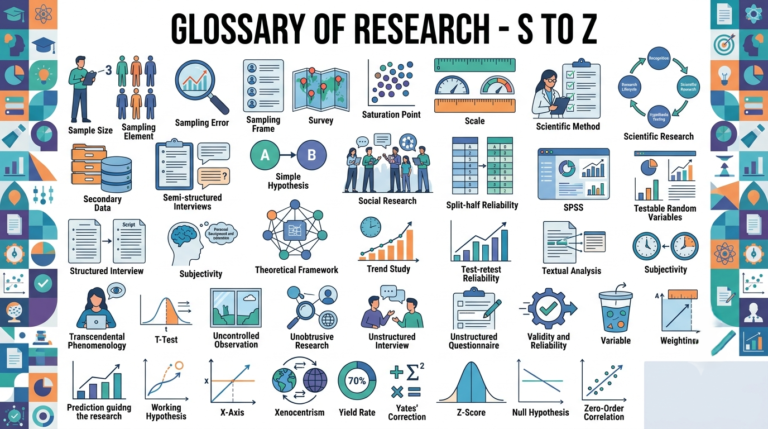
Sample Size
Size of the sample refers to the number of items/individuals to be chosen from the universe to form a sample.
Sampling Element / Sampling Unit
Anything that becomes the basis of selecting your sample such as an individual, family, household, members of an organization, residents of an area, is called a sampling unit or element.
Sampling Error
A sampling error is a statistical error that occurs when an analyst does not select a sample that represents the entire population of data. As a result, the results found in the sample do not represent the results that would be obtained from the entire population.
Sampling Frame
A sampling frame lists all members of the population you’re studying. Your target population is the general concept of the group you’re assessing, while a sampling frame specifically lists all population members and how to contact them.
Sampling
A sample is a smaller representation of a large whole.
Saturation Point
The concept of saturation point refers to the stage in data collection where you, as a researcher, are discovering no or very little new information from your respondents. In qualitative research this is considered an indication of the adequacy of the sample size.
Scale
This is a method of measurement and/or classification of respondents on the basis of their responses to questions you ask of them in a study. A scale could be continuous or categorical. It helps you to classify a study population in subgroups or as a spread that is reflective on the scale.
Scientific Method
Scientific method is characterized by verifiability, ethical neutrality, accuracy, precision, objectivity, and it is systematic, its production based on probability.
Scientific Research
Scientific research is based onprinciples and procedure for the systematic pursuit for knowledge, involving the recognition and formulation of a problem, the collection of data through observation and experiment, and the formulation and testing of hypothesis.
Secondary Data
The data which is already gathered and available on other sources is called secondary data.
Semi-structured Interviews
A semi-structured interview is a type of interview in which the interviewer asks only a few predetermined questions while the rest of the questions are not planned in advance. Since semi-structured interviews combine both the structured and unstructured interview styles.
Simple Hypothesis
Simple hypothesis is that one in which there exist relationship between two variables.
Social Research
Social research is an organized effort to learn new things about different parts of society and social issues.
Split-half Reliability
You randomly split a set of measures into two sets. After testing the entire set on the respondents, you calculate the correlation between the two sets of responses.
SPSS
SPSS stands for Statistical Package for the Social Sciences. It is a software program used by researchers in various disciplines for complex statistical data analysis.
Statistical Hypothesis
A statistical hypothesis, sometimes called confirmatory data analysis, is a hypothesis that is testable on the basis of observing a process that is modeled via a set of random variables.
Structured Interview
Structured interviews are those interviews in which the questions that are to be asked from the respondents are prepared and preplanned in advance by the researcher. The interview is fixed and pre-determined and any deviation from it is not permitted.
Subjectivity
This is an integral part of your way of thinking that is “conditioned” by your educational background, discipline, philosophy, experience and skills. Bias is a deliberate attempt to change or highlight something which in reality is not there but you do it because of your vested interest. Subjectivity is not deliberate; it is inherent in the way you understand or interpret something.
Survey
A survey is a collection of data concerning the living and working conditions, broadly speaking the people in a given community.
Test-retest Reliability
Test-retest reliability measures the consistency of results when you repeat the same test on the same sample at a different point in time.
Textual Analysis
It is a method of studying a text in order to understand the author’s deliberate meaning. Textual analysisis a broad term for various research methods used to describe, interpret and understand texts.
Theoretical Framework
After reading a plenty of literature, the information obtained from different sources needs to be sorted under the main themes and theories, highlighting agreements and disagreements among the authors. This process of structuring a “network” of these theories that directly or indirectly have a bearing on your research topic is called the theoretical framework.
Trend Study / Time Series Research
Examines the changes within a given population overtime.
Transcendental Phenomenology
It seeks to understand people’s lived experiences by going beyond the researcher’s own beliefs and assumptions. In simple, learning about a phenomenon by deeply exploring both your own experience and the experiences of others. It was expressed by Clark Moustakas by 1994.
T-Test
A test of significance used when population standard deviation is unknown and when there are two demographic groups and small sample size 30-120 is utilized. Similarly, t-test is used for continuous (interval or ratio) data and chi-square test used in categorical data.
Uncontrolled Observation
An observation that takes place in natural conditions and the situation is not created by observer own self. That is why, it is also called naturalistic observation. It takes place in natural setting without the influence of external or outside control.
Unobtrusive Research
It refers to methods of collecting data that don’t interfere with the subjects under study. Unobtrusive methods involve indirect data collection. The researcher makes no direct contact with the subject of study.
Unstructured Interview
These interviews are said to be unstructured and sometimes called a non-directive interview, when the researcher conducts an interaction with the respondent in an informal atmosphere. Nothing is preplanned in advance.
Unstructured Questionnaire (Open Ended Questionnaire)
An unstructured questionnaire is not which contain open or provocative questions, inviting you for response.
Validity and Reliability
Validity refers to the appropriateness of each step in the research process. Validity in the broader sense refers to the ability of a research instrument to demonstrate that it is finding out what you designed it to and reliability refers to consistency in its findings when used repeatedly.
Variable
The quantity which is subject to change.
Weighting
A statistical technique used to adjust data so that a sample better represents the target population.
Working Hypothesis
A preliminary assumption or prediction that guides the research process and is tested during the study.
X-Axis
The horizontal axis on a graph, usually representing the independent variable.
Xenocentrism
A tendency to value another culture more highly than one’s own; often studied in social and cultural research.
Yield Rate
The percentage of usable responses or participants obtained from the total number approached in a study.
Yates’ Correction
A statistical adjustment used in chi-square tests when analyzing small sample sizes.
Z-Score
A statistical measure indicating how many standard deviations a value is above or below the mean.
Zero Hypothesis (Null Hypothesis, H₀)
The assumption that there is no relationship, difference, or effect between variables until evidence suggests otherwise.
Zero-Order Correlation
The direct correlation between two variables without controlling for any other variables.