
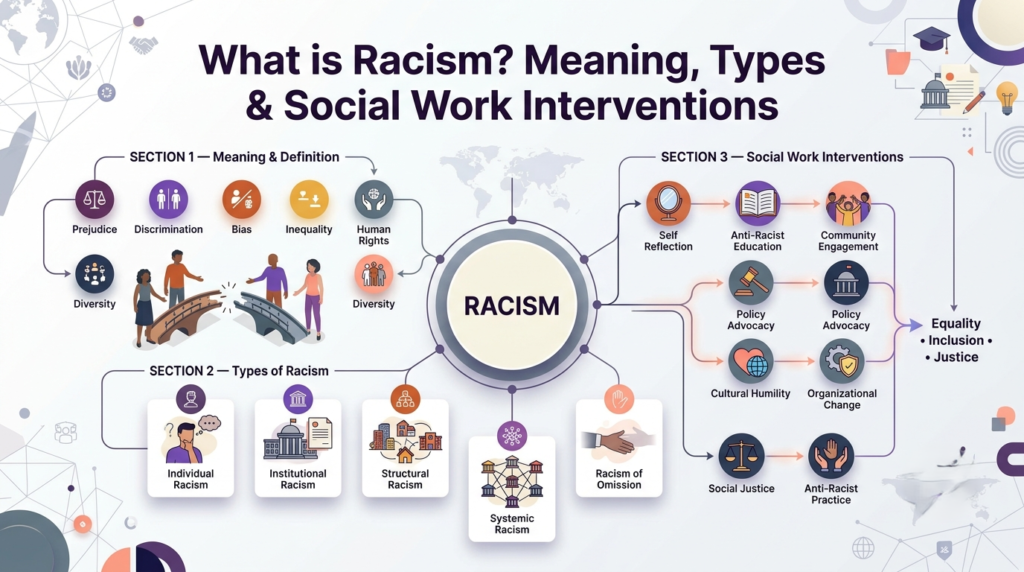
Racism is a complex phenomenon defined differently across disciplines, cultures, and social settings. It includes beliefs, practices, and structures that generate and perpetuate racial inequalities, and different definitions emphasize individual bias, institutional dynamics, systemic structures, and cultural meanings.
What is Racism? Meaning and Concept
Definitions of racism vary across cultures and according to political opinion, gender, income, and personal experience, all of which shape perceptions of intentionality and power in racial discrimination (Valentino & Warren, 2024). Additionally, the explanatory power of institutional racism compared to individual racism and the possible limits of institutional reforms in addressing the moral issues surrounding race continue to be debated (Matthew, 2022).
Systemic racism is also experienced through the resilience and coping strategies of marginalized groups; it is oppressive yet also provides a context for cultural strength and adaptation (Jones, 2023). Racism is fundamentally a mixture of prejudice, discrimination, and inequity derived from the process of racially categorizing people. Its definition varies depending on the emphasis placed on different aspects:
Prejudice and Individual Bias
Many traditional approaches, particularly those in hegemonic social psychology, have reduced racism to prejudice, individual bias, or negative attitudes and stereotypes toward racial groups, generally separated from a wider social and historical context. This tends to focus on the cognitive and emotional levels of racism as individual-level processes (Adams & Omar, 2024).
Power, Intentionality, and Unequal Treatment
In the United States, understandings of racism differ based on the weight given to intent, unequal treatment, unequal outcomes, and power imbalance, as shown in a mixed-methods study. People disagree about whether racism requires prejudice and systemic power, or whether it can exist without such intent (Valentino & Warren, 2024).
Systemic and Structural Racism
Critical Race Theory (CRT) sees racism as a systemic and structural element of societies that are Eurocentric and premodern, not as a personal phenomenon. Structural racism contributes to systemic inequities for marginalized racial populations through persistent organizational, institutional, and structural practices, processes, and patterns (Adams & Omar, 2024; Adkins-Jackson et al., 2025).
Institutional Racism
This refers to the presence of formal or informal rules, policies, and practices in institutions, such as the legal system, police, and education that create or sustain racial inequalities.
There is no universal consensus on a definition of institutional racism, and debates continue about whether it is an aspect of systemic racism or a distinct form of racism itself: a matrix of structural racism. Some define institutional racism as indirect discrimination within institutions (Matthew, 2022; Schols & Maussen, 2025).
Racism of Omission
Acts of omission, systemic failures, or inaction that continue to create racial disparities can also be considered racism, and inaction or omission can be as much a form of racial exclusion as overt discrimination. (Kramer et al., 2025)
Types of Racism
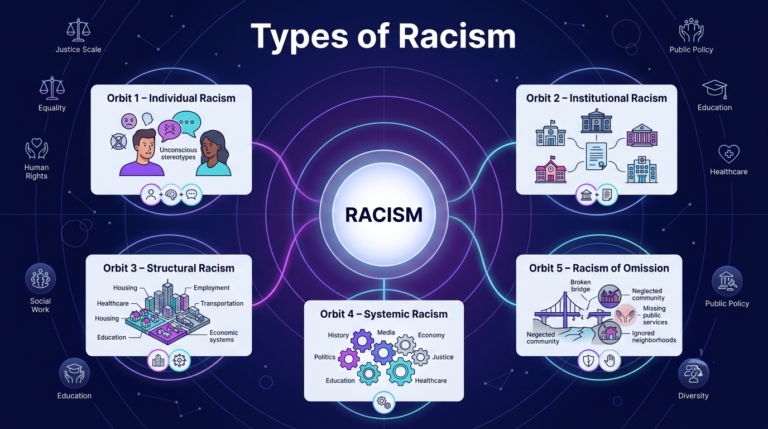
These conceptualizations can be described as follows: racism can be divided into different types.
Individual Racism
Beliefs, attitudes, and behaviors that stem from an individual and are prejudiced or discriminatory against others based on race. This means that discrimination may be obvious, unintentional, or unconscious.
Institutional Racism
Rules, practices, and policies within an institution that have a disproportionate effect, intentionally or unintentionally, on racial differences. For instance, ethnic profiling by police or discriminatory hiring practices.
Structural Racism
The pervasive system of oppression that impacts multiple aspects of society, including health, education, and economic opportunity, through a complex of policies, messages in the culture, and historical practices that continue to create racial disparities (Adkins-Jackson et al., 2025).
Systemic Racism
This term is sometimes used as an alternative for structural racism, but sometimes it specifically highlights how racism is reinforced by the structures and systems within society, such as history, culture, and social institutions.
Racism of Omission
The systemic failure to act, or neglect of action, to address racial inequalities, resulting in long-lasting exclusion and discrimination without explicit racist actions (Kramer et al., 2025).
Examples Illustrating Different Types
To demonstrate different types of racism, the following examples are provided.
Individual Racism
Someone who does not serve people of all races or who uses racial slurs.
Institutional Racism
Ethnic profiling, in which a larger proportion of minority groups are stopped and searched than majorities, resulting from law enforcement policies or practices (Schols & Maussen, 2025).
Structural/Systemic Racism
Individual prejudice alone is not responsible; rather, the combination of disadvantageous conditions, including historical segregation, discriminatory lending, and segregated schooling, constitutes an interlocking system of disadvantages (Adkins-Jackson et al., 2025; Muramatsu, 2022).
Racism of Omission
Insufficient institutional attention to environmental injustices faced by communities of color, or to policy reform that perpetuates racial health disparities (Kramer et al., 2025).
Key Social Work Interventions in Addressing Racism
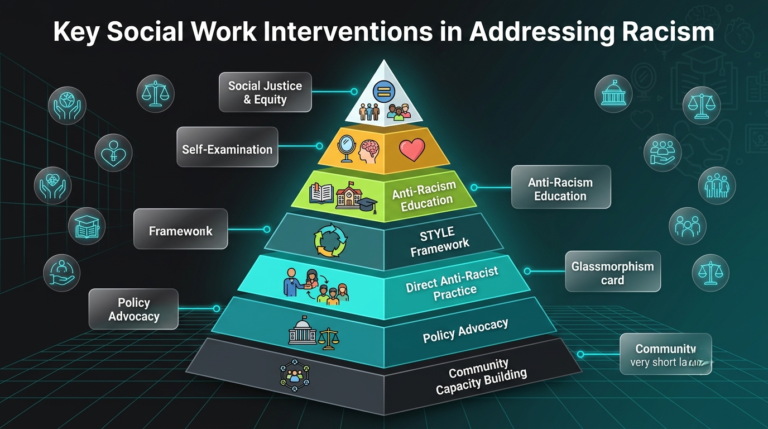
Social work practice in response to racism is multi-level, targeting individual biases, institutional barriers, and systemic inequities that affect marginalized racialized communities. Informed by recent research and practice frameworks, social workers self-reflect, learn, advocate, and propose policy change and direct praxis that are culturally responsive to foster racial anti-oppression.
Self-Examination and Development of Anti-Racist Practice Behaviors
Social workers and students are encouraged to continually examine themselves regarding race to gain awareness of their own racial biases, body reactions, feelings, and behaviors in relation to race. One study of a 10-week experiential program with White-bodied social work students showed substantial progress in awareness of racist acts, bodily sensations associated with race, and skills to take action in practice settings to combat racism.
This “embodied” anti-racist training supports the development of actionable skills needed for anti-racist social work practice (Lerner, 2025).
Integrating Anti-Racism Training in Social Work Curricula
The critical need for anti-racism education across social work education is being recognized and emphasized. Courses that center on unlearning socially conditioned racism, applying anti-racism frameworks, and critical consciousness foster key knowledge and mindsets in students.
Multi-day workshops and systematic content on anti-racist practice throughout MSW programs have been shown to develop critical awareness and readiness for anti-racist practice in professional social work roles (Cornell, 2024).
Use of STYLE Framework for Continuous Anti-racist Practice
STYLE is a tool that supports practitioners in five steps: Self-examination, Talk about racism, Yield time to anti-racism work, Learn about structural racism, and Evaluate policies and practices. This approach helps social workers critically examine themselves, engage in honest conversations about racism, commit to anti-racist action, learn more about systemic racism, and challenge their own organization’s policies for racism.
STYLE aims to cultivate active partnerships with impacted communities and to foster justice cooperation, particularly for clients who engage with other systems, such as the legal or health systems (Fix et al., 2023).
Culturally Sound and Anti-Racist Direct Interventions
Culturally humble, strengths-based interventions, combined with an explicit anti-racist stance, are beneficial in clinical and community settings with couples, families, and communities of people of color, particularly African American couples and families.
Therapy should be competent and critical, confronting oppression while promoting resilience and freedom from systemic racism. This involves systemic awareness, cultural responsiveness, and social attunement in assessment and intervention (Kaslow et al., 2023).
Advocacy for Institutional and Policy Change
Professionally, social workers are responsible for opposing institutional and systemic racism through policy assessment and change. This means advocating for organizational accountability, policy change, and anti-racist institutional practices. Advocacy can take the form of addressing racial inequities in institutional norms and practices, including in health care, housing, and social service systems (Fix et al., 2023; Khan-Gökkaya et al., 2025).
Rejecting Culturally Assimilative ‘Competence’ in Favor of Explicit Anti-Racism
Social work critiques challenge the use of cultural competence strategies that can be problematic because they can essentialize racial identities and depoliticize racial discrimination by minimizing it as “cultural differences.”
Rather than that, explicit anti-racism practices that challenge whiteness, structural power, and anti-racism practices which challenge whiteness, structural power, and anti-racism practices which challenge whiteness, structural power and institutional post-racism are required to tackle racial injustice in social housing and other social work areas (Clare & Clare, 2025).
Capacity Building and Community Engagement for Systemic Change
Anti-racism professional development training and peer networks allow professionals and organizations to gain experiential knowledge, reflect on their work, and engage in collaborative problem-solving. These efforts increase practitioners’ awareness of systemic inequities and develop strategies for sustainable anti-racist practice (Kanninen et al., 2025) that are situational and context-dependent and best aligned with each setting.
Summary of Social Work Interventions
There are multiple dimensions of social work interventions to tackle racism, including:
- Broad self-awareness of personal and professional identity and anti-racist actions
- Educational reform that includes full-scale curriculum and workshops addressing anti-racism.
- Continuous reflective practice and policy assessment using a framework (e.g., STYLE)
- Culturally humble, strengths-based direct services with folks of color
- Advocate for organizational accountability and system change in policies.
- Avoiding the superficial practice of “cultural competence” to embrace explicit anti-racism. Omitting the “cultural competence” approach to embrace explicit anti-racism.
- To build the capacity to engage in coalition building with racialized communities and peers.
This integrative approach is aligned with social work practice and its commitment to social justice that is rooted in an understanding of the importance of equitable access to resources and to dismantling the structures that underlie racial inequities (Clare & Clare, 2025; Cornell, 2024; Fix et al., 2023; Kanninen et al., 2025; Kaslow et al., 2023; Lerner, 2025).
FAQs
References
Adams, G., & Omar, S. M. (2024). Confronting Racism‐evasive Ignorance in Standard Pedagogy of Hegemonic Social Psychology. Journal of Social Issues, 80(2), 607–628. https://doi.org/10.1111/josi.12618
Adkins-Jackson, P., Haozous, E., Kim, B., Cooke, A., Hladek, M., Samuel, L., Crews, D., & Szanton, S. (2025). Better Science Enough? Autoethnography of a Collaboration to Measure Structural Racism. Innovation in Aging, 9(Suppl 2). https://doi.org/10.1093/geroni/igaf122.1476
Clare, N., & Clare, G. (2025). Against Cultural Competence: Social Housing and Institutional Post-Racism. Housing, Theory and Society, 42(5), 679–697. https://doi.org/10.1080/14036096.2025.2513595
Cornell, D. (2024). Teaching Anti-Racism to White Social Work Students. Advances in Social Work, 23(2), 278–294. https://doi.org/10.18060/26267
Fix, R. L., Thurston, I. B., Johnson, R. M., & Andrisse, S. (2023). Promoting anti-racism in the legal system: an application of the STYLE framework. Frontiers in Psychology, 14, 1061637. https://doi.org/10.3389/fpsyg.2023.1061637
Jones, J. M. (2023). Surviving While Black: Systemic Racism and Psychological Resilience. Annual Review of Psychology, 74(1), 1–25. https://doi.org/10.1146/annurev-psych-020822-052232
Kanninen, A., Kalke, Y., Eid, M., & Castaneda, A. (2025). 217 Anti-racism capacity building: from evidence to action. The European Journal of Public Health, 35(Suppl 6). https://doi.org/10.1093/eurpub/ckaf180.022
Kaslow, N. J., Clarke, C., & Hampton-Anderson, J. N. (2023). Culturally humble and anti-racist couple and family interventions for African Americans. Family Process, 63(2), 512–526. https://doi.org/10.1111/famp.12938
Khan-Gökkaya, S., Mcmillan, F., & Williams, D. R. (2025). Anti-Racist Practices in Health Care Organizations-A Qualitative Analysis. International Journal of Environmental Research and Public Health, 22(11), 1641. https://doi.org/10.3390/ijerph22111641
Kramer, R., Ray, V., & Bonilla-Silva, E. (2025). Introduction to the Special Issue: Racism of Omission. Social Problems, 72(2), 331–340. https://doi.org/10.1093/socpro/spaf006
Matthew, D. C. (2022). Against ‘institutional racism.’ Philosophy & Social Criticism, 50(6), 971–996. https://doi.org/10.1177/01914537221114910
Lerner, J. E. (2025). “It’s on a Cellular Level”: Embodying Social Work’s Commitment to Anti-Racist Practice Through a 10-Week Experience with White Bodied Social Work Students. Journal of Teaching in Social Work, 45(5), 770–791. https://doi.org/10.1080/08841233.2025.2567250
Muramatsu, N. (2022). PLACE, TIME, AND STRUCTURAL RACISM: GLOBAL PERSPECTIVES FOR REIMAGINING AGING. Innovation in Aging, 6(Suppl 1), 278–279. https://doi.org/10.1093/geroni/igac059.1106
Schols, H., & Maussen, M. (2025). Changing conceptions of racism in the Netherlands. From interpersonal bias to racism as institutional. Ethnic and Racial Studies, ahead-of-print(ahead-of-print), 1–19. https://doi.org/10.1080/01419870.2025.2549367
Valentino, L., & Warren, E. (2024). Cultural Heterogeneity in Americans’ Definitions of Racism, Sexism, and Classism: Results from a Mixed-Methods Study. AJS; American Journal of Sociology, 130(4), 846–892. https://doi.org/10.1086/733194