
Glossary of SGW – A to D
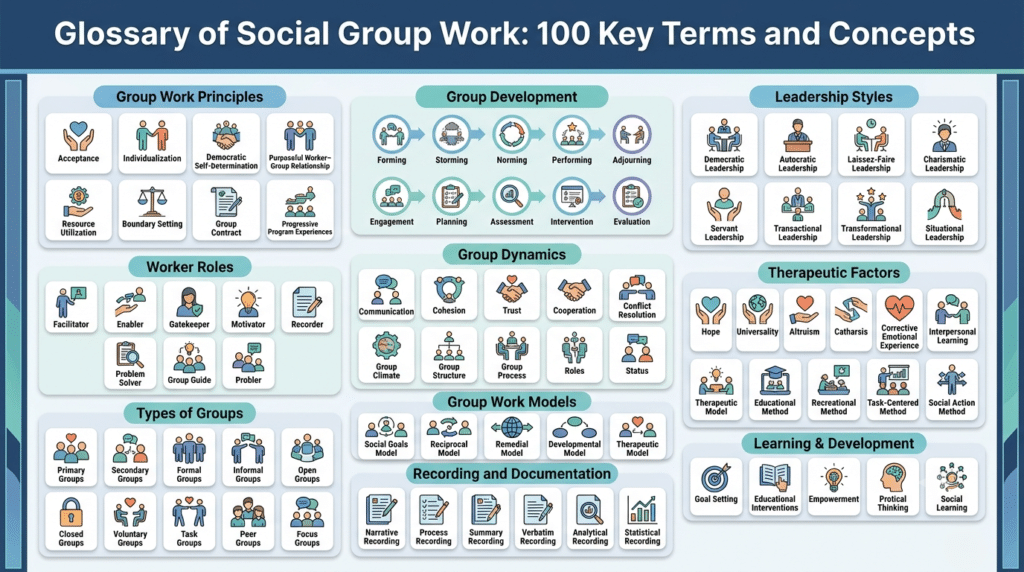
Acceptance (Principle)
A principle that requires respecting and valuing all members regardless of their differences or problems. It creates a safe and non-judgmental environment.
Adjourning Stage (Termination)
The final stage of group development where the group ends its activities. Members review their experiences, achievements, and prepare for separation.
Agency (Member)
The ability of members to make choices and influence their own lives. Group work encourages members to become active and self-directing.
Altruism
A therapeutic factor in which members gain satisfaction from helping others. It improves self-esteem and creates a supportive group environment.
Assessment (Phase)
Assessment is a continuous process of collecting and analyzing information about members’ needs, strengths, and problems. It helps the worker plan suitable interventions and activities.
Autocratic Leadership
A leadership style in which the leader makes decisions with little or no input from members. It provides strong direction but may limit participation and independence.
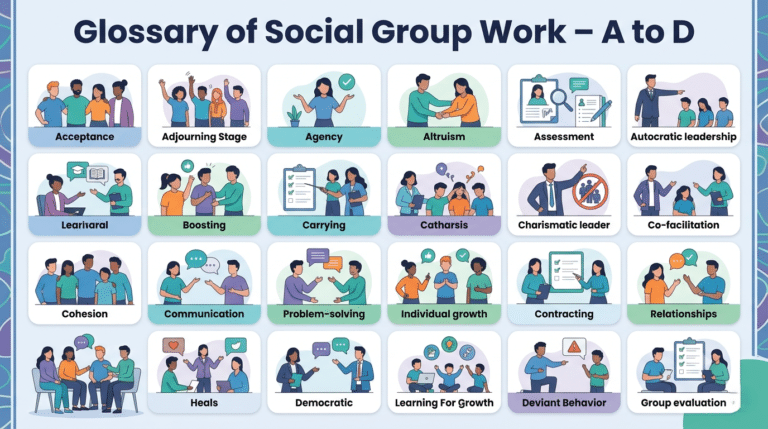
Behavioral Theory (of Leadership)
A theory that explains leadership through learned behaviors and actions rather than inborn traits. It suggests that leadership skills can be developed through training and practice.
Boosting
A technique used by the worker to encourage and praise members’ efforts and achievements. It increases confidence and motivation.
Boundary Setting
The process of establishing clear rules and limits for behavior and relationships in the group. It helps maintain safety, order, and professionalism.
Carrying
A worker’s effort to keep the group focused, connected, and functioning during difficult times. It helps the group remain stable during conflict or crisis.
Catharsis
The release of strong emotions through expressing feelings in a safe group environment. It helps members feel relief and emotional healing.
Charismatic Leadership
A leadership style based on personal charm, inspiration, and strong communication. It can motivate members but may create dependence on the leader.
Closed Group
A group with fixed membership where no new members can join after it starts. It promotes stability, trust, and deeper relationships.
Co-facilitation (Co-leadership)
A leadership arrangement where two workers jointly lead the group. It provides shared responsibility and diverse perspectives.
Cohesion / Cohesiveness
The degree of unity, trust, and attraction among group members. Strong cohesion increases participation, cooperation, and commitment to group goals.
Communication Patterns
The regular ways information is shared within a group. Effective communication promotes understanding, while poor communication can lead to conflict and exclusion.
Confrontation
A technique that highlights inconsistencies in a member’s behavior, thoughts, or actions. It promotes self-awareness and positive change when used respectfully.
Continuous Individualization (Principle)
Each group member should be treated as a unique individual with different needs, strengths, and experiences. The worker respects these differences and supports each member’s growth.
Contracting
The process of establishing agreements about goals, rules, expectations, and responsibilities in the group. It creates clarity and mutual understanding.
Corrective Emotional Experience
An experience in which members develop healthier relationships than those they had in the past. It helps change negative emotional patterns and beliefs.
Curative Factors (Therapeutic Factors)
The elements of group interaction that promote healing and personal growth. Examples include hope, altruism, cohesion, and catharsis.
Democratic Group Self-Determination (Principle)
The group has the right to make decisions about its goals and activities. The worker encourages participation, choice, and shared responsibility.
Democratic Leadership
A leadership style that involves members in decision-making and problem-solving. It promotes participation, confidence, and a sense of ownership among members.
Developmental Model
A group work model that considers the developmental stage and needs of members. Activities are planned according to members’ age and level of development.
Deviant Member
A member whose behavior differs from group norms and expectations. Such behavior may affect group functioning and require worker attention.
Diagnostic or Analytical Recording
A method of recording that analyzes group interactions, member progress, and worker interventions. It helps in evaluating and improving future group sessions.
Glossary of SGW – E to H
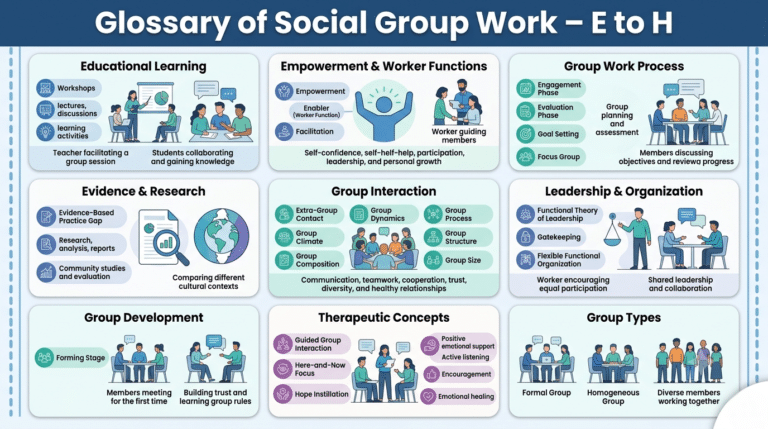
Educational Interventions
Planned activities designed to increase members’ knowledge, awareness, or skills. Examples include lectures, discussions, workshops, and role-plays.
Educational Method
A group work approach focused on teaching knowledge or practical skills. The worker guides members through structured learning activities.
Empowerment
A process that helps members gain confidence, control, and the ability to make decisions about their lives. It encourages self-determination and social action.
Enabler (Worker Function)
A role in which the worker helps members use their own strengths and resources to solve problems. The worker encourages self-help, participation, and mutual support.
Engagement (Phase)
The first phase of group work where the worker builds trust and rapport with members. Members learn about the group’s purpose, rules, and expectations.
Evaluation (Phase / Principle)
The process of assessing whether group goals and member outcomes have been achieved. It helps measure effectiveness and improve future practice.
Evidence-Based Practice Gap
A gap that occurs when theories and interventions from other cultures are used without local adaptation. This may reduce their effectiveness in contexts such as Pakistan.
Extra-Group Contact
Interactions between group members outside formal group sessions. These contacts may strengthen relationships but can also create challenges.
Facilitation
The process of guiding and supporting the group to achieve its goals. It includes managing discussions, conflict, and group dynamics.
Flexible Functional Organization (Principle)
A principle stating that group rules, roles, and procedures should be adjusted as members’ needs change. The group structure should remain supportive and adaptable.
Focus Group
A small discussion group used to collect information and opinions on a specific topic. It is commonly used for research and evaluation.
Formal Group
A group organized with specific rules, roles, and objectives. Examples include schools, offices, and committees.
Forming Stage
The first stage of group development where members get acquainted and learn about the group. They usually depend on the worker for guidance and direction.
Functional Theory (of Leadership)
A theory that views leadership as a set of functions rather than a position. Different members can perform leadership tasks as needed.
Gatekeeping
Gatekeeping is a role that encourages equal participation by inviting quiet members to speak and limiting domination by others. It helps maintain balanced group interaction.
Goal Setting
The process of identifying clear and achievable objectives for the group and its members. Goals provide direction and a basis for evaluation.
Group Climate
The overall emotional atmosphere and quality of relationships within a group. A positive climate encourages trust, participation, and cooperation.
Group Composition
The combination of members’ characteristics such as age, gender, background, and needs. Group composition influences group dynamics and effectiveness.
Group Contract
An agreement that outlines the group’s rules, expectations, rights, and responsibilities. It helps create clarity, safety, and accountability.
Group Dynamics
The forces and interactions that influence how a group functions. These include communication, roles, power, norms, and conflict.
Group Process
The ongoing interactions, relationships, and dynamics that occur within a group. It shapes how members work together and achieve goals.
Group Size
The number of members in a group. Group size affects participation, communication, and overall group dynamics.
Group Structure
The organized system of roles, rules, communication patterns, and relationships within a group. It provides order and helps the group achieve its goals.
Guided Group Interaction (Principle)
A principle that requires the worker to encourage positive and purposeful interactions among members. It helps develop effective communication and healthy relationships within the group.
Here-and-Now Focus
A therapeutic approach that focuses on members’ current feelings and interactions within the group. It helps members learn from present experiences.
Homogeneous vs. Heterogeneous Groups
Homogeneous groups consist of members with similar characteristics, while heterogeneous groups include diverse members. Each type offers different benefits for learning and support.
Hope Instillation
A therapeutic factor where members gain hope by seeing others successfully overcome similar problems. It increases motivation and optimism.
Glossary of SGW – I to P
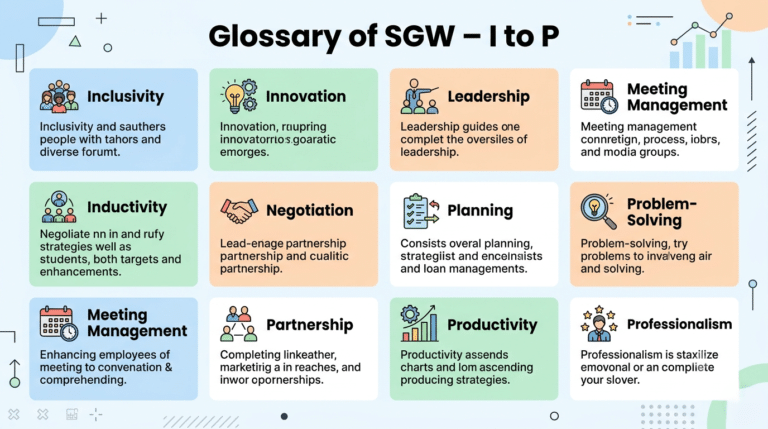
Informal Group
A group formed naturally through personal interactions and friendships. It has no official structure or written rules.
Informed Consent
The process of providing members with complete information about the group before participation. It allows them to make a voluntary and informed decision.
In-Group
A group to which a person belongs and feels a sense of identity and loyalty. Members see themselves as “we” and share common interests or values.
Interdependence of Members
Group members influence each other’s thoughts, feelings, and behaviors. The actions of one member can affect the entire group.
Interest Group
A group formed to promote a particular interest or cause. Members work together to achieve specific objectives.
Interpersonal Learning
A process through which members learn about themselves and improve their relationships with others. It occurs through feedback and interaction within the group.
Intervention (Phase)
The phase where planned activities and strategies are carried out to achieve group goals. Members actively participate while the worker guides the process.
Involuntary Group
A group into which a person is born or assigned without choice. Examples include family, ethnicity, and nationality.
Laissez-Faire Leadership
A leadership style that gives members maximum freedom to make decisions and manage activities. It works best with independent and responsible groups.
Membership Group
A group of which an individual is an actual member. The person participates directly in its activities.
Narrative Recording
A chronological written account of group activities, interactions, and observations. It helps document what happened during a session.
Non-Membership Group
A group to which a person does not belong but may admire or reject. It can still influence the person’s behavior and opinions.
Norming Stage
The stage where members develop trust, accept group norms, and cooperate more effectively. Group cohesion and teamwork begin to increase.
Norms in Group
The rules and expectations that guide members’ behavior in a group. They help maintain order and positive interaction.
Open Group
A group that allows new members to join after it has started. It provides flexibility but may affect group cohesion.
Out-Group
A group to which a person does not belong and may feel separate from. Members of an out-group are often viewed as “they” or “others.”
Parallel Process
A situation where patterns and dynamics from one relationship are repeated in another relationship. It often occurs between groups and supervisors.
Peer Group
A group of people with similar age, status, or interests. Members influence each other’s attitudes and behavior.
Performing Stage
The stage where the group functions effectively and works toward its goals. Members cooperate well and require less direction from the worker.
Planned Group Formation (Principle)
A principle that stresses careful selection of members based on their needs and characteristics. Good group composition improves effectiveness and cohesion.
Planning (Phase)
The phase in which the group’s goals, membership, activities, and schedule are designed. Proper planning helps ensure successful group work.
Primary Group
A small group with close, personal, and long-term relationships. Examples include family and close friends.
Problem-Solving Interventions
Structured activities that help members identify problems and find solutions. They develop critical thinking and decision-making skills.
Process Recording
A detailed record of group sessions that includes events, interactions, worker observations, and analysis. It is used for learning, supervision, and evaluation.
Progressive Program Experiences (Principle)
A principle that activities should gradually increase in difficulty and responsibility. This helps members grow without becoming overwhelmed.
Purposeful Worker–Group Relationship (Principle)
The worker’s relationship with the group should always support the group’s goals and member development. It is based on professionalism, respect, and empathy.
Glossary of SGW – R to S
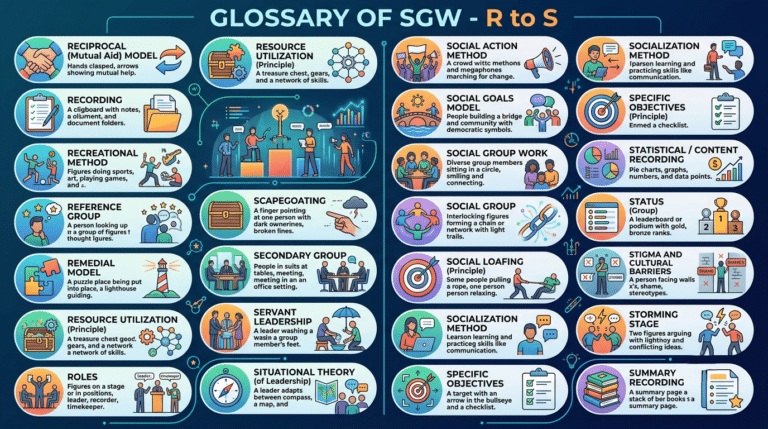
Reciprocal (Mutual Aid) Model
A group work model where members help and support one another. The worker encourages communication and mutual assistance among members.
Recording
The systematic documentation of group sessions, member progress, and activities. It ensures accountability and continuity of services.
Recreational Method
A group work approach that uses games, arts, and leisure activities to promote learning and social development. It helps build relationships and group cohesion in an enjoyable way.
Reference Group
A group that influences a person’s attitudes, values, or behavior. People often compare themselves with or aspire to join this group.
Remedial Model
A group work model that helps members overcome emotional, behavioral, or social problems. It focuses on improving individual functioning through planned interventions.
Resource Utilization (Principle)
A principle that encourages the use of members’ strengths and available community resources. It helps the group achieve its goals more effectively.
Roles
The expected duties and behaviors assigned to or adopted by group members. Roles help organize group activities and interactions.
Scapegoating
A group dynamic where one member is unfairly blamed for the group’s problems or tensions. This can harm the targeted member and disrupt group functioning.
Secondary Group
A larger and more impersonal group formed to achieve specific goals. Relationships are usually formal and temporary.
Servant Leadership
A leadership style where the leader focuses on serving and supporting group members. It promotes trust, empowerment, and personal growth.
Situational Theory (of Leadership)
A theory that suggests leaders should adapt their style according to members’ needs and abilities. Effective leadership depends on the situation.
Social Action Method
A group work method that encourages collective action to address social problems and injustice. It promotes advocacy and social change.
Social Goals Model
A group work model that develops democratic values, social awareness, and community responsibility. It focuses on both personal and social development.
Social Group Work
A method of social work that uses group experiences to help individuals grow and improve social functioning. It promotes learning, support, and positive relationships.
Social Group
Two or more people who interact regularly and share a common identity. Members are connected through relationships and mutual expectations.
Social Loafing
A situation where some members contribute less effort when working in a group. It often occurs when individual contributions are not monitored.
Socialization Method
A group work approach that helps members learn social skills, values, and acceptable behaviors. It prepares individuals for effective participation in society.
Specific Objectives (Principle)
A principle stating that group goals should be clear, realistic, and measurable. Clear objectives provide direction and help evaluate success.
Statistical / Content Recording
A recording method that documents numerical and factual information about group activities. It is mainly used for reporting and administrative purposes.
Status (Group)
The level of respect, influence, or prestige a member has within a group. Higher-status members often have greater influence on group decisions.
Stigma and Cultural Barriers
Social and cultural factors that discourage people from joining or participating in groups. These barriers may include shame, stereotypes, or restrictive social norms.
Storming Stage
A stage of group development marked by conflict, disagreement, and competition among members. It helps the group establish roles, norms, and relationships.
Summary Recording
A brief record of the main activities, discussions, and outcomes of a group session. It provides a quick overview of group progress.
Glossary of SGW – T to Z
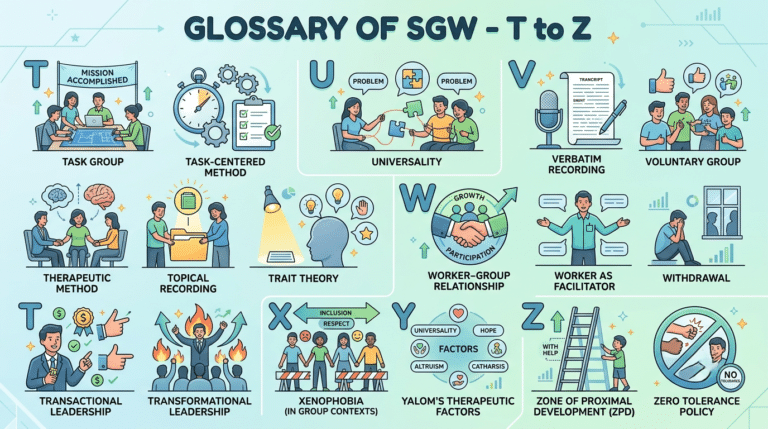
Task Group
A group created to complete a particular task or project. It usually dissolves after achieving its goal.
Task-Centered Method
A structured approach that focuses on completing specific tasks within a limited time. It emphasizes practical solutions and measurable results.
Therapeutic Interventions
Professional techniques used to improve members’ emotional wellbeing and coping skills. Examples include counseling exercises, relaxation techniques, and cognitive strategies.
Therapeutic Method
A group work approach that helps members overcome emotional, psychological, or behavioral problems. It uses group support and interaction to promote healing and growth.
Topical Recording
A recording method that focuses on one specific issue or theme discussed in a session. It allows detailed analysis of that particular topic.
Trait Theory (of Leadership)
A theory that suggests effective leaders possess certain inborn qualities such as confidence, intelligence, and integrity. It focuses on personal characteristics rather than learned skills.
Transactional Leadership
A leadership style based on rewards and consequences to achieve goals. It emphasizes structure, rules, and performance.
Transformational Leadership
A leadership style that inspires members to achieve shared goals and personal growth. It promotes motivation, commitment, and positive change.
Universality
Universality is a therapeutic factor in which members realize that others share similar problems and feelings. This reduces isolation and strengthens group connection.
Verbatim Recording
A detailed record that captures the exact words and important behaviors of group members. It is mainly used for training, supervision, and detailed analysis.
Voluntary Group
A group that people join by their own choice. Examples include clubs, NGOs, and sports teams.
Worker–Group Relationship
The professional relationship between the social group worker and group members that supports growth, participation, and goal achievement.
Worker as Facilitator
A role in which the social worker guides group interactions, encourages participation, and helps members achieve group objectives.
Withdrawal
A situation in which a member becomes emotionally or physically disengaged from group activities and discussions.
Xenophobia (in Group Contexts)
Fear, prejudice, or hostility toward people perceived as different or from other cultural or social groups. Group workers address xenophobia to promote inclusion and respect.
Yalom’s Therapeutic Factors
The healing elements identified by Irvin Yalom that contribute to positive change in groups, such as universality, hope, altruism, and catharsis.
Youth Group Work
A specialized form of social group work focused on the developmental, educational, and social needs of young people.
Zone of Proximal Development (ZPD)
A concept from Lev Vygotsky referring to tasks individuals can accomplish with support from others. In group work, members often learn through peer assistance and guidance.
Zero Tolerance Policy
A group rule that strictly prohibits behaviors such as violence, bullying, harassment, or discrimination to maintain a safe environment.