What is Group Development?
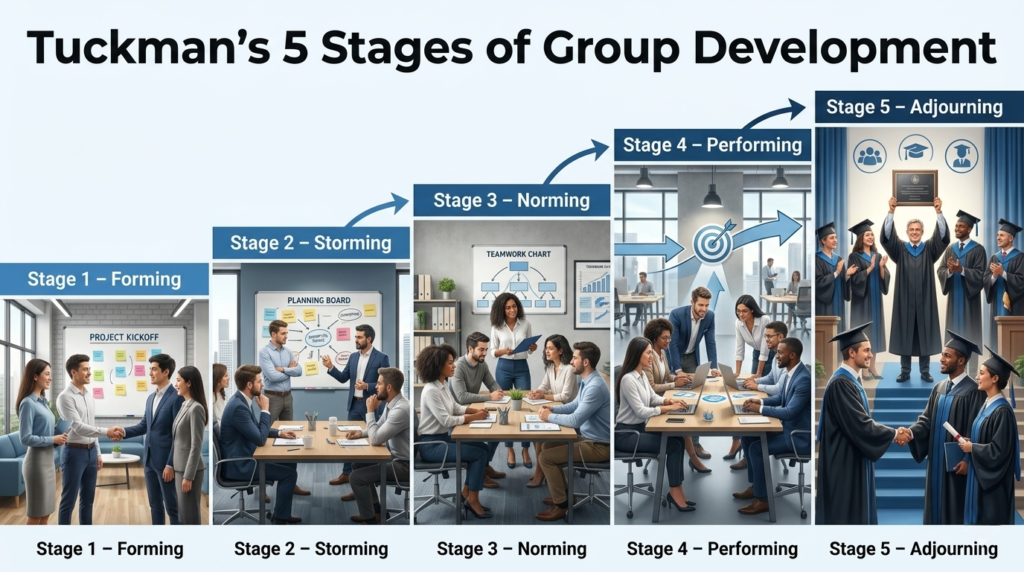
Group development is a dynamic process through which individuals gradually evolve into a cohesive and functional group while working toward shared goals.
In social work, it refers to the stages a group passes through as members build relationships, establish trust, manage conflicts, develop cooperation, and achieve collective objectives. This process influences members’ behavior, communication, roles, and interactions within the group.
Before describing Tuckman’s stages of group development, it is essential to understand the nature of group. When people meet as a group, they go through stages. These stages may occur even over one meeting. If the group continues to meet regularly, it will go through stages with particular characteristics. This is sometimes called the life cycle development of a group.
Life Cycles
A group’s life cycle begins, middles, and ends. Initially, group members decide what they can do and accomplish together and set restrictions for themselves and the group. The middle phase builds on first impressions. Because the group values its work, it develops understanding and solves problems.
Lastly, this includes saying farewell, realizing they’ve done all they can, deciding to move on, celebrating success, admitting what remains to be done, and acknowledging the group’s relationships.
Models of Group Development
The ideas that inform the following models of group development should enhance the facilitator’s understanding of the group’s process. Remember, as with individuals, all groups are unique. No group will correspond directly to any model. All groups will move through the phases outlined below, but not necessarily in the same order.
Groups can and do move backward as well as forward. Within any one phase, a group might have an internal cycle during which it goes through yet other phases or stages.
Bruce W. Tuckman’s (1965) model of the developmental process has been the most influential, certainly when it comes to its influence on texts targeted at professionals. Although there are some variations in the number of stages and their names, many have embraced a version of Tuckman’s model—forming, storming, norming, and performing.
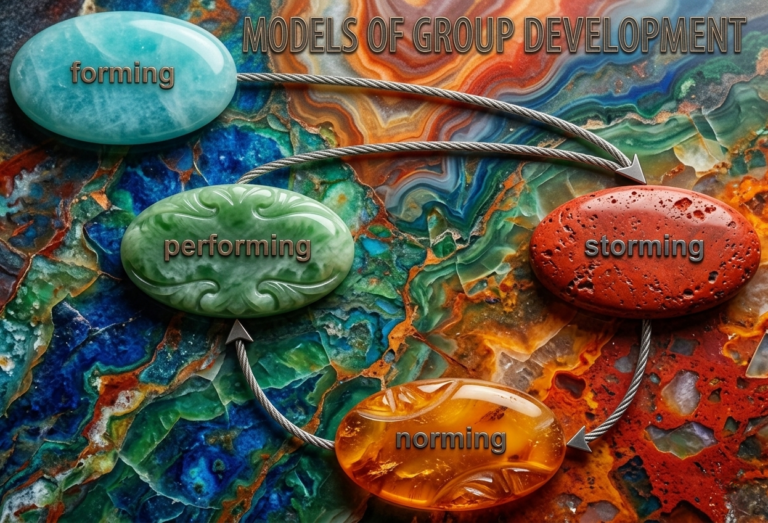
He was later to add a fifth stage “adjourning” in 1977 (Tuckman and Jensen 1977).
Stage 1 – Forming
Members’ Needs: To be comfortable within the group, safe, and to know and share information.
Forming is the first stage, also known as orientation, when the group members have just met. Feelings of uncertainty and anxiety prevail, with limited self-disclosure. Group members tend to rely on the leader, who provides structure and space for members to share their hopes for the group.
At this stage, members are learning what to do, how the group will operate, what is expected, and what is acceptable. During the forming stage, it is important to consider various aspects such as the group’s purpose, organization, responsibilities, milestones, rules, and available resources.
The title of this stage conveys the socio-emotional and task issues that concern group members. In the initial stage, the predominant socio-emotional issue is inclusion, referred to as approach-avoidance behaviors and engagement. Individuals employ different methods to determine their eligibility for group membership.
Orientation is the primary focus in the task area. Members actively engage with the worker and fellow members, exchanging information and exploring shared experiences to uncover the significance of the group for each individual. As individuals adjust to their new circumstances, they gradually establish a preliminary contract or agreement.
| STAGE 1: FORMING — ORIENTATION & INCLUSION | |
| Visible Group Behaviors | • Polite, cautious interactions and tentative participation • Members orient to each other on a personal level and avoid controversy • Groups begin to form; members seek safety and approval • Attempts to define tasks, processes, and decision-making norms • Discussion drifts to topics unrelated to the team’s actual mission |
| Internal States & Perceptions | • Many feel excited, optimistic, and full of anticipation for the group • Others experience suspicion, fear, or anxiety about joining the team • Uncertainty about personal expectations and role within the group • Members question why others are present and what will be required • Prevailing sense of apprehension and approach-avoidance tension |
| What the Team Requires | • A clearly articulated team mission, vision, and shared purpose • Specific objectives, defined roles, and individual responsibilities • Established team ground rules and operational guidelines • Structured in-class and virtual meetings for early coordination • Timely first-round feedback from project guides to ground expectations |
| Guidance & Leadership Role | • Project Guides and Instructors supply clear structure and task direction • Allow dedicated time for members to get acquainted with one another • Build an atmosphere of confidence, optimism, and psychological safety • Maintain active involvement; demonstrate one-way, directive communication • Members look to the appointed leader for decision-making authority |
Example: A teacher assigned five students to work together on a community awareness project. During their first meeting, everyone behaved politely and spoke carefully. Most students were quiet and unsure about their roles, so they looked to the teacher for guidance about what they needed to do and how the group would work together.
Stage 2 – Storming
Members’ Needs: To belong and be secure in the group, to review aims, and to absorb material.
The second stage of group development is the storming stage, also known as the power struggle or conflict stage. Common behavior patterns often involve feelings of uncertainty and anxiety regarding acceptance and group identity, a desire for power, and the search for satisfying positions within the group.
Because group members now have an understanding of the work and a general sense of belonging to the group, subgroups can form during this time. Dominating group members emerge, while less confrontational members stay in their comfort zones.
The group leader assists members in expressing and navigating through feelings of frustration and other challenging emotions that may arise, reinforcing the guidelines and expectations set during the formation stage. The subject of this stage indicates that there is a sense of uncertainty among members regarding various aspects of the group’s functioning, particularly in terms of power dynamics and decision-making authority and whether they can find acceptance in the group.
The predominant socio-emotional theme is conflict and difference, especially regarding the group leader’s authority and the power distribution among the members. The predominant task is exploring the situation with its hoped-for benefits, acquiring realistic mutual expectations, and establishing interpersonal relationships based on mutual trust and acceptance. Ultimately, the group becomes a system of mutual aid.
| STAGE 2: STORMING — CONFLICT & POWER STRUGGLE | |
| Visible Group Behaviors | • Open arguing among members and visible competition for leadership • Stark differences in viewpoint and personal style become apparent • Role ambiguity persists; team struggles to self-organize effectively • Power struggles, interpersonal clashes, and lack of progress • Unrealistic goals are set; concern grows over excessive workload |
| Internal States & Perceptions | • Members feel defensive, confused, or disengaged from the group • Resistance to assigned tasks and fluctuating attitudes toward the team • Doubt about the team’s mission and the wisdom of fellow members • Rising tension and jealousy; uncertainty about personal influence • Shared frustration expressed as ‘We’re not getting anywhere’ |
| What the Team Requires | • Attention to both inter- and intra-personal relationship dynamics • Skills for identifying and bridging stylistic and personal differences • Active listening practices and structured giving/receiving of feedback • Conflict resolution frameworks and re-established ground rules • Clarification of team purpose and timely feedback from project guides |
| Guidance & Leadership Role | • Project Guides openly acknowledge and normalize the presence of conflict • Encourage consensus-building and guide members toward shared ownership • Teach conflict resolution methods; offer genuine praise and support • Transition team toward shared leadership and collaborative decision-making • Members begin consulting each other, though joint decisions remain difficult |
Example: As the project continued, differences of opinion started to appear. Two students wanted to lead the group, while others felt their ideas were being ignored. Small arguments began during discussions, and some members became frustrated because the group was not making decisions easily.
Stage 3 – Norming
Members’ Needs: To be independent, recognized, and have self-esteem.
In this stage, the group becomes enjoyable. Therefore, it is also called the cooperation and integration or group cohesion stage. Group interactions are much easier, more cooperative, and more productive, with balanced give and take, open communication, bonding, and mutual respect.
During this stage, cooperation becomes more prominent as there is a strong sense of shared purpose among the individuals involved. Trust, intimacy, and commitment are fostered within the group. At this stage, the leader can take a less active role. The group has set norms and is now more open and cohesive. At this stage, group members take the initiative and move forward together.
There are certain patterns of behavior that are commonly observed, which involve an increased level of personal engagement, a desire for or avoidance of intimacy, and a focus on developing individual and collective identities. Interpersonal relationships are often marked by a sense of mutual acceptance, empathy, and respect for differences.
Conflict is acknowledged and addressed in constructive ways, encouraging a functional dynamic within the group. The group maintains a healthy level of cohesiveness, allowing for both individuality and integration. The primary focus is to ensure the group flourishes and evolves, serving as a platform for personal development and effective problem-solving.
There is a strong sense of collective support and collaboration. Resistance is successfully overcome during this stage, as a sense of solidarity and cohesiveness begins to emerge. As a result, new standards are established, and individuals take on new roles. In the task domain, individuals freely express their personal opinions. Therefore, we are finally at the norming stage.
| STAGE 3: NORMING — COHESION & COLLABORATION | |
| Visible Group Behaviors | • Agreed-upon processes and procedures guide the team’s daily work • Comfortable, cooperative relationships replace prior interpersonal tensions • Energy and focus are directed toward tasks and milestone achievement • Effective conflict resolution skills are applied when disagreements arise • Balanced influence, shared problem-solving, and established team routines |
| Internal States & Perceptions | • Strong sense of belonging, team identity, and mutual acceptance • Confidence is high; members feel free to express ideas and contribute • Criticism is delivered and received constructively among peers • General sense of trust and assurance that the work will succeed • Members feel empowered and recognized for their individual contributions |
| What the Team Requires | • A clear, shared decision-making process embraced by all members • Open exchange of ideas, suggestions, and creative problem-solving • Full utilization of each member’s strengths and available resources • Continued ownership of shared leadership responsibilities by all members • Ongoing feedback from project guides to sustain momentum |
| Guidance & Leadership Role | • Shared leadership is practiced and modeled consistently across the team • Project Guides offer feedback and support while reducing direct control • Promote team interaction, collaboration, and inclusive decision-making • Encourage contributions from every member to strengthen group cohesion • Continue building trusting relationships and fostering collective identity |
Example: After spending more time together, the students slowly learned how to cooperate. They started respecting each other’s opinions, divided the work fairly, and communicated more openly. The group atmosphere became friendlier, and members began supporting one another instead of competing.
Stage 4 – Performing
Members’ Needs: individual maintenance for personal needs that re-emerge must be recognized and met within the group.
At the Performing stage, the group members actively recognize and appreciate each other’s talents, skills, and experience, which boosts morale. Thus, this stage is referred to as synergy or functional role-relatedness. A strong sense of community develops, and the group remains dedicated to its mission and objective.
Members exhibit a high level of flexibility, rely on each other, and have a strong sense of trust. Leadership is collaborative, and individuals can adjust based on the group’s requirements.
At this stage, the group is able to function independently. As the leader continues to be involved, their main focus is on assisting the group in functioning efficiently. Roles become flexible and functional, channeling group energy into the task. Structural issues have been resolved, and the structure can now support task performance. This stage can be labeled as performing.
| STAGE 4: PERFORMING — SYNERGY & TRUE INTERDEPENDENCE | |
| Visible Group Behaviors | • Fully functional, self-organizing team operating at peak effectiveness • Roles are clearly understood; the team develops genuine independence • Members function fluidly — individually, in subgroups, or as a whole unit • Deep understanding of each other’s strengths, weaknesses, and contributions • Structural issues are resolved; group energy is channeled entirely into tasks |
| Internal States & Perceptions | • Strong empathy for teammates and high, sustained commitment to goals • Tight interpersonal bonds; genuine fun, excitement, and shared enthusiasm • Rich personal development, creativity, and collaborative discovery • General sense of satisfaction and accomplishment within the group • Continuous exploration of how to sustain momentum and group energy |
| What the Team Requires | • Project Guides confirm the team is moving in a collaborative direction • Ongoing maintenance of flexibility and adaptability within the team • Performance measurement and knowledge assessment (e.g., post-test) • Free flow of information, resources, and constructive feedback • Continued dialogue with project guides to sustain high performance |
| Guidance & Leadership Role | • Shared leadership is fully practiced and embedded in daily team operations • Project Guides observe, inquire, and fulfill emerging team needs with minimal direction • Collaborative efforts among members drive all major decisions and outputs • Team members provide positive reinforcement and mutual support autonomously • New information and insights are shared openly to sustain peak performance |
Example: Once the group became fully organized, everyone worked confidently toward the same goal. Each student completed assigned tasks responsibly, helped others when needed, and solved problems together. The group successfully organized the awareness campaign without depending too much on the teacher.
Stage 5 – Adjourning
In 1977, Tuckman collaborated with Mary Ann Jensen to propose an update of the model. He mentioned that they reviewed 22 studies that had been published since the original release of the model. These articles generally supported the idea of the four stages but also proposed the existence of a fifth stage that lacked a perfect rhyme. We referred to it as ‘adjourning’ (Tuckman 1984)
Members’ Needs: As the group’s life nears its conclusion and the decision to break up is made, anxiety and a sense of loss will emerge among members. A strong need is felt to mark this ending, acknowledge what has been achieved, and look forward to new beginnings and tasks.
Adjourning entails the process of dissolution. It involves ending roles, finishing tasks, and decreasing dependency. The members have mixed feelings about being separated from the worker, the group, and other members. They get ready to move on from the group and transition to new relationships and activities.
In the case of temporary groups, like a project team or task force, which have a limited task, there is also a fifth stage known as adjourning. The group decides to disband. Some members may feel happy over the performance, and some may be unhappy over the stoppage of meetings with group members.
Some analysts have characterized this stage as a period of mourning, as individuals may experience a sense of loss after leaving the program. The process can be quite difficult, especially when the dissolution is unexpected.
Similar to the experience of ending therapy, this stage can evoke feelings of anxiety, loss, sadness, and gratitude. Leaders help with the planning process to ensure that the group’s goals are maintained even after it comes to an end.
| STAGE 5: ADJOURNING — DISSOLUTION & TRANSITION | |
| Visible Group Behaviors | • Visible signs of grief, nostalgia, or sadness as the group approaches closure • Team momentum slows; restless or distracted behavior becomes noticeable • Bursts of extreme energy alternating with periods of low engagement • Members begin to disengage from tasks and reduce interdependence |
| Internal States & Perceptions | • Sadness and a sense of loss associated with the ending of the group • Humor that may appear inappropriate or dark to outside observers • Relief or gladness that the experience has concluded • Anxiety and anticipatory grief as members prepare for new beginnings |
| What the Team Requires | • Structured evaluation of the team’s collective efforts and accomplishments • Opportunity to tie up loose ends, complete outstanding tasks, and close work • Formal recognition and reward of individual and team contributions • Space to acknowledge what has been achieved and look forward to new chapters |
| Guidance & Leadership Role | • Project Guides help the team develop healthy options and rituals for closure • Provide active, empathetic listening and space for members to express feelings • Facilitate reflection and help members carry collaborative learning forward • Ensure the group’s goals and accomplishments are recognized and preserved |
Example: After completing the project, the students held a final meeting to discuss their experiences and celebrate their success. They thanked each other for their teamwork and shared memories from the project. Although they felt proud of what they achieved, many also felt a little sad that the group was coming to an end.
FAQs
References
Forsyth, D. R. (1990, 1998) Group Dynamics, Pacific Grove CA: Brooks/Cole Publishing.
Northen, H., & Kurland, R. (2001). Social work with groups. Columbia University Press.
Prendiville, P. (2004). Developing facilitation skills: A handbook for group facilitators. Combat Poverty Agency.
Smith, M. K. (2005) ‘Bruce W. Tuckman – forming, storming, norming and performing in groups, the encyclopaedia of informal education, www.infed.org/thinkers/tuckman.htm.
Tuckman, Bruce W. (1984) ‘Citation classic – Developmental sequence in small groups’ Current Concerns.
Tuckman, Bruce W., & Jensen, Mary Ann C. (1977). ‘Stages of small group development revisited’, Group and Organizational Studies, 2, 419- 427.