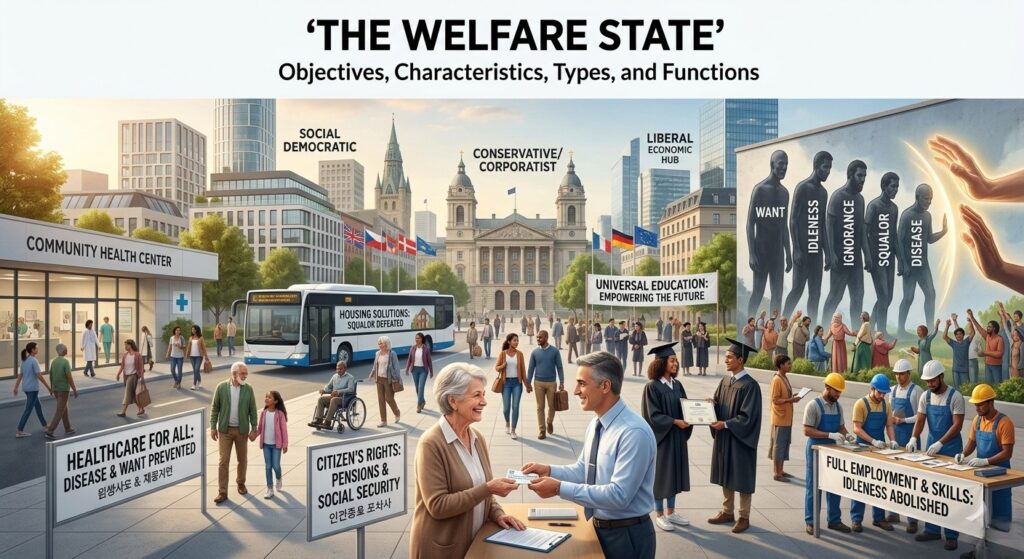
The welfare state is basically a system of social organization where the state collectively assumes the responsibility of the welfare of its citizens. It is a perfect state of affairs in which social welfare is made available to the possible standards and is accepted to be a normal, institutionalized aspect of existence.
The origins of the organized welfare can be traced to the nineteenth century Poor Laws, but the modern welfare state in Britain was officially established in the 1940s through the impact of the Beveridge Report of 1942.
Objectives of Welfare State
The main goals of the welfare state are associated with the security of the community and redistribution of resources to achieve social justice.
Vanquishing the “Five Giants”
Sir William Beveridge desired to abolish society of five so-called giant evils, namely, Want, Idleness, Ignorance, Squalor, and Disease. This gave the ethical and practical outline of a holistic social security system, healthcare system and educational framework.
Guaranteeing a National Minimum
One of the central aims is to make sure that all citizens are insured against the loss of income due to sickness, disability, unemployment or old age. The initial idea behind this was to give everyone the guarantee of subsistence minimum.
Pursuit of Equality
This is the non-discriminative goal of the welfare state that aims to bring towards equality, through the creation of universal systems, where services can be provided to the entire population irrespective of their capability to pay.
Social Protection
It attempts to reduce industrialization and market-driven social costs, which is known as dis-welfares, and provides a safety net to those who are vulnerable to life-cycle contingencies.
Characteristics of Welfare State
The contemporary welfare states can be characterized by a number of fundamental features that determine the way in which they relate to the individual and the market.
The rights-Based Citizenship
In a welfare state, there are no acts of charity but social rights of citizenship. This is an indication that social rights were perceived by T.H. Marshall to be a twentieth century extension of the civil and political rights.
Universalism vs. Selectivity
The traditional welfare state is characterized by universality where benefits such as healthcare and education can be offered to everyone as a right and this avoids the stigmatization that comes with means-testing.
State Intervention in the Market
The welfare state actively limits the free market functioning by ensuring the presence of specific group rights and the provision of necessary services, which the market will not be able to offer in a fair manner.
The Mixed Economy of Welfare
It is the state which plays a central role but welfare is regularly provided by a plurality of sectors, such as the state, the private, the voluntary, the informal (family) and the voluntary sectors.
Institutional Framework
Within an institutional model, need and dependency is a social fact, all are to be young, old, or sick, and there has to be a social response.
Types of Welfare State
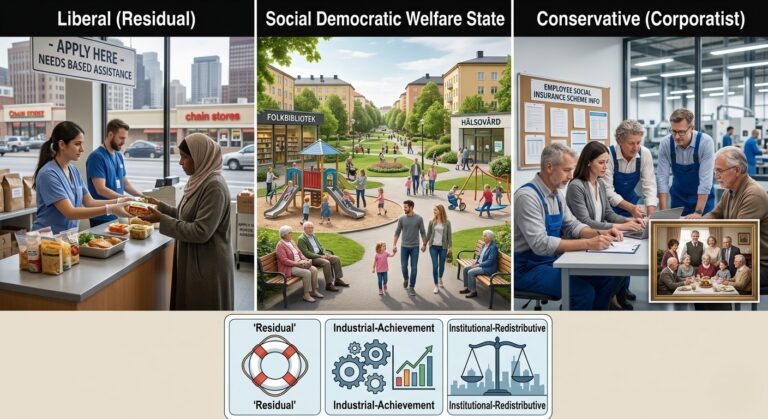
Scholars define welfare states in various so-called regimes depending on the intensity of the state intervention and the ideology behind it.
Liberal (Residual) Welfare States
These systems establish a basic safety net mainly to the poor. They are based on heavy reliance on the private market and means-testing, and state services are the last option (e.g., USA, Australia).
Social Democratic Welfare State
In these regimes, social equality and universalism is of greatest priority. They entail large amounts of national expenditure and a universal nature of the services offered to the citizens irrespective of necessity (e.g. Scandinavian countries such as Sweden).
Conservative (Corporatist) Welfare States
These are based on mutual aid and social insurance, and usually attach benefits to employment and social position (e.g. Germany, France). They prioritize preservation of traditional families and social order.
Titmuss’s Three Models
- Residual: Welfare as a temporary safety net.
- Industrial-Achievement: Welfare as an adjunct to the economy, rewarding work performance.
- Institutional-Redistributive: Welfare as an integrated system based on need and equality.
Functions of Welfare State
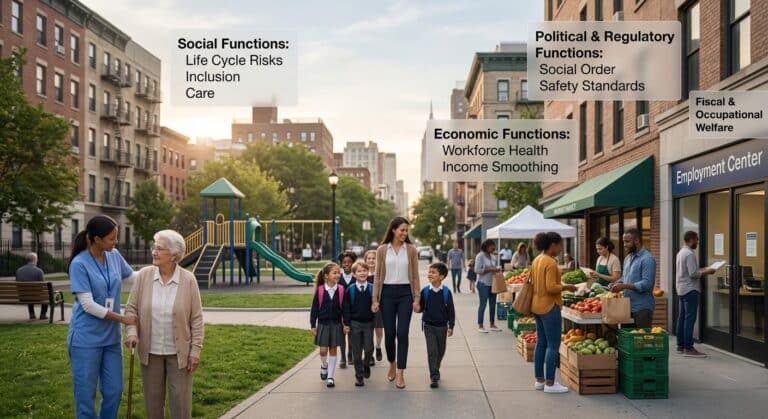
The roles of the welfare state may be viewed in social, economic and political perspectives.
Social Functions
The welfare state controls life cycle social risks and dependencies. It also ensures social inclusion by integrating the marginalized groups into positive networks and even offering services such as social care to the elderly and even child protection. It also attempts to control such social problems as crime, addiction and family disintegration.
Economic Functions
Welfare is a handmaid to the economy in that it ensures a healthy and educated and productive workforce. It also executes income smoothing (such as pensions and social security) which transfers money between the working and the dependent life of an individual. According to neo-Marxists, welfare is a prerequisite to accumulating capital since it stabilizes the labor force and prevents collapse of the economy.
Political and Regulatory Functions.
One of the key roles is maintaining the social order and legitimation. The state ensures that citizens have their basic needs and therefore their loyalty to the state is secured as well as the working class is not likely to be involved in civil unrest. It also performs a regulatory role in which it sets laws that regulate the public health, safety standards as well as the environmental protection. Lastly, it administers delivery of complex services by using the vast bureaucracies and professional hierarchies in its administrative processes.
Fiscal and Occupational Welfare
The welfare state operates in other ways beyond direct services by using fiscal welfare (redistribution by the tax system, such as tax credits) and occupational welfare (benefits offered by employers as a part of employment, such as sick pay).
Critiques of the Welfare State
Despite its benefits, the welfare state has a number of criticisms:
Dependency Problems
Critics believe that welfare programs might cause dependency among recipients who will refuse to work and that they will develop a culture of rights/entitlement. This issue indicates that the extended dependence on the state care can be a disadvantage to the personal motivation.
Economic Sustainability
There has been persistent debate on whether welfare funding can be sustained over the long term especially in older populations whereby the number of beneficiaries is higher and the number of contributors is lower. The sustainability of having large welfare systems is subject to question due to the financial cost of maintaining them.
Impact on Individual Responsibility
There are critics who argue that large welfare systems can destroy individual responsibility. Dependence on state aid among people can reduce their work motivation and desire to self-develop.
Social Policy, Social Welfare, and Welfare State
Aligned Framework
These three concepts consist of an integrated system in which social policy offers the blueprint and principles, social welfare offers the real programs and services, and the welfare state offers the institutional structure through which all these efforts are delivered and coordinated. The social policy defines the direction and priorities of how and what issues should be addressed in the society.
The policies are transformed into tangible programs, services, and benefits that flow to the citizens by social welfare. The organizational framework, funding schemes and administrative capability to carry out and maintain these initiatives in the long term is acquired through the welfare state.
Dynamic Relationships
It is a dynamic and changing relationship between these elements. The welfare programs can be reconstructed by altering the social policy, and the experiences in the delivery of welfare can guide the policy reforms. The institution of welfare state also can have impacts on what policies are possible and how the organization of welfare is possible, as well as policy priorities and welfare needs can provide institutional changes.
Conclusion
To sum up, the welfare state has transformed into a centralized model that is characterized by a big government to a modern system of mixed welfare that has integrated public, private, voluntary, and informal provision. The fundamental purpose of the organization, namely, safeguarding citizens against Want, Disease, Ignorance, Squalor, and Idleness has not been changed, however in modern times the method has become more focused on means-tested models to meet the demands of globalization, growing old and new demands on social services.
Although there are still some economic and political difficulties, the welfare system is still a necessary instrument of social justice, which redistributes resources towards the neediest and provides support to the social rights of citizenship. It still remains a crucial compromise between the individual enterprise and the collective responsibility, after all.