
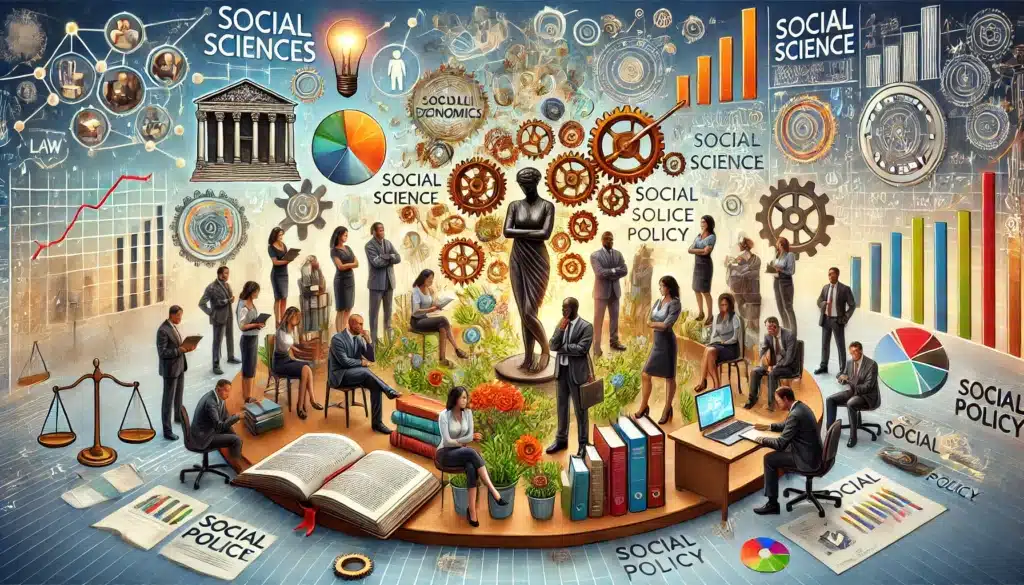
The application of social policy goes beyond the confines of academia; it operates within the realm of social problem solving and addressing complex social issues. Social policy is usually thought of not as an academic discipline, but as an area of study that integrates several academic disciplines to solve a problem.
This area of study is highly dependent on social science disciplines. Therefore, it is labeled a magpie discipline (flying from field to field to collect bright and shining treasures). One can think of social policy as an “applied social science” rather than an independent discipline. It interfaces with other fields of study to propose solutions to real-world issues.
There are some relationship between social policy and social sciences like sociology, social work, economics, and public policy etc.
Sociology
Social policy draws on concepts of sociology to study social phenomena and people’s lives. However, it goes further than sociology by formulating policies and providing services. Social policy has also been described as coming from the other end of the problem of sociology. The main aim of sociology is to understand social phenomena.
Social policy also draws from the sociology of social phenomena to study the social norms, values, and social pressures that shape the welfare system and the various social groups that policy seeks to address.
Social Work
Social policy extends social work by examining how social services are organized and the impacts of policies on people. It accounts for how policies are planned and steps are taken to implement them.
Economics

Social policy draws assistance from economics in order to understand how the allocation of resources and the adoption of particular economic theories impact society. This aids in designing policies and evaluating the impact of policies. Influences from economics are becoming more common within social policy.
This area of policy studies the economics of policy issues and the costs and benefits associated with other policies (i.e. policies on child benefits). While practitioners analyze certain frameworks proposed by economic theory, they recognize that life is not as simple as proposed by theory.
Public Policy
Public policy is concerned with the study of processes of policy formulation in general. However, social policy is mainly concerned with those policies that address social issues such as poverty, health, and education.
Political Science
Social policy draws from political science to understand the structure of power, systems of governance, and the processes of policymaking and implementation. It analyzes how political ideas, party systems, and governmental structures are organized to distribute social welfare and to determine the emphasis that policies, implementation, and reforms should receive.
Psychology
Social policy draws upon psychology to comprehend human behavior, motivation, and well-being with respect to specific social problems. It assists the social policy maker in developing responses that focus on mental health, behavior, and the psychological aspects of poverty, unemployment, and social exclusion in individuals and families.
Law
Social policy and law converge in the construction of social rights and entitlements. It analyses the impact of law on the distribution of social benefits and services, the determination of eligibility, the human rights compliance of legal frameworks, and the resolution of legal obstacles that prevent marginalized people from accessing social assistance.
Social Policy as an Applied Discipline
Despite its reliance on other fields, there is a strong argument for recognizing Social Policy as a distinct discipline. Its core focus is unique because it is fundamentally an applied subject, concerned not just with descriptive analysis but also with prescription identifying what empirically “should be done” about social issues.

Social policy applies its knowledge to systematically research the impact of social policies on people’s lives, a function which distinguishes it from the fundamental theory and curiosity-driven research common in other social sciences
Conclusion
To summarize, social policy is perhaps one of the most interesting applied fields, as it examines a myriad of social science disciplines to understand and respond to pressing social problems. While drawing heavily from sociology, economics, psychology, law, and political science, it is uniquely concerned with the formulation and execution of policies that shape the lives of people.
While social policy is an applied social science, it is not a social science in the pure sense because it does not stop at the mere description of social phenomena. Rather, it strives to respond to the description of social issues that are complex in nature-or what is called the social problems nexus, such as poverty, health, and education.
By synthesizing theoretical models to develop a practical policy response, social policy stands out among many social sciences as a field that integrates the knowledge of theory with work in real life. The recognition of social policy as a separate and distinct field is long overdue, especially for its emphasis on improving social welfare and the overall well-being of people, and for its commitment to social progress and the advancement of society in general.