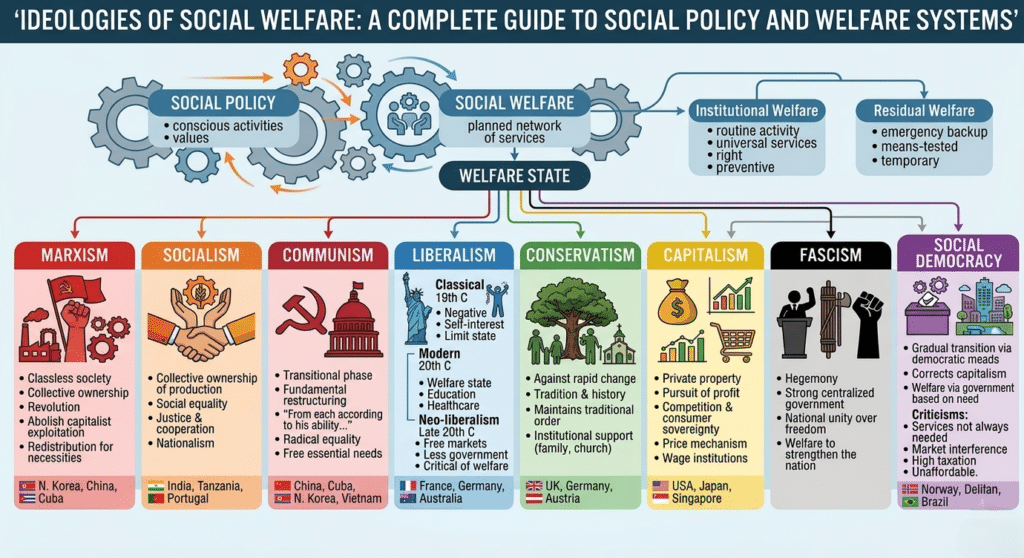
The social welfare and social policy, as well as the welfare state are interrelated concepts which shape the base of the contemporary societies dealing with collective issues and enhancing the welfare of the citizens.
“Social policy can be defined as the conscious activities, values, and policies that are embraced by governments and organizations to deal with social issues and enhance social wellbeing”. It also includes the systematic way of living conditions improvement, decrease of inequalities, and assurance of all citizens access to basic needs and possibilities of their personal growth.
The social policy exists in various fields such as healthcare, education, housing, employment, income support and social services. As opposed to economic policy, which mainly resides on market processes, social policy is an initiative that is more concerned with the development of man, social justice and the collective responsibility in solving problems that affect people.
Key Characteristics of Social Policy
- Concentrates on the redistribution of resources to narrow the inequality.
- Protects vulnerable members of the society.
- Facilitates social cohesion through strengthening solidarity and inclusion.
- Includes prevention strategies to deal with the underlying causes of social issues.
- Has proactive responses to help individuals during troubles.
- Focuses more on rights-based models where services access is treated as universal rights but not charity.
What is Social Welfare?
Social welfare refers to the planned network of social services and benefits aimed at helping individuals and groups to access their needs and attain a satisfactory standard of living. It involves the material support (financial aid, healthcare, housing) as well as the non-material support (counseling, education, social services).
Levels of Social Welfare
Social welfare operates on multiple levels:
- Individual welfare focuses on personal well-being and life chances.
- Family welfare addresses household security and functioning.
- Community welfare emphasizes collective well-being and social solidarity.
Types of Social Welfare
- Institutional Welfare: This school of thought focuses on social welfare as a routine activity of the modern society and offers universal services as a right. This is a preventive approach that views welfare as an investment in human capital and social development.
- Residual Welfare: It considers social welfare an emergency backup system that steps in when the market, family and community have broken down and therefore cannot deliver the needs. This strategy focuses on means-testing and one-time aid.
- Mixed Welfare Systems: It bring together the two methods offering universal services in certain parts and selective, targeted services in other parts.
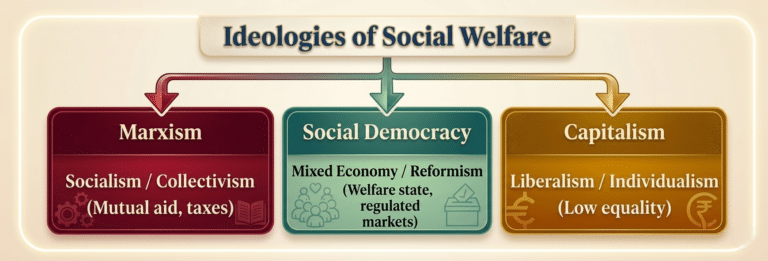
Ideologies of Social Welfare
Marxism
Marxism is a socio political theory that was originally formulated by Karl Marx and Friedrich Engels in 1848, Marxism views a society where there is no classes, where all people are equal by removing capitalist exploitation. It is based on the idea of the struggle of classes and criticizes the nature of the exploitative relationship between the capitalists and the working population where the laborers take a disproportionately low wage even though they generate value.
According to Marxism, a revolution ought to ruin the capitalist society so that the working classes take over the power of the capitalist classes, and make the economy to be collectively owned by the people. This system gives social welfare first priority, through wealth redistribution so that everyone can have access to the necessities such as health care, education, and homes breaking the gap between the wealthy and the poor.
Through democratic control of production and distribution, Marxism seeks to eliminate exploitation and promote communal cooperation for the common good.
Countries: Among the many communist countries North Korea, Russia, China, Libya and Kenya, Cuba are well-known examples.
Socialism
It is an ideology in which people prefer unity rather than individuality in solving their problems. More precisely this system demands that natural resources as well as the means of producing goods and services should be collectively owned. It is an economic system. It is contradictory to Privatism and exist low equality.
It is consisted of Nationalism in which government retain money in its custody and provide services. It emerged at the beginning of the 19th Century. Socialists believed in social equality or equality of outcome because it upholds justice, fairness and cooperation. Under Socialism, the means of social production, distribution and exchange are placed under social ownership and control.
Countries: Countries that have constitutional references to socialism and are thus considered to be socialist states include: Bangladesh, Eritrea, Guyana, India, Nepal, Nicaragua, Portugal, Sri Lanka and Tanzania.
Communism
In terms of social welfare, communism is the most radical and absolute approach. The state (in its transitional phase) assumes full responsibility for providing every citizen with essential needs healthcare, education, housing, food, and employment entirely free of cost. Wealth is not merely redistributed but fundamentally restructured under the principle “From each according to his ability, to each according to his needs.”
No individual accumulates private wealth; instead, all surplus is directed toward the collective good. This makes communism the ideology with the highest theoretical commitment to equality and social welfare, though in practice many communist states have faced criticism for authoritarian governance, suppression of freedoms, and economic inefficiency.
Socialism can coexist with democracy and gradual reform, whereas Communism demands total systemic transformation and the complete abolition of class and private ownership. In practical terms, socialism is seen as a transitional or standalone system, while communism represents the theoretical final stage of that transition.
Socialism can coexist with democracy and gradual reform, whereas Communism demands total systemic transformation and the complete abolition of class and private ownership.
Countries: China, Cuba, North Korea, Vietnam, Laos.
Liberalism
It came into being since 17th Century in the west but popularized in 19th century. The core principle of liberalism is on ‘liberty’ of individual. It is against restraints imposed by an authoritarian state.
Under this political ideology the state should have a limited role in the society and the economy. It gives priority to the individual’s political and economic freedom. The distinctive features of modern liberalism include individualism, materialism, an emphasis on natural rights, liberty and freedom, equality limited for some by social contract, private property, separation of religion and politics (or church and state), and republican democracy.
It is opposite to the Marxism and not based upon equality. People make their own decisions and work for their welfare on self-help basis.
Types of Liberalism
There are three types of liberalism.
- Classical Liberalism: This 19th-century idea promotes individual freedom and self-interest, believing people should be free from government control. It’s called “Negative Liberalism” because it focuses on limiting state interference.
- Modern Liberalism: Emerging in the early 20th century, it supports a welfare state to help people with education, healthcare, and jobs. Known as “Positive Liberalism,” it encourages government action to promote equality.
- Neo-Liberalism: Gaining traction in the late 20th century, it pushes for free markets and less government control, criticizing welfare programs. It aims to revive individual freedom in economic activities.
Countries: Andorra, Australia, Belgium, France, Germany and Greece
Conservatism
It is against the change, reform and revolution. It is first use in 19th century. It is a philosophy of Human Imperfection. It is an aggregation of beliefs which stress the maintenance of traditional order. The conservatives, although, resist abrupt and rapid changes, yet favour slow and piecemeal alterations. They base their thinking upon the tradition and history rather than abstract principles.
Conservatives support traditional institutions like family and church, believing they provide the best welfare for people. The government has no legitimate power to interfere with the authority and property of these institutions. This ideology refers to the old customs and traditions. There are some countries in which royal system exist.
Countries: Some prominent conservative’s countries of the present day include Germany, France, Belgium, UK and Austria.
Capitalism
It is an economic system which stresses upon the private ownership of natural resources and the means of producing goods and services. It is considered to be an opposite extreme point of socialism. In a nutshell, this economic system is characterized with three distinctive features:
- Private ownership of property,
- Pursuit of personal profit,
- Competition and consumer’s sovereignty.
Features of Capitalism
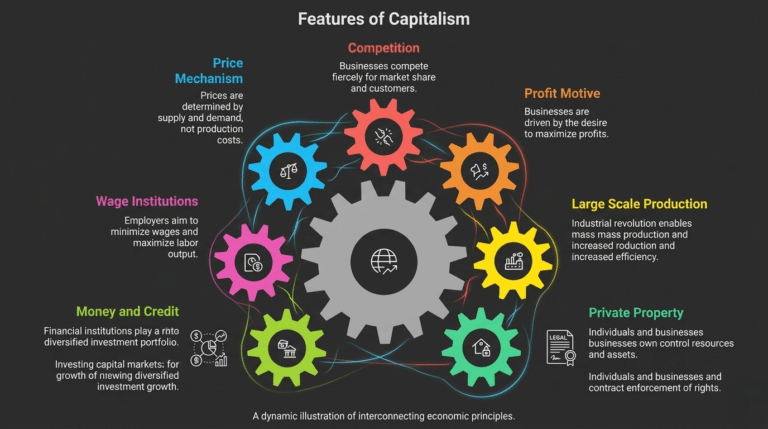
- Private property: Note on why the government individual on property and the sources.
- Large scale production: Capitalism arise as a result of industrial revolution which made large scale production possible production mean wider use of capital and lead to more profits.
- Profit as key of motive: Money left over can we spend in any way the manufacturer want production under capitalism is profit oriented.
- Competition: In capitalism there is extreme competition between capitalist demand is artificial Re increase and supply is decrease there is cut throat competition under capitalism.
- Price mechanism: In capitalism, the price of a commodity is determined not by the cost of production but by the law of demand and supply.
- Wage institutions: The objective of the capitalists is to pay as less as possible and to take as much work as possible out of him.
- Money and credit: In capitalist Institutions of credit has become important he capitalist get money on loan and develop their business
Countries: United States, United Kingdom, Canada, Australia, Germany, Japan, South Korea, Singapore, Switzerland, Hong Kong.
Fascism
This type of welfare ideology based upon hegemony in which some people having power and resources want to ride on the world. They also do welfare but eager that people may lie down in front of them. Prioritizes a strong, centralized government led by a powerful leader. It focuses on national unity and strength, often at the expense of individual freedoms. Welfare exists to strengthen the nation, not to promote equality.
Social Democracy
“The belief in a gradual transition from capitalism to socialism by democratic means.”Social democracy is a political ideology that emerged in 20th century with destruction of socialism. Social democracy creates transition in capitalism and replaces it with different social and economic system.
It correct capitalism and plays its role to fulfill the deficiencies of the government. It is supported by Marxism who said the transition can be occurred without revolution. Social democratic model based upon democracy in which welfare is provided by the government or the state according to needs and wish of its people.
Common Criticism of Social Democracy
- The services which are provided to every individual that may not be need or demand of any particular individual.
- According to conservatism and liberalism, social democracy interferes in the market mechanism because a huge budget badly affects the economy.
- Social democracy encourages high taxation that unable people to invest that caused low production in the country.
- It is unaffordable, particularly as the population ages putting more demands on pensions and health care provision.
Countries: Brazil, Denmark, Italy, Japan, Mexico, New Zealand, Norway, India.
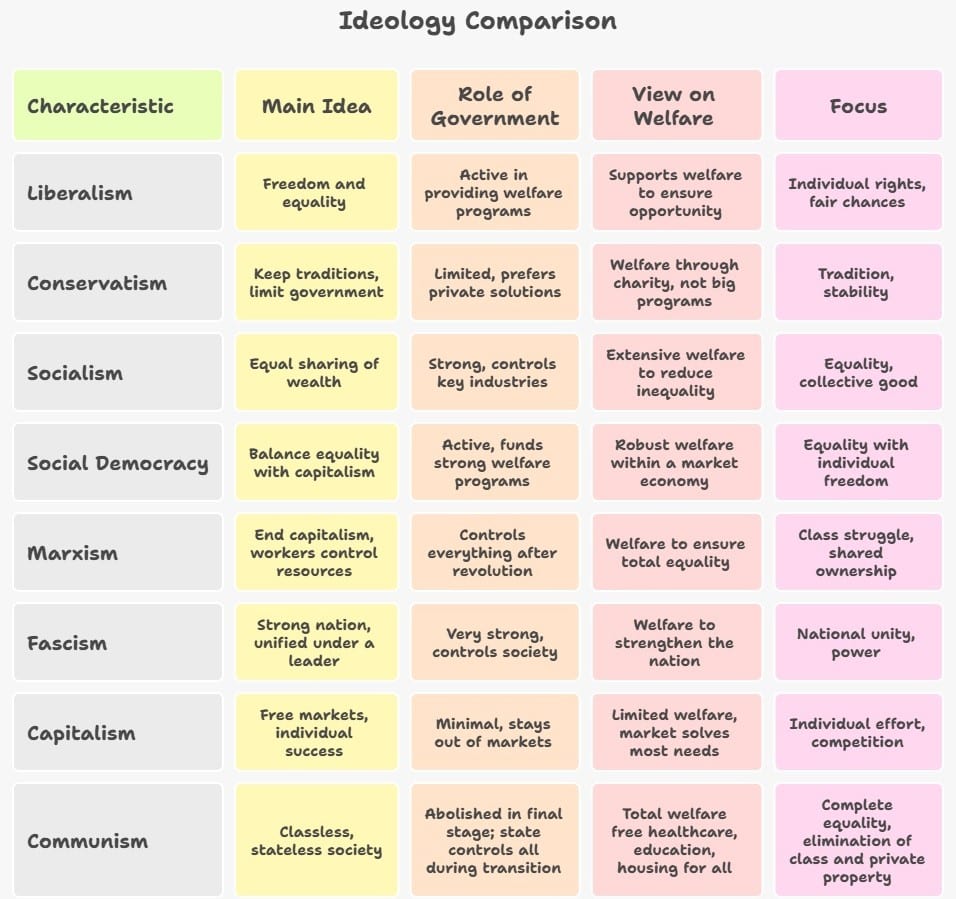
Comparison of Welfare Ideologies
Here is the updated table with Communism added: