
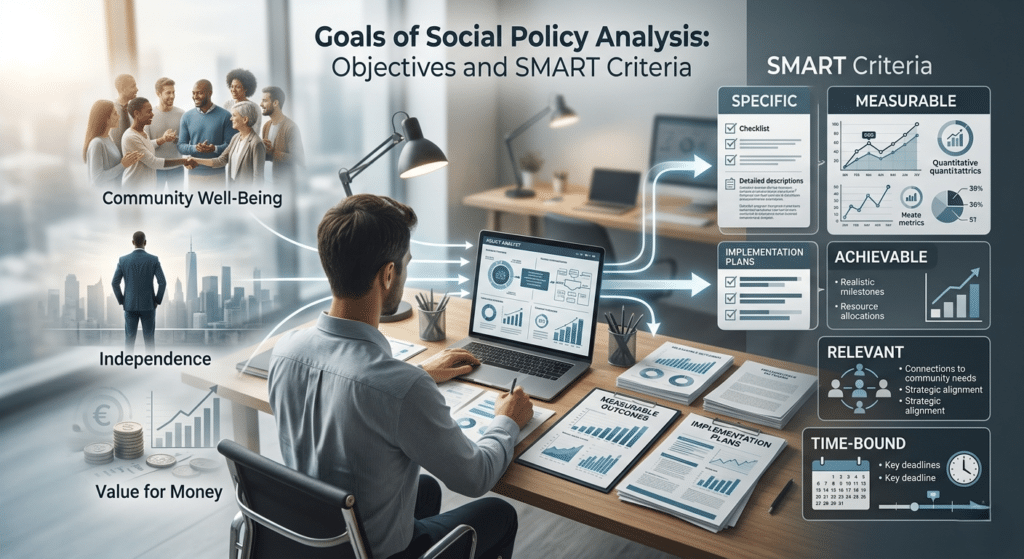
Goals of social policy analysis can be written in a general or in a very specific way, depending on how much detail is needed. Aims are usually stated in very broad terms, like “promoting independence” or “presenting value for money.”
Goals (or targets) are more specific, operationalized versions of these. This distinction is vital as goals convert general intentions into actionable and quantifiable parameters, despite the lack of universal consensus on these specific definitions.
Operationalizing Goals
Operationalization is a key part of making policy because it turns broad ideas into specific, achievable goals. This step may seem technical, but it is crucial because the problem can change while you are working on it. For instance, when people are worried about “poverty,” they may start with living standards but then switch to “low income” because it is easier to measure.
This changes the meaning of the issue. “Management by objectives” means that there are different ways to reach the same goal, and goals are set with specific results in mind.
The SMART Criteria
A widely recognized framework for setting effective goals is the SMART principle, which dictates that targets should be:
- Specific: Clearly defined, leaving no room for ambiguity.
- Measurable: Quantifiable, allowing for objective assessment of progress.
- Achievable: Realistic and attainable given available resources and constraints.
- Relevant: Directly pertinent to the policy’s overall aims.
- Time-bounded: Set with a specific deadline or timeframe for achievement.
SMART criteria might seem useful at first, but if you use them too strictly, they can cause problems. Sometimes, vague goals are better because they show the way without setting strict limits. Also, putting too much emphasis on “achievability” may conceal assumptions about methods and lead to establishing goals in a wrong sequence.
Instead of setting a SMART goal like “reduce unemployment by 10% in one year,” it might be better to set a broader goal like “create more job opportunities.” The first one might limit choices or push for methods that aren’t possible, while the second one allows for flexible manners to achieve the goal.
Advantages and Disadvantages of Precise Goals
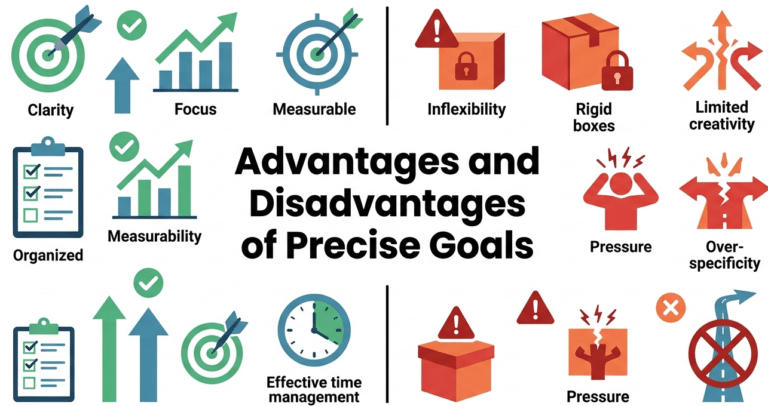
Policymakers may keep track of progress and hold people accountable by setting explicit goals in social policy. But having goals that are overly rigorous can also cause huge difficulties, such making things excessively rigid, introducing management bias, and making it more probable to miss out on broader but less measurable societal effects. We will discuss about the advantages and disadvantages of having clear goals in social policy in greater detail below.
Advantages of Precise Goals
- Clarity and Direction: Clear goals help people understand what a policy seeks to do.
- Performance Measurement: Setting measurable goals lets you see how you’re doing and how much progress you’re making.
- Responsibility: They set clear benchmark that agencies and policies must meet in order to be held responsible.
Disadvantages of Precise Goals
Neglecting Target
When policies set strict goals, they often become the main focus, and other important but harder-to-measure goals are ignored. This can change the real purpose of services and cause practices that seem good on paper but aren’t in real life. For instance, police might only focus on solving small, easy crimes because doing so quickly improves their performance records, which means that more serious cases get less attention.
Substitution of Problems
When an issue is hard to break down into simple goals (like poverty, which is a complicated, changing problem), planners might want to replace it with a problem that is easier to deal with and less important. For example, money for “poverty” might be used to make housing look better, which is easier to count than actually dealing with the complicated problem of poverty.
Management Perspective Bias
When setting goals and objectives, the focus is often on what management wants. If the opinions of the people using the service aren’t included from the start, their needs or concerns may be ignored.
Not being flexible
Policy should change over time, so goals and objectives should not be set in stone.
In practice, agencies often don’t say exactly what criteria they use, and criteria incorporated at the final stage of a review process can be used to defend a policy instead of really testing whether it worked or not.
Major Goals of Social Policy Analysis
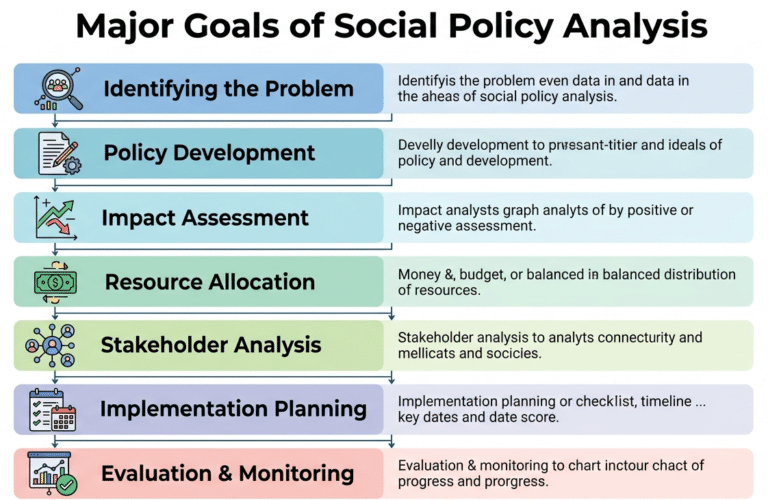
Identifying the Problem
The first step in social policy analysis is to clearly define the problems that exist in society. This means knowing who is affected, how many people have the problem, and why it is important. Before coming up with solutions, analysts collect data and evidence to figure out how big and bad social problems are.
Policy Development
This goal is about making new rules or making old ones better to solve problems that have already been found. Analysts look into different ways of doing things, see what has worked in other places, and come up with policy frameworks. They think about different choices and how they might affect different groups in society.
Impact Assessment
Analysts look at how policies will affect people, communities, and society as a whole before they are put into place. They think of both good and bad outcomes, including ones that weren’t planned. This helps people who make policy understand what might happen when they put policies into action.
Resource Allocation
Social policy analysis looks at how to best use limited resources like time, money, and people. Analysts help figure out the best and most fair ways to spend public money. They look at costs and expected benefits to make sure that taxpayers get the most value.
Stakeholder Analysis
This means figuring out all the groups that are affected by or care about a policy issue. Analysts look at different points of view from people, groups, businesses, and government agencies. When you understand different points of view, you can make policies that are better and more acceptable.
Planning for implementation
Analysts come up with ways to make sure that policies are put into action in the best way possible. They figure out what might get in the way, what resources they need, and who they need to work with. Setting up timelines, assigning tasks, and setting up systems for monitoring are all part of this.
Evaluation and Monitoring
This goal is to keep an eye on how well policies are working after they are put into place to see how well they are working and what needs to be changed.
Conclusion
In conclusion, the objectives of social policy analysis constitute the cornerstone for effective and significant policy formulation, directing analysts from the identification of social issues to the assessment of policy results. Frameworks like SMART criteria and processes like operationalization turn general social goals into specific, measurable, and doable goals.
Specific goals can help with clarity, accountability, and measuring performance, but they also come with risks like being too rigid, having management bias, and replacing real problems with ones that are easier to measure. So, to make sure that social policy really meets the needs of society and not just meets numerical goals, we need a balanced approach that includes clear goal-setting, flexibility, and real stakeholder involvement.