

The New Right Approach to social policy is a conservative viewpoint that emphasizes on personal responsibility, supports the idea that the role of the government in welfare should be reduced, supports solutions that are based on free market principles, and proposes that excessive welfare encourages reliance and reduces social accountability.
The Rise of New Right
The New Right was a prominent conservative movement in the United States that significantly influenced the evolution of American politics in the late 20th century. It resisted several social and cultural transformations instigated by the liberal movements of the 1960s, encompassing elevated taxes, affirmative action, and abortion.
The movement was deemed “new” for its capacity to revitalize conservative politics via enhanced organization and strength, appealing to a younger demographic of primarily white, middle-class, suburban Americans who felt that traditional values were under threat.
The New Right had swift expansion in the 1960s and 1970s, propelled by concerns over rising crime rates, drug consumption, permissive sexuality, and social turmoil. Young Americans for Freedom and other groups facilitated the consolidation of these discontented people into a unified political entity.
A considerable faction of the movement ascribed the moral and political challenges faced by the country to liberal government policies, asserting that excessive governmental interference was inflicting more harm than benefit. Their collective frustrations united a previously fragmented conservative coalition into a formidable and influential force.
Core Philosophy of New Right Approach
The New Right prioritized individual liberty, traditional values, and free-market principles above governmental control and social programs. It vehemently opposed liberal values, perceiving extensive government intervention as a threat to social order and personal responsibility.
Principles of New Right Approach
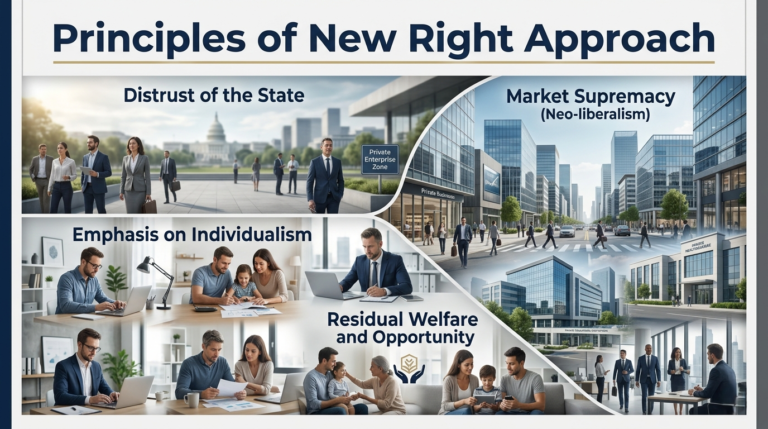
The key principles of new right approach are following:
Distrust of the State
The New Right demonstrates a prominent intolerance to political power, arguing that state intervention in social and economic affairs is harmful rather than advantageous.
Friedrich von Hayek stressed that excessive governmental control undermines individual liberty and that society’s complexity beyond the capacity of any singular central authority to effectively regulate.
The New Right is adamant about diminishing state authority due to their belief that government-operated services are inefficient, wasteful, and subsequently harmful to society.
Emphasis on Individualism
The fundamental principle of the New Right’s ideology is that individuals are most equipped to make decisions regarding their own lives, therefore emphasizing the importance of personal autonomy and accountability.
Rather of relying on government assistance, individuals should assume responsibility for their own well-being via careful planning, family associations, and personal effort. The New Right opposes social equality initiatives, arguing that they impede individual liberty and foster a culture of dependency instead of self-sufficiency.
Market Supremacy (Neo-liberalism)
The fundamental principle of the New Right is that governmental regulation should be secondary to the market. This concept is frequently exemplified by neoliberal practices. The New Right asserts that government-operated services such as welfare, healthcare, and education are inferior in utility and efficacy compared to market alternatives.
The main features of this market-based approach include:
- Laissez-faire: A reduction in government activity and reliance on the market.
- Marketization: Developing and encouraging markets, privatizing activities previously managed by government, and creating market mechanisms where they did not exist before.
- Free Economy: The New Right believes that government and economic systems should be changed to create a free economy. They think that the free market, which is made up of the choices and actions of many individuals, is the best way to protect personal freedom.
They also believe that private businesses work better and more efficiently than the government because competition forces them to improve and use resources wisely.
Residual Welfare and Opportunity
The right wing generally favors residual welfare. The concept of residual welfare treats collective provision as a “safety net” for those who are left out and unable to rely on their own or their family’s resources.
This means that state support is only provided as a last resort, once all other options such as personal savings, family assistance, and charitable help have been exhausted.
The New Right argues that keeping welfare minimal and targeted in this way encourages individuals to remain self-sufficient, avoid dependency, and take greater personal responsibility for their own well-being.
Policy Objectives and Strategies
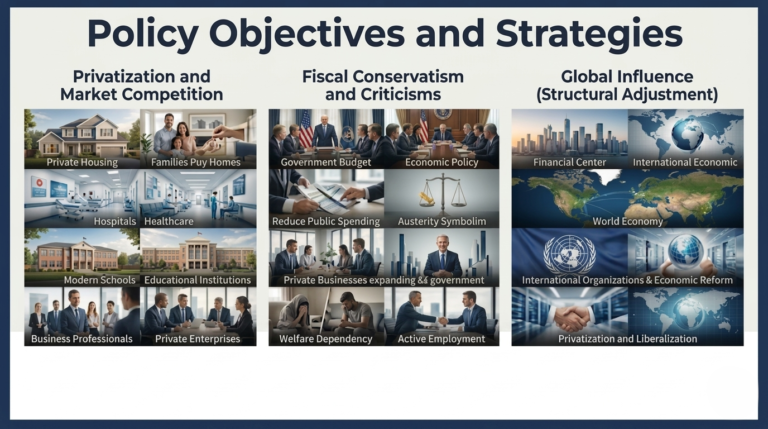
Privatization and Market Competition
The primary objective of the New Right was to privatize a significant portion of the welfare system. This indicates a preference for private enterprises over governmental oversight in managing various services.
Mrs. Thatcher’s government endeavored to enhance the efficacy and competitiveness of public services by integrating market and commercial concepts.
- Housing: In 1979, Mrs. Thatcher implemented a housing program known as “Right to Buy,” enabling individuals to acquire their government-owned council houses. This underscored the efficacy of free market concepts during the 1980s and 1990s. The New Labour administration continued this initiative initiated by the Conservatives.
- Health: The Conservative administration implemented new regulations to promote competition within the National Health Service (NHS). Hospitals and health services were compelled to compete in a “internal market” to enhance treatment quality and optimize cost distribution.
- Education: The Education Reform Act of 1988 implemented market-oriented modifications in educational institutions. To elevate educational standards, it promoted parental choice and competition.
Fiscal Conservatism and Criticisms
Controversy over the economic viability of the welfare system was a component of the New Right’s strategy, which frequently reemerged under the disguise of “austerity.” Those who support the New Right have voiced a number of concerns that are associated with the welfare state and economic governance.
- Distortion of Markets: Arguments derived from the Poor Law tradition (which persist in contemporary debates) suggest that state intervention leads to the distortion of markets, and welfare provision should be kept separate from the economy.
- Crowding Out: Critics said that excessive government expenditure on public services and welfare diminished income that could have been allocated to foster the growth of private enterprises.
- Dependency and Disincentives: Commentators on the right claimed that an “over-generous” welfare system creates social costs such as welfare dependency and work disincentives.
Global Influence (Structural Adjustment)
Neo-liberal ideas, prominent under the presidencies of Reagan in the United States and Thatcher in the United Kingdom in the 1980s, were later adopted in developing nations by the World Bank and the IMF.
The “Washington Consensus,” which emphasized market-oriented solutions to economic issues, laid the foundation for structural adjustment programs that executed this approach. Privatization, liberalization, and the application of price incentives to govern public policy were essential components.
Outcomes and Assessment
The implementation of New Right ideas during the almost 20 years of Conservative government (1979–97) did not lead to the full-scale arguing of the welfare state, though many significant changes occurred.
By the 1990s and early 2000s, people began to realize that privatization, market competition, and other New Right ideas had both advantages and serious limits. By 2007, the left-wing ideas of the 1970s and 1980s looked old-fashioned, while the New Right ideas also seemed tired and less effective.
Even though politics changed, the New Labour government (after 1997) still used some right-wing policies, such as expanding the Private Finance Initiative (PFI), starting student loans, and ending the lone parent premium (extra payment given to single parents). Their housing policies also followed the same path as the previous Conservative government.
Conclusion
The New Right fundamentally changed social policy by replacing free-market principles, privatization, and minimal state intervention for socialist welfare support. The changes enhanced competition and options in public services, however incited significant backlash on escalating inequality, reliance on assistance, and the erosion of the safety net.
The legacy of the New Right endures. Subsequent regimes, particularly New Labour, maintained several core policies. This reflects the solid establishment of New Right ideology throughout mainstream political and economic discourse.