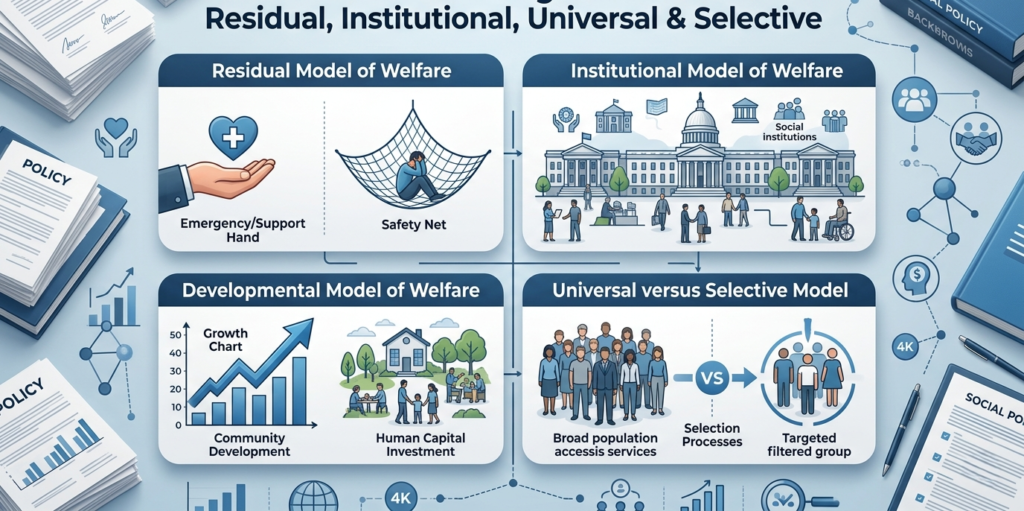
Social policy is developed through the integration of numerous theoretical and practical approaches. These approaches frequently interact and blend in complex ways.
Some of the primary distinctions between universal versus selective provisions, and the residual versus institutional frameworks include the practical integration of social welfare policy practices within what is occasionally referred to as a “mixed economy of welfare”.
The underlying philosophies, practical approaches, and social implications of various welfare administrations are clarified by these distinctions.
Residual versus Institutional Approach
The distinction between residual and institutional welfare approaches is significant because it demonstrates the evolution of social policy over time.
Residual Approach of Welfare
Social welfare assistance is intended to function as a “safety net” in accordance with the residual welfare approach. It is typical for families and individuals to depend on their own resources. Welfare is referred to as “residual” because it is exclusively intended for individuals who are unable to manage through primary resources, particularly those who are disadvantaged.
This approach frequently results in minimalist, means-tested assistance that is primarily directed at individuals who are in acute need or who are impoverished and have no other alternatives. This concept is historically illustrated by the English Poor Law, which restricts assistance to the impoverished and renders services as unappealing as possible in order to discourage demands.
Critics argue that residual approach fails to address the needs of a significant number of individuals and provides substandard, stigmatized services. The residual effects may be advantageous for a more comprehensive structure that is designed to address extraordinary situations and fill in gaps.
Institutional Approach of Welfare
In contrast, the institutional approach of welfare accepts need and dependency as a normal, inherent part of society. It recognizes social responsibility for these needs and makes general provision accordingly. Richard Titmuss argued that “states of dependency” are a normal part of social life, as everyone is a child at some stage, likely to be sick, or grow old.
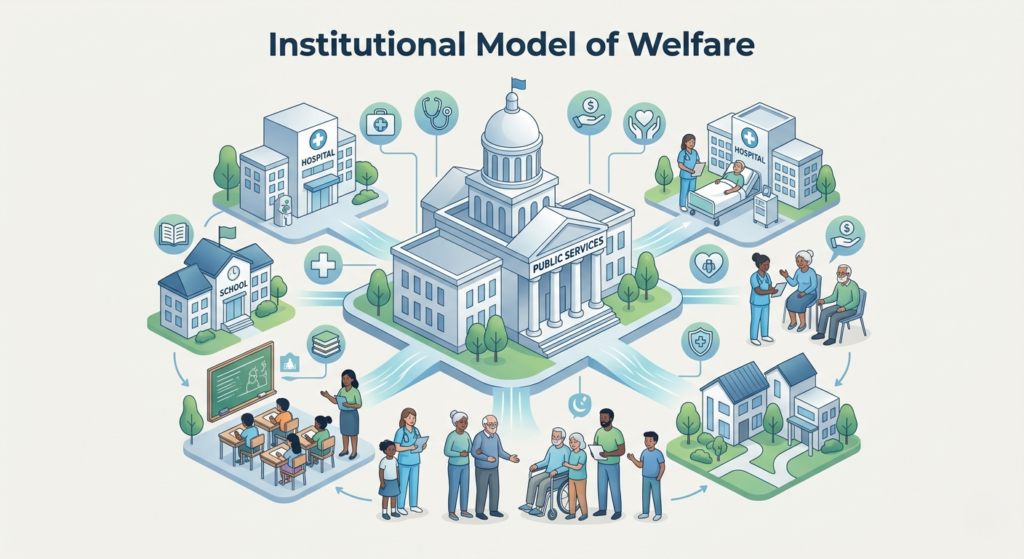
An institutional system, therefore, is built on the acceptance of social responsibility for these socially encouraged conditions of dependency. This approach promotes social integration and participation in society, a process sometimes called “social inclusion”.
The approach of the “welfare state,” particularly in the UK after World War II, aimed to move beyond the punitive Poor Law by offering protection and services to everyone as a right, rather than just the poor.
Developmental Approach of Welfare
Midgley asserts that the developmental viewpoint provides an alternate method that seems to resonate with liberals, conservatives, and the general populace. He characterizes this strategy as a “systematic process of intentional social transformation aimed at enhancing the welfare of the entire population alongside a progressive economic development framework.”
The developmental perspective on social welfare emphasizes the establishment of enduring solutions to social issues via the enhancement of individuals’ abilities, opportunities, and general quality of life. This method seeks to avoid issues and foster economic and social growth, rather than only offering assistance during situations.
This viewpoint resonates with liberals as it advocates for the creation and enhancement of essential social welfare programs. This viewpoint attracts conservatives since it posits that the establishment of certain social welfare programs would positively influence the economy.
Midgley and Livermore assert that “the global significance of the developmental perspective originated in the Third World during the decolonization period following World War II.”
The United Nations subsequently employed a developmental strategy in its initiatives inside emerging nations to foster the advancement of social programs, since it contended that these programs held the potential to enhance the entire economy of these Third World countries.
Titmuss’s Extended Models
Titmuss further elaborated on this distinction by outlining three models of welfare:
- Residual: As described above, focused on minimal support for those who cannot cope.
- Institutional-Redistributive: Combines institutional principles with an aim to equalize resources between people through redistribution.
- Industrial-Achievement/Performance: This model views social policies as supportive of economic development, securing benefits to contributions and work effort, much like the Bismarckian system of social insurance (A welfare model in which workers and employers contribute to insurance funds that provide benefits like health care, pensions, and unemployment support.). Education, for example, can be seen as preparing children for work, and healthcare as maintaining the workforce.
These models emphasize a variety of perspectives regarding the scope and purpose of welfare, including a safety net structure and an all-encompassing system that actively pursues social justice and encourages economic participation.
Universal versus Selective Approaches
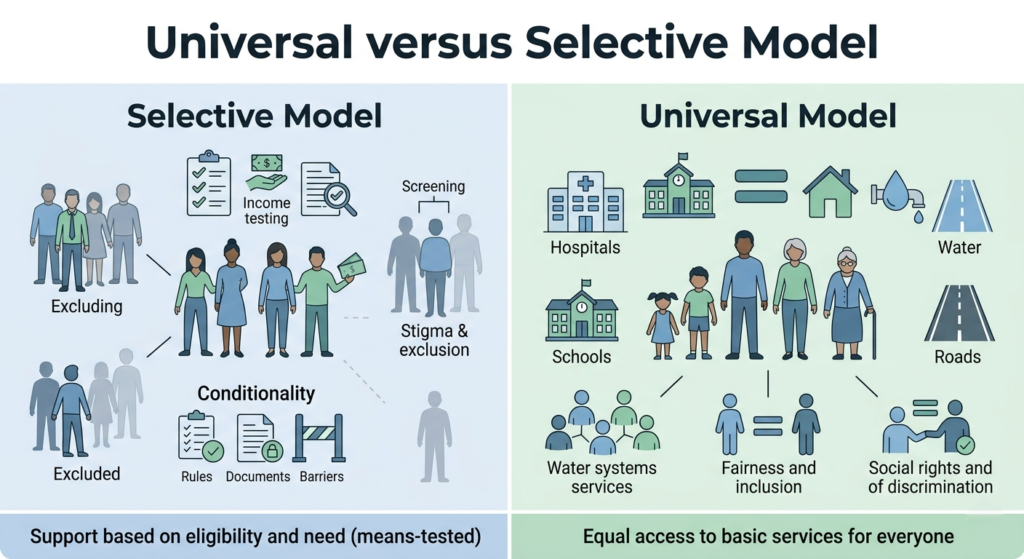
The approaches of giving welfare usually follow the residual and institutional approaches, and appear as either universal (for everyone) or selective (for specific groups) approaches.
Selective Approach
A selective policy explicitly selects the people who will receive a service. This involves identifying not only who should receive benefits but also who should not. Recipients are typically subjected to a means-test (assessing income or capital) or needs (e.g., assessing disability). Those who meet the criteria are provided for, while others are excluded.
Further restrictions, known as “conditionality,” can also be imposed, such as rules about residency, active engagement from unemployed people, or avoidance of immoral conduct. Selectivity is often confused with “targeting,” but it is a very specific form of it. While targeting simply means policies are directed at someone or something, selectivity specifically involves exclusion based on tests.
A major criticism of selective policies is that they are believed to be socially controversial, often attaching blame to individuals for their circumstances and leading to stigma. They can also be inefficient, as many eligible people may not receive benefits due to the administrative burden or the stigma associated with claiming.
Universal Approach
Conversely, universality includes the provision of every individual’s fundamental needs. This approach is based on the assumption that universal services can more effectively address the fundamental needs of all individuals. Roads, public water systems, and adequate housing, healthcare, and educational facilities have been available since the 1940s.
Universality is justified as a means of creating a society in which all individuals have access to fundamental services, thereby protecting individuals from arbitrary disadvantages. This emphasizes the social rights of all individuals and bolsters the concept of institutional welfare.
Management is simplified due to the fact that universal systems are consistent across all individuals. Occasionally, these comprehensive strategies may be less expensive than those that are more specific. The service is normalized, enabling the protection of the vulnerable without stigmatization, as all members of the target group are involved.
Blending Social Welfare Policy Approaches
In fact, social welfare systems seldom adhere to a single model or approach in its totality. Instead, they frequently exhibit a synthesis of numerous approaches, resulting in “hybrid” or “mixed” systems.
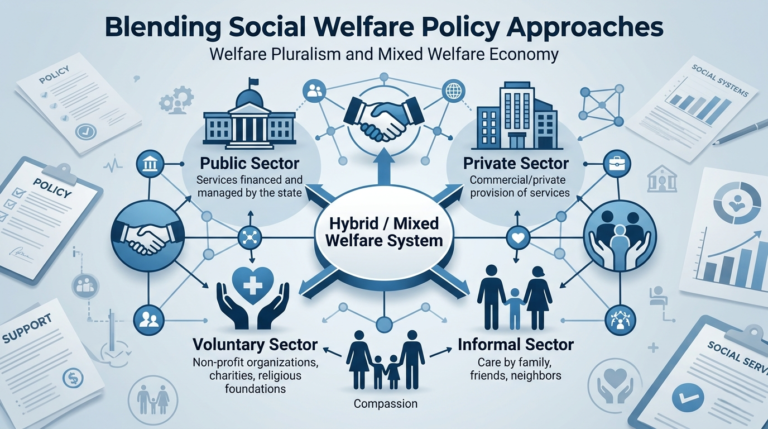
Welfare Pluralism and Mixed Welfare Economy
The concept of welfare pluralism, also referred to as the “mixed economy of welfare,” emphasizes that social services are provided by sources other than the government. Typically, these sources consist of:
- Public sector: Services financed and managed by the state.
- Private sector: Commercial activity where commodities are exchanged for money, or other forms of private provision.
- Voluntary sector: Action by non-profit organizations, often charities or religious foundations.
- Informal sector: Care provided by friends, neighbors, and families, most commonly by women within families.
Advocates of welfare pluralism assert that it enhances services by providing a greater variety of options. It also fosters a “welfare society,” in which individuals provide support to one another through a variety of networks, fostering interwoven relationships and compassion.
The British Welfare State
Following World War II, the British “Welfare State” endeavored to offer comprehensive assistance by means of social security, healthcare, accommodation, and other services. The Beveridge Report advocated for a National Health Service, child allowances, and full employment in order to combat the “five giants“: Want (poverty), Idleness (unemployment), Ignorance, Squalor (poor living conditions), and Disease.
The objective was to address all of these issues due to their interconnectedness. The system became increasingly disjointed as a result of the separation of services and their exclusive focus on specific subjects, such as social security. Welfare programs undergo modifications, concessions, and political debates rather than adhering to a single, definitive strategy.
Conclusion
The evolution of social policy is characterized by a dynamic interplay between practical realities and theoretical concepts. The fundamental distinctions between universal and selective approaches, as well as residual and institutional approaches, serve as a basis for comprehending policy design.
Nevertheless, genuine welfare systems consistently implement a combination of these strategies, frequently operating within a “mixed economy” of diverse providers. This combination is indicative of the intricate historical, social, political, and economic contexts in which welfare services are conceived, as well as deliberate policy decisions.