
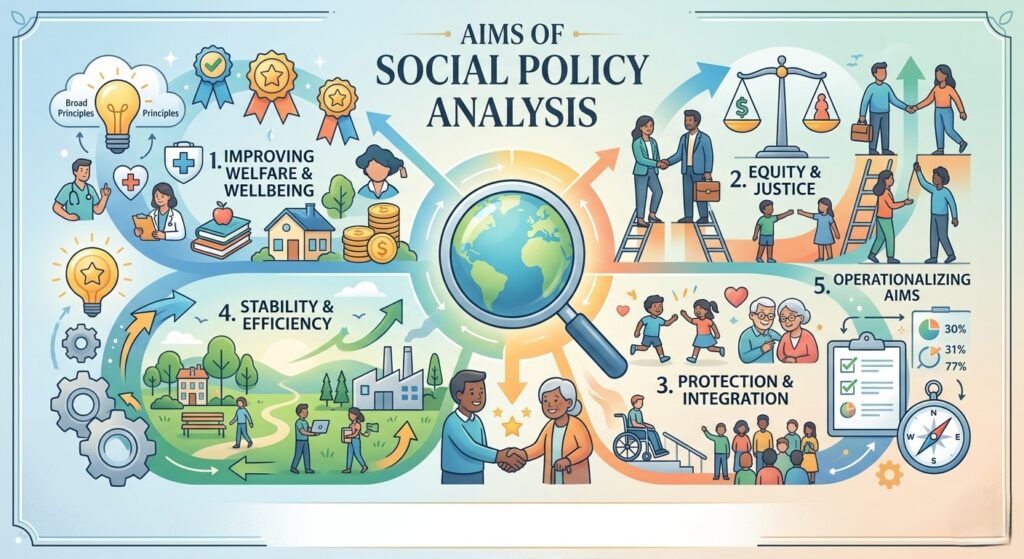
Aims are broad goals that an agency, service, or policy is supposed to attain. Aims of social policy play a central role in policy analysis, which is the initial stage of learning and assessing policy in practice.
The main assumption is that the policies are not made without a purpose: to do something and make things better. By default, the main aim of social policy is typically the improvement of welfare. In the social policy, it is essential to learn about the concept of Aims.
Aims are the standards according to which the effectiveness or ineffectiveness of a policy may be evaluated. This implies that in the case of any social policy, defining its objectives is the first step that one can be able to measure its impact and effectiveness.
Defining Policy Aims
Policy aims can be understood in a couple of ways:
Based on Principles
There are objectives based on generalized rules or moral principles, e.g. the child protection is in the best interests of the child, or the benefits are an incentive to work by the able-to-work. Within this strategy, every phase of a policy process must be consistent with larger values such as human rights or the rule of law.
Normative Objectives
Aims may also imply a particular goal or outcome, such as the elimination of poverty or the establishment of a free market economy. Though goals might look like principles, they are not the same. Goals or objectives that are grounded on values, principles or concepts of what ought to occur in the society. Normative objectives are concerned with such ideals as justice, equality, fairness, human rights, and welfare not only based on practical outcomes.
Aims should be differentiated with goals or targets. Though aims are usually general statements, goals (or targets) are measurable, specific and operationalized objectives. An example, promoting independence is an aim, and the benefits calculated in 95 out of 100 cases is a goal. This is referred to as operationalization, which is the process of translating general aims into concrete, measurable objectives.
Different Types of Aims
Policies tend to emphasize their positive goals, such as enhancing health or social justice. For this purpose, policies have various aims that are as discussed below;
Negative Aims
Negative aims are things that they should must avoid like being excessively expensive, violating professional regulations, or misusing funds. These negative aims are not always documented, yet when they are overlooked, people observe them, and this can easily result in criticism of the services.
Subsidiary Aims
In addition to these explicit statements, there are also subsidiary aims of social policies connected with practical considerations such as resource saving, accountability, and careful decision-making.
Positive Aims
It is usually easy to identify positive aims of an agency since they are clearly spelled out in policy documents, such as improving public health, reducing poverty, providing education, ensuring social security, promoting equality, and enhancing the overall well-being and quality of life of individuals and communities.

As an example, a service serving the elderly population could state the following aims:
- To enhance the general wellbeing of the aged people.
- To maintain their domestic autonomy as long as possible.
- To provide the necessary assistance to the helpless senior citizens and their care givers.
- To facilitate transitions in case of need of other types of care. In addition to these explicit statements, there are some further aims, which can be frequently deduced or revealed after a critical examination of the related literature.
The aims of a policy are not necessarily obvious. What appears to be a technical issue, like cost reduction or redistribution of wealth, is sometimes founded on values and modes of thought. As an illustration, the concept of poverty may have different definitions in different locations, and that is why there are different policy outcomes.
Ultimately, politicians make policy choices, and these choices are largely due to the conflict of interests. This is why it is not always clear why a policy was developed and who benefits in it.
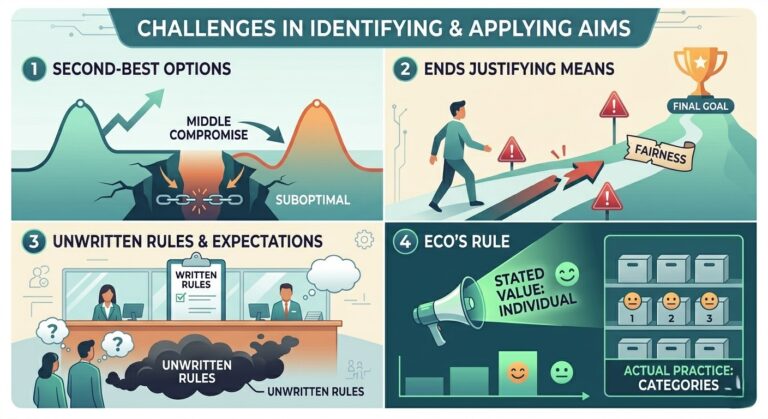
Challenges in Identifying and Applying Aims
Several challenges arise in the practical application of aims:
Second-Best Options
In welfare economics, a middle or compromise policy may in fact be worse than one of the extreme ones, particularly when fundamental rules or assumptions are not taken into account.This means that where there is no perfect or ideal solution, making a compromise or second-best option does not necessarily result in a better solution, and in certain situations may cause more problems, inefficiencies, or contradictions than merely following a single clear and consistent policy direction.
Ends Justifying Means
One of the challanges of policymaking is the tendency of individuals to concentrate on the end result and permit malicious or unjust activities to reach that end. History knows numerous instances of such an issue.
Unwritten Rules and Expectations
Services are often judged by hidden rules or expectations that are not written down. When these are not met, people see the service as a failure. These unwritten rules are informal standards and social norms which are expected to be followed by the population by service providers like treating the clients in a respectful manner, responding in a timely manner, and acting in a certain basic manner of ethics and even though these rules are never written down formally, their violation is easily detected and may harm the reputation and credibility of the service significantly.
Eco’s Rule
Umberto Eco made a point of observing that when an organization continues to emphasize a particular value (such as treating everyone as an individual), it might be the case that in actual the reverse is taking place (people are being treated in fixed categories). This indicates the gap between promise and delivery.
Major Aims or Objectives of Social Policy
Welfare and Wellbeing
Social policy seeks to improve people’s lives by investing in them in terms of provision of basic needs such as health care and education as well as housing and income support. This is beneficial towards the living of every person with a decent and secure life.
Equity and Justice
This is aimed at minimizing inequitable disparities within the society i.e. between the rich and poor, men and women. This is aimed at providing all people with equal chances and treatment.
Protection of Vulnerable Groups
The vulnerable populations such as children, women, old people, people with disability as well as the poor are protected with special consideration. This guarantees their safety, support as well as non-abandonment.
Social Order and Stability
Social policy contributes towards peace in the society by generating solutions to such problems such as poverty, unemployment as well as crime. It decreases the disagreements and establishes a persistent social atmosphere.
Economic Efficiency
The social policy aims at helping the population and not damaging the economic growth. It encourages prudent consumption of resources and the strike between welfare and development.
Rights and Participations of the Citizens
It makes sure that the citizens of a country are in a position to get access to services such as education and health. There is also an opportunity of citizens participating in making decisions in life which pertain to them.
Poverty Reduction
Social policy aims to alleviate poverty through offering money, employment opportunities, and maintenance programs. This assists the individuals in fulfilling their daily needs and come out of poverty.
Human Development
It aims at enhancing the skills, knowledge as well as health of people. The healthcare, education and training enables the people to attain their potential.
Social Integration
The social policy fosters the integration process by the different groups in society. It lessens the discrimination and promotes respect and inclusion and equal opportunity to everyone.
Sustainable Development
It provides that the existing welfare policies should not be offensive to the successive generations. The fines are spent wisely as to ensure that the current and future needs are satisfied.
Conclusion
To sum it up, although a clear set of aims is essential to assess social policy, students should remember that there is a complex interdependence of explicit and implicit goals, normative evaluations, and political aspects affecting the establishment of social policy as well as its practical consequences. These facets are important to the analytic examination of the practice of social policy.