
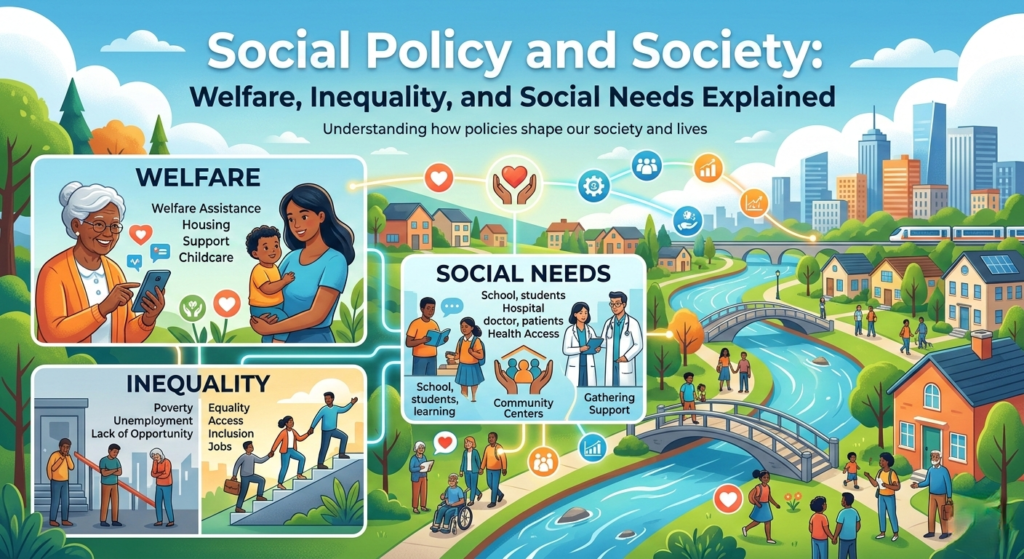
Explore the link between social policy and society — how policy shapes welfare, addresses inequality, and responds to social needs. Learn the key concepts here.
At its core, social policy focuses on social services and welfare. It is an applied discipline, meaning that instead of only seeking to comprehend social debates, it proposes actions to address those issues.
The practical nature of this discipline social policy means that it is predominantly tied to the context of the society it serves, as the welfare of a community can only be understood within its social environment.
Social Context of Welfare
The core element of social policy revolves around the social character of welfare. While some economic theories may focus on the individual, social policy focuses on the welfare of individuals as members of a community. This approach counters the individualistic stance that addresses the community as simply a collection of individual interests.
Social policy, on the other hand, addresses the complexity of social relations beyond individuals, including families, communities, work organizations, and even countries. The meaning of social policy remains contested; therefore, understanding the social constructs of “the individual,” “the family,” and “the community” becomes pivotal.
This is because the diversity of meanings, especially in the context of social policies, makes it difficult to have unambiguous policies.
The Person in Society and Social Networks
Individuals come into the world, and their life experiences are shaped by society and those around them. Social policy appreciates needs that go beyond the biological, subsistence needs. Social policy considers the human social needs such as human contact and the affectionate interactions.
Social Unites and Networks Influencing Welfare
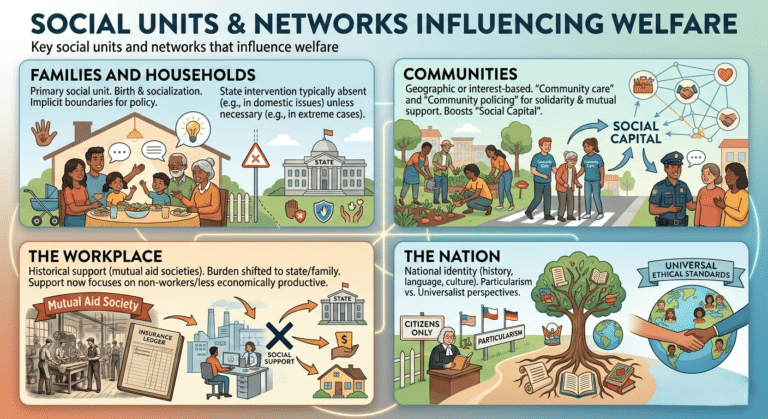
Key social units and networks that influence welfare include:
Families and Households
The family is the primary social unit in which certain social processes, such as the birth of children and socialization, take place. Policies such as family policy exist, but the family also shapes, often implicitly, the boundaries of social policy. Typically, state intervention in family issues is absent, unless there are extreme situations, such as domestic violence and child abuse, which necessitate state intervention.
Communities
Communities are important for social welfare, whether they are defined geographically or as social networks based on interactions and shared interests. The phrase “community care” or “community policing” describes these social networks and are typically associated with solidarity mutual support and obligation. The expression “social capital” refers to the worth of these networks and the increased capability of individuals.
The Workplace
Historically, social support structures existed within the workplace. Employees would buy insurance and form mutual aid societies. Over the years, however, the welfare burden shifted to the state, and, to some degree, the family. Consequently, social support structures became centered around those outside of working, and hence, those who less economically productive.
The Nation
Countries sometimes define national identity and the feeling of accountability of citizens based on a common history, language or culture. Such phenomena may lead to particularism, the belief that citizens and non-citizens deserve different laws or rights. On the other hand, a universalist perspective maintains that every person, irrespective of their country, is entitled to a set of ethical standards.
Role of Social Policy in Society
Inequalities and Social Divisions
Inequalities act as societal dividing lines and are extensively managed by social policy. While examining inequality, the predominant focus typically centers on the primary domains that exhibit differential treatment of individuals or disparate opportunities.
Class
Each theory explained class differently. Marx explained class above the economic structures of production. Weber explained class through the economic situating of people. In contemporary society class is explained through occupation and education.
Socio-economic status is a valuable variable to explain inequities of health, education, and housing. Wealthy families can afford better health services and private education whereas disadvantaged families have limited access to health services and low quality education.
Status
This is a socially defined variable that in a structured way determines access and limits in life, often through education, social mobility, etc. The term status is often linked to stigma, where possessing an attribute leads to social rejection. Richard Titmuss argued that stigma should not be associated with publicly provided services, emphasizing that all social rights of citizenship should be included.
Power
The ability to bring about the outcome you want is power. This can be done through the use of force, influence, or authority. Power is explained in relation to organization of society and that is why some policies are of greater benefit to some groups and not others.
Inequality is damaging because it is associated with social issues such as insecurity, health, and increase in crime, impacting whole societies.
Social Issues and Social Policy
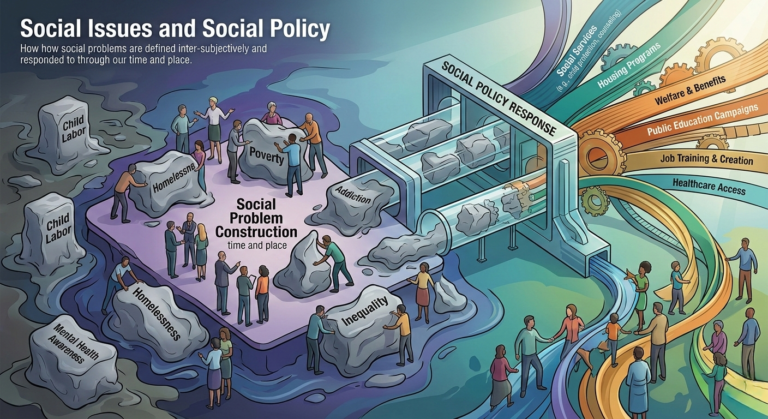
Social policy is about social issues, which is the way social problems are defined and need a social response. These problems are not defined objectively, but rather inter-subjectively, as problems are defined by the social construction of reality. What is perceived as a problem varies with time and place (i.e. child abuse). However, social problems can be responded to by:
Immediate Response
Addressing the problem directly (i.e. providing financially to the financially disadvantaged). Such a response is often criticized for dealing with the symptoms, but in some cases, it can be an appropriate response.
Cause Response
In this type of response, the aim is to address the root of the problem. However, this is often a challenge as the true causes may remain hidden and even the solutions may not achieve the desired results.
Key Area Intervention
This describes providing for one important area which is expected to lead to an improvement in several other areas. For example, the provision of child care can enable a greater number of women to participate in the labor market.
Policies are usually “targeted” to particular persons or social units such as individuals, families, households, communities, social groups, or society at large. Targeting certain social units or groups often reveals hypothesized causes of the social problem.
Needs and Welfare
Social policy analysis is primarily concerned with “needs.” Social response is required because social construction and response is organizational in nature. Consider children’s dependency on adults. Their young age requires adult dependency. But sociocultural constructions necessitate adult dependency.
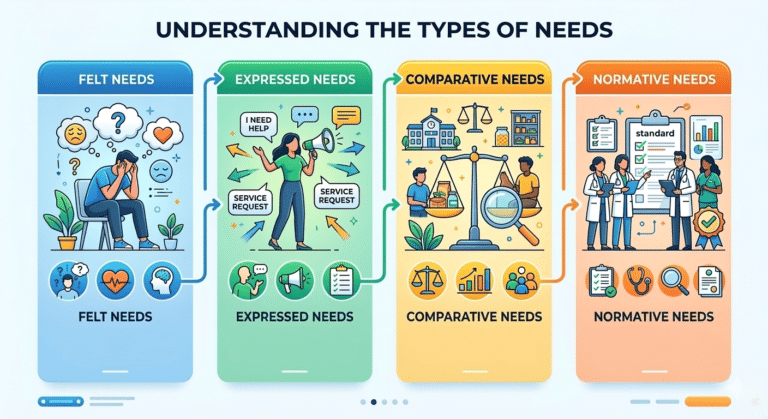
Policy needs with respect to children, the aged, and the disabled are distinct and divergent from one another. Social construction is temporal, responsive, and ongoing. Consider the contemporary need for computers and phones. Needs as a heterogenous construct are on the spectrum of action and response. Needs as a construct is heterogeneously diverse and found on the spectrum of action and response. There are four types of need:
- Felt needs: are a subjective sense of deprivation.
- Expressed needs: are a social demand.
- Comparative needs: constitute a social analysis of a given social context.
- Normative needs: are described, defined, and explained by a professional commentator.
Indicators for Measuring Social Issues
Social policy analysis uses quantitative data for problem analysis and interrelatedness. Problems can be analyzed and measured by the following:
- Prevalence: is the cross-sectional analysis of a given problem.
- Incidence: is the quantification of new cases, sans precedent.
- Distribution: Who suffers more in comparison to who suffers less, this provides an insight into inequity and its potential root causes.
- Intensity: How grave, how deep is the issue, not simply an existence or non-existence.
It’s worth noting that the problem’s magnitude does not explain its root or provide the answer, as the issue is usually much more intricate.
Conclusion
The study of society and social policy is a study of interlinkages. Social policy begins with a problem and attempts to understand and articulate how to change the situation within the encompassing social, economic, and political complexities. It is a problem-solving, practical, interdisciplinary and political field which utilizes several branches of social sciences to analyze data and construct social policy.
Social policy is ultimately about transforming the condition of people through the identification of social problems and proposing solutions in order to give effect to the ideals of improving people’s lives, rights, social, and economic equality and justice.