
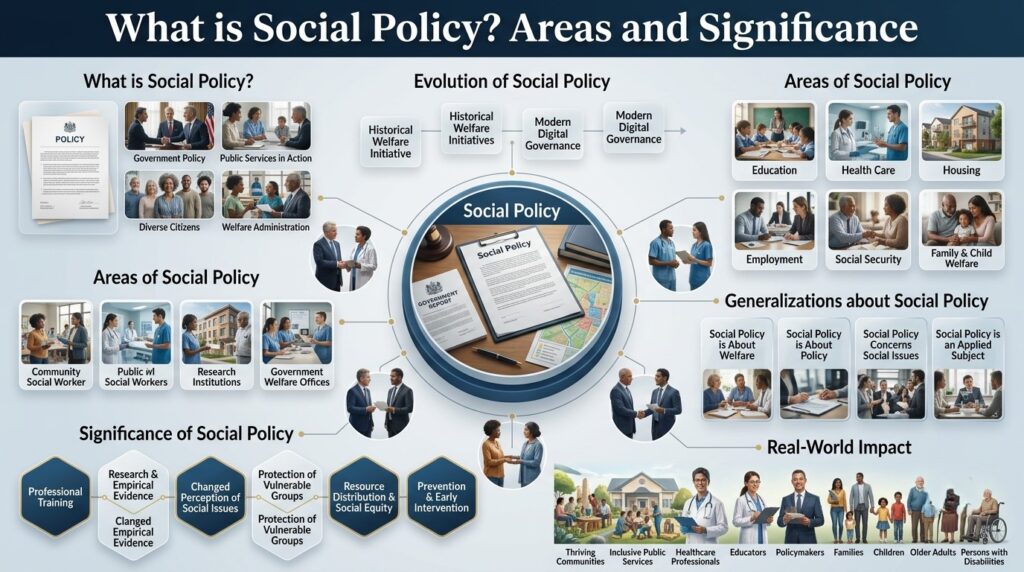
Social policy encompasses a broad range of beliefs, principles, and regulations employed by governments and institutions to address the needs of individuals. It encompasses deliberate measures at the national, regional, or organizational level to promote social welfare, address inequality, and protect marginalized populations.
Social policy basically concerns the organization and allocation of resources, rights, and obligations among individuals within a society to ensure their dignity and security. Social policy is a field and practice focused on examining human existence and the influence of public programs and institutional structures that shape it.
It pertains to the design and delivery of services in the domains of health, education, housing, employment, and social protection. The significance of social policy lies in its capacity to transform the system, transitioning from isolated interventions to addressing the structural determinants of poverty, exclusion, and social vulnerability.
What is Social Policy?
What is social policy is best understood through the definitions offered by leading scholars, each of whom highlights a distinct yet complementary dimension of this foundational concept.
- Plan of action to deliver social benefits in the form of social services (Thomas H. Marshall).
- Policy of the government which is related to the welfare and protection of the people.
- Social policy primarily refers to the guidelines, principles, legislation, and activities that affect living conditions and promote human welfare.
Evolution of Social Policy
While training people to work in social services constituted the first phase of social policy as “social administration“, it was David Donnison who discussed social policy as the study of the systems designed to address human needs and the conditions in which people live. He dealt with health, housing, education, social work and social security (called big five) and also with some employment and legal services.
Richard Titmuss’s 1955 essay, The Social Division of Welfare”, was a turning point in showing that welfare should be studied and viewed in wider sense rather than as isolated services. This also diverted attention from social administration to social policy, which incorporated planning, governance, and social contracts, as well as concepts like needs assessment, performance measurement, empowerment, and others.
Areas of Social Policy
According to Paul Spicker’s areas of social policy, social welfare and social services include the following:
- Policies and administrative actions in the areas of health services, social security, education, employment, community care, and housing management.
- Factors that restrict welfare, like disability, unemployment, mental health, and aging.
- Active social problems such as crime, substance abuse, and the disintegration of the family.
- Social disadvantage issues such as ‘race’, gender, and poverty.
- Organized social action to these issues, which goes beyond state welfare to include self-help, volunteers, and welfare in other industrialized nations.
Taking into account these aspects of social policy, the primary goals of social policy are:
- To provide employment.
- To foster change in agriculture.
- To restrict population growth.
- To enhance and broaden the housing, health, and education services.
- To provide social security to the citizens.
- To provide social care and child protective services.
- To achieve social equity within the community.
- To provide health care services.
- To reduce criminal activity within the community.
Generalizations about Social Policy
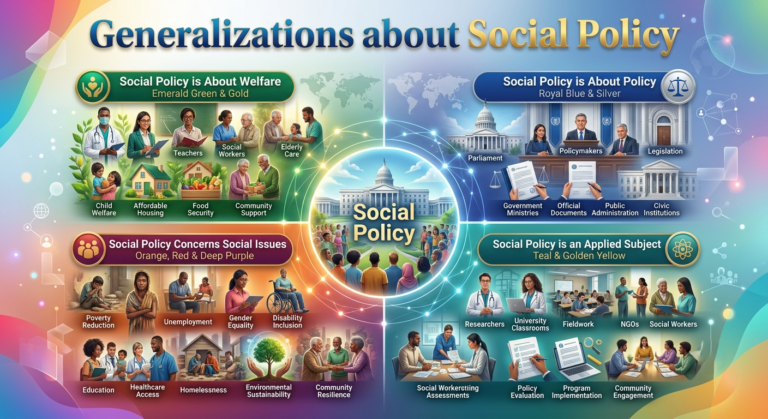
There are four key generalizations about social policy:
Social Policy is About Welfare
Welfare has many meanings and interpretations. Most commonly, it refers to the general `well-being’ of a person. When it comes to social policy, welfare concerns are more specific as they deal with collective care provisions that aim to protect the welfare of those who are victims of problems and/or vulnerable.
Social Policy is about Policy
The relevance of social, economic, of politics relationships is mainly of a social policy scope practical interest as it seeks to understand the different aspects of social policy: the formation of social policy, its objectives, implementation, and evaluation.
Social Policy Concerns Social Issues
The term “Social” refers to the collective response to individual problems (as opposed to private) of a society, that is, social issues. This is to differentiate the social problems from personal issues that are private, as well as macroeconomic issues of a nation.
Social Policy is an Applied Subject
It identifies a problem and, using tools from different disciplines, seeks a solution and achieves practical outcomes. It shifts its focus towards the context of the situation to achieve.
Significance of Social Policy
Discussing social policy is important because it concerns itself most with social issues, and most importantly, seeks to find and implement ways to alleviate them. It is relevant because of:
Professional Training
Social policy prepares social workers, nurses, and housing officers, among other professions, with the tools to effectively address some of the most pressing social issues.
Research and Empirical Evidence
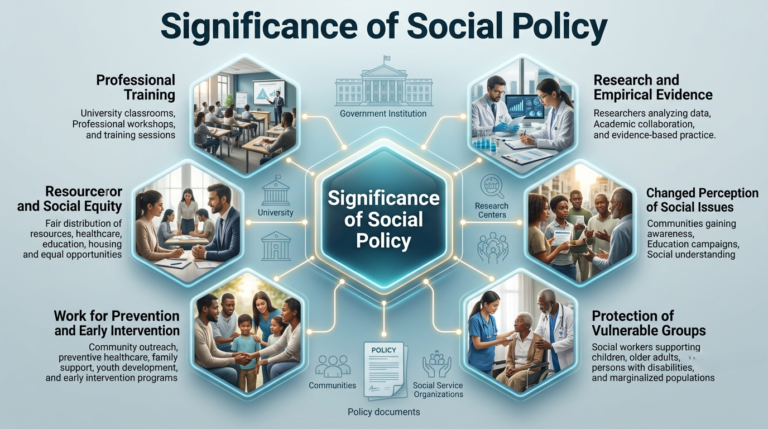
Social policies provide research evidence to governments. It assists them in formulating policies and services directed towards alleviating poverty and improving social care.
Changed Perception of Social Issues
Social policies influence the way people think about social issues. It promotes critical thinking instead of simplistic thinking and moving beyond stereotype beliefs.
Protection of Vulnerable Groups
The Social Policy of a given country helps in the protection of the rights and the interests of the vulnerable and marginalized members of society, especially children, elderly, the handicapped, and the people of the minority groups in the country. It builds the legal tools and assistance structures, which allow these groups access to necessary services and protection from abuse and discrimination.
Resource Distribution and Social Equity
Social policy informs Government in the fair distribution of societal resources and opportunities. It describes systemic inequities and unequal social determinants of health (how money should be spent on education, health care, housing, welfare) and advocate loss of social inequity.
Work for Prevention and Early Intervention
Social policy is about prevention and early intervention rather than reactive responses. Social policy demonstrates the identification of risk factors and the implementation of social policy, and the prevention of long-term social and economic costs of unemployment, homelessness, and family breakdown. Social policy creates resilient communities.
The following principles explain the purpose of formulating a social policy:
- Providing basic human needs.
- Meeting the basic social needs.
- Providing services to people.
- Improving the quality of life.
- Eliminating social problems within the community.
- Addressing the risk of war and violence.
- Concern with the development and advancement of a community.
Conclusion
Social policy addresses and remedies social issues and assists in the improvement of the wellbeing of society. Social policy addresses issues and provides the social workers, nurses, and housing officers the real world social challenges. Social policy provides the support for and helps the governments the research to make an evidence based social policy to help issues of poverty and social care.
Social policy shapes the concern of the people and provides the social issues with the concern of the social issues and the social issues with the attention the analysis. The social policy fulfills the principle of sustaining humane social relations, the social provision, and improvement of the quality of life, the eradication of social vices, and the social advancement and development. Also, it addresses the risk of war and fosters the wellbeing of people and the community.