

Defining Sampling Error
Sampling errors may occur when the sample utilized in a study fails to accurately represent the entire population. Researchers must consistently indicate a margin of error when presenting their final results due to the prevalence of sampling errors. This is a prevalent statistical technique that ensures the consideration of any errors.
The margin of error indicates the permissible degree of inaccuracy in a calculation, ensuring that it accurately reflects the disparity between the sample and the entire population. This is not a mistake but this is exactly what occurs when one examines a smaller subset rather than the entire population.
Causes of Sampling Error
Sampling errors do not arise without reason. Several identifiable factors contribute to their occurrence. Understanding these causes is the first step toward effectively controlling them:
Insufficient Sample Size
When the sample size is too small compared to the population, it is less likely to show all of the population’s variability, which leads to a higher sampling error.
Poor Sampling Frame
If the sampling frame is incomplete or wrong, it means that some members of the population are left out or misrepresented, which causes systematic error.
Inappropriate Sampling Method
If you use a sampling method that doesn’t fit the population or objectives of the research, you could end up with a biased or unrepresentative sample.
Random Variation
There will always be some random variation between the sample and the population, even if the sample is well-designed. This natural change is a natural cause of sampling error.
Fail in Following Sampling Procedures
When interviewers or data collectors don’t follow the sampling plan and pick people who are easy to reach instead of the ones who were supposed to be picked, the sampling error goes up a lot.
How to Calculate Sampling Errors?
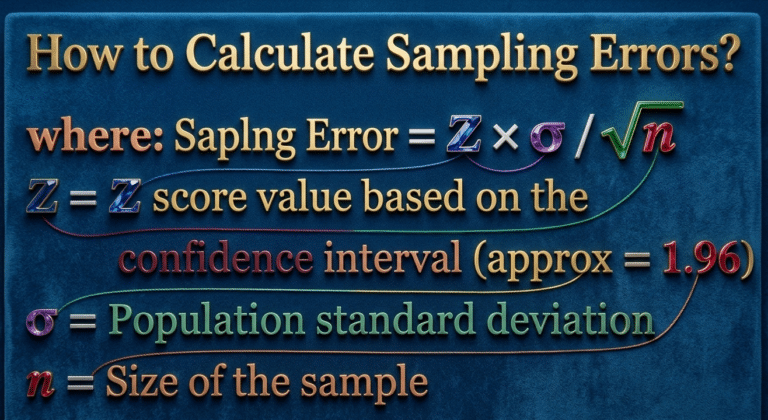
The formula for sampling error is employed to determine the total sampling error in statistical analysis. The sampling error is determined by dividing the population’s standard deviation by the square root of the sample size and subsequently multiplying the result by the Z-score corresponding to the confidence interval.
Understanding Formula for Sampling Errors
Sampling Error = Z × (σ / √n)
Explanation of each part is discussed here in detail;
- Z (Confidence Level): This represents how sure you want to be. If you want to be 95% certain of your results, you use a Z-score of 1.96.
- σ (Population Standard Deviation): This measures how different people are from one another. If opinions vary wildly, the error increases.
- n (Sample Size): The number of people surveyed. As this number goes up, your error goes down.
Example: Studying Student Burnout
Imagine you are a sociologist studying stress levels among 10,000 students at a major university. You can’t interview all 10,000, so you pick a sample of 400.
1) The Variation (σ): You find that some students are perfectly fine, while others are extremely stressed. If students’ stress levels vary wildly, your sampling error increases because a small group might not represent all those different experiences.
2) The Sample Size (n): If you only talk to 10 students, your sampling error will be huge. You might accidentally pick 10 relaxed students and miss the stressed ones entirely. By talking to 400 students, the “law of averages” kicks in, significantly shrinking your error.
3) The Certainty (Z): To say you are “95% sure” the average stress score is within a certain range, you use the 1.96 multiplier. This creates the “margin of safety” around your survey result.
In short, to minimize error in research, you aim for:
- A large sample size (high n).
- A population with similar characteristics (low σ).
- A standard confidence level (usually 95%).
Types of Sampling Errors
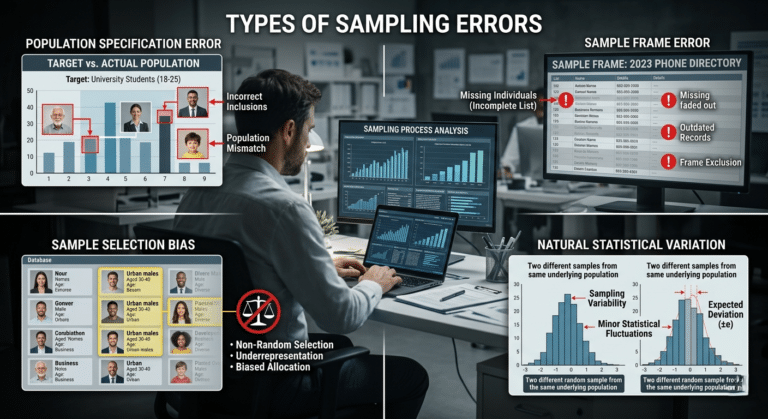
Sampling errors can be categorized based on their origin and nature. The following are the main types recognized in research methodology:
Population Specification Error
A population specification error arises when researchers lack clarity on the appropriate survey subjects. For example, consider a research study concerning children’s clothing. Who is the appropriate individual to survey? It may involve either the parents, solely the mother, or the child.
Parents ultimately determine purchasing decisions; yet, it is crucial to acknowledge that children can significantly impact these choices. This error occurs at the initial stage of the sampling design, indicating that the target population is not distinctly or accurately defined.
Sample Frame Error
Sampling frame errors occur when researchers mistakenly target the wrong sub-population during sample selection. For example, researchers may employ resources such as school enrollment lists or voter registration lists; however, these lists may exclude individuals who are neither enrolled in school nor registered to vote, so failing to accurately represent the entire population.
Selection Error
A selection error occurs when participation in a survey is self-selected, meaning only those who are interested choose to respond. This can make the results less representative. To reduce this error, researchers should try to involve respondents from the entire sample. Proper pre-survey planning, regular follow-ups, and a well-designed survey can help increase the response rate and improve the quality of data.
Random Sampling Error (Statistical Error)
This kind of error happens because of natural statistical variations between a sample and the population it represents. It shows how different the average values of the sample are from those of the whole population. This error happens a lot when the sample isn’t well-planned.
To minimize it, researchers must carefully design the sample, utilize an adequately large sample size, and ensure it accurately reflects the population. Random sampling error is a natural part of sampling; it can be reduced, but it can’t be completely removed. For example, a researcher chooses 50 college students to find out how many hours a week all students study.
The sample shows an average of 4 hours, but the real average for the whole university is 5 hours. This mismatch is due to random sampling error, which means that the chosen sample does not accurately represent the whole population.
Non-Sampling Error
When a small group of people is chosen from a larger group, this is called a sampling error. Non-sampling errors can happen at any point in the research process, and they can even happen in a census survey that looks at the whole population.
Types of Non-sampling Errors
Errors in Data Collection
These happen when surveys are poorly designed, questions are leading, terms are unclear, or the interviewer shows bias in their answers.
Data Processing Errors
Errors made while entering, coding, or cleaning data can change the results, no matter how good the sample selection is.
Non-Response Error
The results are not accurate when a large part of the chosen sample does not respond and the people who do respond are different from the people who do not respond in a systematic way.
Measurement Error
This happens when the tool used to gather data doesn’t accurately measure the concept it was meant to measure, which leads to responses that don’t show the real values.
The primary distinction is that sampling errors can be mitigated by enhancing the sampling design and increasing the sample size. Non-sampling mistakes must be rectified by enhancing questionnaire design, improving interviewer training, and refining data handling techniques.
Steps to Reduce Sampling Errors

Identifying sampling errors is a relatively straightforward task. Here are some practical methods to minimize sampling error:
Increase Sample Size
An increased sample size results in a more accurate outcome as the study represents the actual population size. As the sample size increases, the results increasingly align with the actual characteristics of the population, hence reducing the error. Researchers must evaluate the benefits of a larger sample in relation to practical constraints, like time, cost, and resource availability.
Divide the Population into Groups
Establish test groups based on population size rather than employing a random sampling. If a specific demographic constitutes 20% of the population, it is crucial to use this variable in your study to reduce sampling bias. Utilize the stratified sampling method to achieve maximum participation from diverse demographics. The accompanying article on Sampling Methods provides a comprehensive analysis of stratified and other probability sampling techniques.
Analyze the Population
Dedicate time to carefully examine the population you are interacting with in order to gain a comprehensive understanding of its unique demographic composition. Determine the demographic groups showing notable traits relevant to your study and focus solely on the applicable sample.
Pilot Testing
Before conducting the complete major survey, it is recommended that an initial trial run, known as a pilot test, should be conducted. A pilot test is a preliminary research conducted before to the main data collection phase. The goal is to find problems with the sampling design, the data collection tools, and the whole study plan.
Problems found during the pilot test, like questions that aren’t clear, wrong sampling units, or procedures that don’t work, can be fixed before they affect the main study. This will make the research more reliable and effective.
Reduce Data Collection Errors
To reduce sampling errors, you also need to reduce errors in data collection. Providing interviewers with enough training and giving them clear and easy-to-understand questionnaires or surveys are two ways to do this. Mistakes made while collecting data lead to wrong answers, which cause sampling errors in the study. This phase talks about the overlap between sampling and non-sampling mistakes. Collecting data incorrectly can make the problems with a bad sample even worse.
Conclusion
Researchers need to choose the right sampling method very carefully to avoid making mistakes in the sample. Sampling errors can happen for a number of reasons, such as how the population is defined, how the sample is chosen, and differences between the sample and the population in terms of statistics. Researchers can minimize sampling errors by augmenting the sample size, categorizing the population into specific groups, and conducting a comprehensive analysis of the population to ascertain its demographic characteristics. Researchers must also differentiate between sampling errors and non-sampling errors, as each necessitates distinct correction measures. To fix sampling problems, you need to enhance the design of the questionnaire, train the interviewers, and handle the data properly. By carefully addressing both types of error, researchers can get results that are accurate, reliable, and truly represent the population they studied.